Samsung Reveals Crease Free Foldable Display at CES 2026 as Apple Foldable Ambitions Come Into Focus
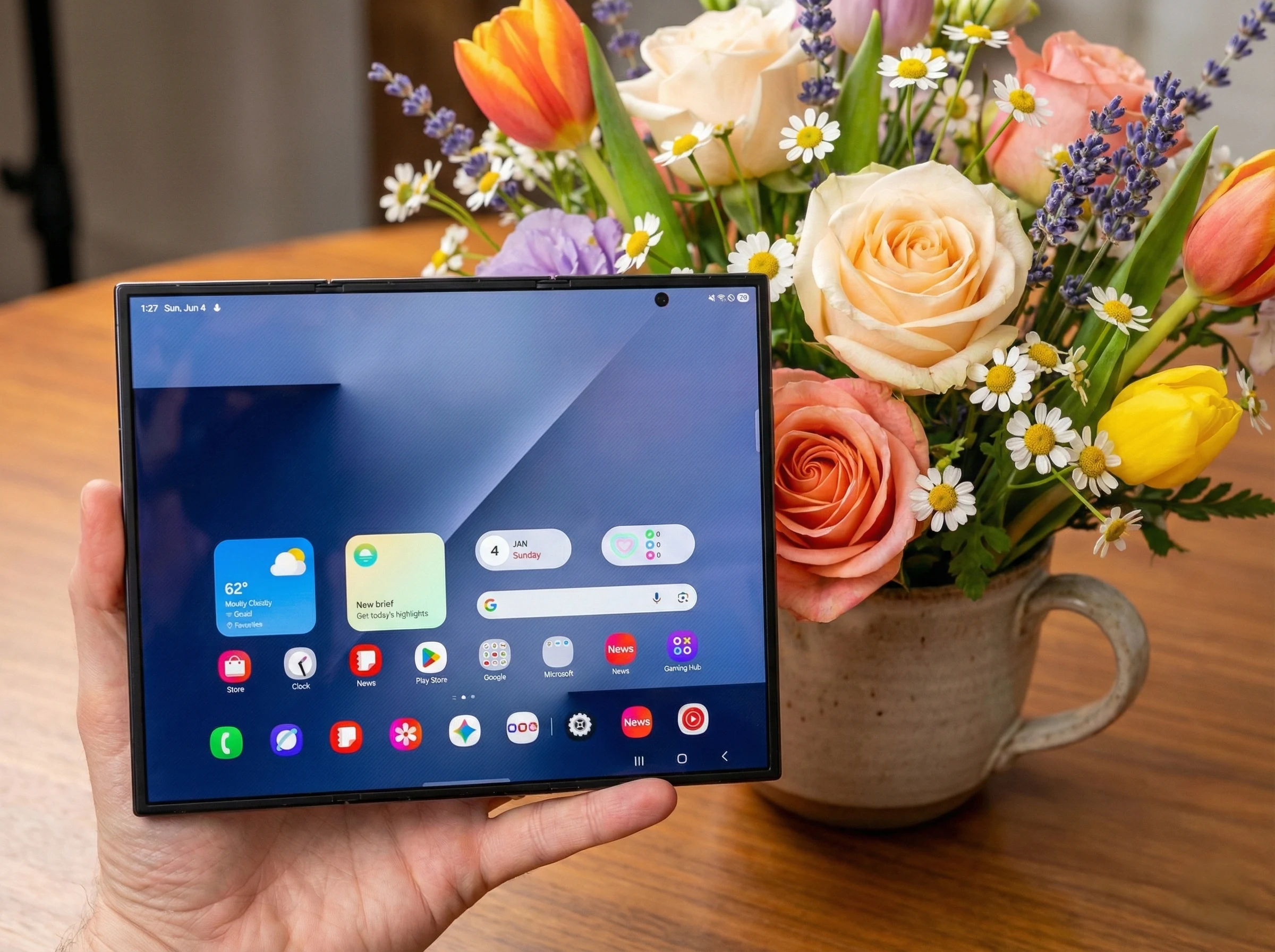
Samsung has unveiled a near flawless foldable display at CES 2026 in Las Vegas, offering a glimpse into what could become the defining standard for the next generation of premium smartphones. The breakthrough screen, which shows virtually no visible crease when folded, has intensified industry attention because it closely aligns with the display qualities Apple is believed to be targeting for its first foldable iPhone. For consumers, the development signals that foldable devices may soon overcome one of their most persistent compromises and move closer to mainstream acceptance at the highest end of the market.
The announcement matters beyond a single product showcase. Foldable phones have promised larger screens in compact designs, yet visible creases and durability concerns have limited their appeal. Samsung’s demonstration suggests that these limitations are no longer inevitable. If adopted by Apple, whose design decisions often influence the wider industry, the technology could reshape expectations for premium smartphones and accelerate competition across the global market.
A milestone moment at CES 2026
The display was revealed by Samsung during CES 2026, the annual technology exhibition that often sets the tone for innovation across consumer electronics. While Samsung has long been the dominant supplier of foldable displays, this year’s presentation stood out for its emphasis on refinement rather than novelty. The panel folded smoothly with no obvious central dip, even under close inspection, addressing a flaw that has defined foldable devices since their introduction.
The screen drew immediate attention from analysts and rival manufacturers alike. Observers at the show described the fold as exceptionally smooth, with reflections and colour uniformity maintained across the hinge area. This level of finish suggests a maturity in foldable display engineering that has not previously been achieved at commercial scale.
Crease free engineering signals a turning point
At the core of Samsung’s advancement is a new internal structure that allows the display to bend without forming a visible crease. According to sources familiar with the technology, the panel relies on a laser drilled metal substructure that distributes stress more evenly across the folding area. This approach prevents the material fatigue and indentation that typically appear over time in foldable screens.
For users, the implications are significant. A crease free display improves visual immersion, enhances durability perception and removes a psychological barrier that has made some consumers hesitant to invest in foldable devices. From a design perspective, it also gives manufacturers greater freedom to treat foldable screens as uninterrupted canvases rather than surfaces defined by a hinge line.
Under display camera integration moves forward
Another notable feature of the new panel is the integration of under display camera technology. Close up images shared by respected industry source Ice Universe highlighted a seamless main screen with no visible camera cutout. This allows the display to function as a single uninterrupted surface when unfolded.
Under display cameras have previously involved trade offs in image quality, but Samsung’s implementation appears focused on minimising visual compromise rather than maximising camera performance. The approach reflects a broader industry trend in which primary cameras are prioritised elsewhere, while front facing cameras on large internal displays are designed to remain discreet.
Apple and Samsung paths begin to align
The technology on display closely matches what Apple is widely understood to be seeking for its first foldable smartphone. Although Apple has not confirmed plans publicly, multiple sources indicate that the company has been waiting for a foldable display that meets its standards for visual consistency and long term reliability.
If adopted, the panel could form the foundation of the long rumoured iPhone Fold, positioning Samsung not only as a competitor but also as a critical supplier. This relationship would echo previous collaborations in which Samsung provided advanced display technology for Apple devices, even as the two companies compete fiercely in the smartphone market.
Expected timing and product positioning
Industry reports suggest that Apple’s foldable iPhone could launch alongside the iPhone 18 Pro and iPhone Air 2 in September 2026. While Apple has not confirmed these details, the timeline aligns with the pace at which Samsung’s display technology appears to be reaching production readiness.
The proposed device is expected to adopt a book style folding design, with a compact external display for everyday tasks and a larger internal screen for productivity and media consumption. Such a configuration would place the iPhone Fold directly in competition with established foldable flagships while maintaining Apple’s emphasis on premium build quality.
Display sizes and form factor expectations
According to the information available, the iPhone Fold would feature a 5.5 inch external display and a 7.8 inch internal screen when opened. The internal display size is comparable to that of an iPad mini, suggesting a focus on reading, multitasking and video consumption.
Samsung’s new panel appears well suited to this form factor, offering a large uninterrupted surface that enhances tablet like use cases. For Apple, achieving a crease free internal display would be essential to delivering a user experience consistent with its existing tablets and phones.
Biometric changes support a cleaner design
Alongside display innovation, Apple is reportedly considering a shift in biometric authentication. Instead of Face ID, the foldable iPhone may rely on a Touch ID sensor embedded in the power button, similar to the approach used in recent iPad Air and iPad mini models.
This change would simplify the front of the device and reduce the need for additional sensors on the internal display. Combined with an under display camera, it would allow Apple to present a clean and uninterrupted screen, reinforcing the visual impact of a crease free panel.
Battery capacity and internal hardware
Leaks suggest that the iPhone Fold could include a battery capacity ranging from 5400mAh to 5800mAh. For a foldable device, this would represent a substantial power reserve, supporting the demands of a large internal display and multitasking features.
Such capacity would also align with Apple’s emphasis on all day battery life, even in devices that push the boundaries of form factor design. Efficient power management would be critical to ensuring that the foldable experience does not compromise usability.
Camera configuration and imaging approach
The camera system described in reports includes a 24MP under display camera on the internal screen, a hole punch style selfie camera on the external display and a dual rear camera setup with 48MP sensors. This configuration reflects a balance between innovation and familiarity.
By prioritising rear camera performance and maintaining a conventional external selfie camera, Apple could ensure reliable image quality while still showcasing under display technology where visual continuity matters most.
Thickness and competitive comparisons
Analyst Ming Chi Kuo of TF International has suggested that the iPhone Fold may measure between 9 and 9.5mm when folded and between 4.5 and 4.8mm when unfolded. These dimensions would make it thicker than the Galaxy Z Fold 7 but slimmer than the Pixel 10 Pro Fold.
While thickness remains a key metric in foldable comparisons, the absence of a visible crease could outweigh minor differences in dimensions for many users. A smoother display experience may prove more influential than marginal gains in thinness.
Pricing reflects premium positioning
The projected retail price of around 2400 US dollars would place the iPhone Fold among the most expensive smartphones ever released. Such pricing underscores Apple’s intention to position the device as a flagship product rather than a mass market experiment.
For buyers, the cost would need to be justified by tangible benefits. A crease free display, premium materials and refined durability could form the basis of that value proposition, particularly for users who view foldables as productivity tools rather than novelty devices.
Samsung’s internal considerations
While Samsung could introduce the new display in its own future devices, reports indicate that internal discussions within its Mobile Experience division may influence how the technology is deployed. The company must balance the competitive advantage of exclusive hardware against the commercial benefits of supplying panels to partners like Apple.
This dynamic highlights Samsung’s unique position as both a device manufacturer and a critical component supplier. Decisions made in the coming months could shape not only its own product lineup but also the broader direction of the foldable market.
A broader impact on the foldable market
Samsung’s CES demonstration represents more than an incremental improvement. It suggests that foldable displays are approaching a level of refinement that could satisfy even the most design focused manufacturers. If Apple adopts the technology, it would validate years of investment and signal that foldables have reached a new phase of maturity.
For consumers, this progress could translate into devices that combine the versatility of foldables with the visual consistency of traditional smartphones. For the industry, it raises the bar for what premium devices must deliver.
A defining moment for next generation smartphones
The convergence of Samsung’s display innovation and Apple’s anticipated entry into the foldable space sets the stage for intensified competition at the top end of the smartphone market. A crease free foldable display would not only address long standing criticisms but also redefine user expectations for design and usability.
As manufacturers race to refine their approaches, the developments unveiled at CES 2026 may be remembered as a pivotal step toward making foldable smartphones a polished and enduring category rather than a niche experiment.

Edit Profile
Help improve @KR

Was this page helpful to you?
Contact Khogendra Rupini
Are you looking for an experienced developer to bring your website to life, tackle technical challenges, fix bugs, or enhance functionality? Look no further.
I specialize in building professional, high-performing, and user-friendly websites designed to meet your unique needs. Whether it’s creating custom JavaScript components, solving complex JS problems, or designing responsive layouts that look stunning on both small screens and desktops, I can collaborate with you.
Create something exceptional with us. Contact us today
Open for Collaboration
If you're looking to collaborate, I’m available for a variety of professional services, including -
- Website Design & Development
- Advertisement & Promotion Setup
- Hosting Configuration & Deployment
- Front-end & Back-end Code Implementation
- Code Testing & Optimization
- Cybersecurity Solutions & Threat Prevention
- Website Scanning & Malware Removal
- Hacked Website Recovery
- PHP & MySQL Development
- Python Programming
- Web Content Writing
- Protection Against Hacking Attempts