India and New Zealand Conclude Free Trade Talks With Deal Signing Planned for 2026
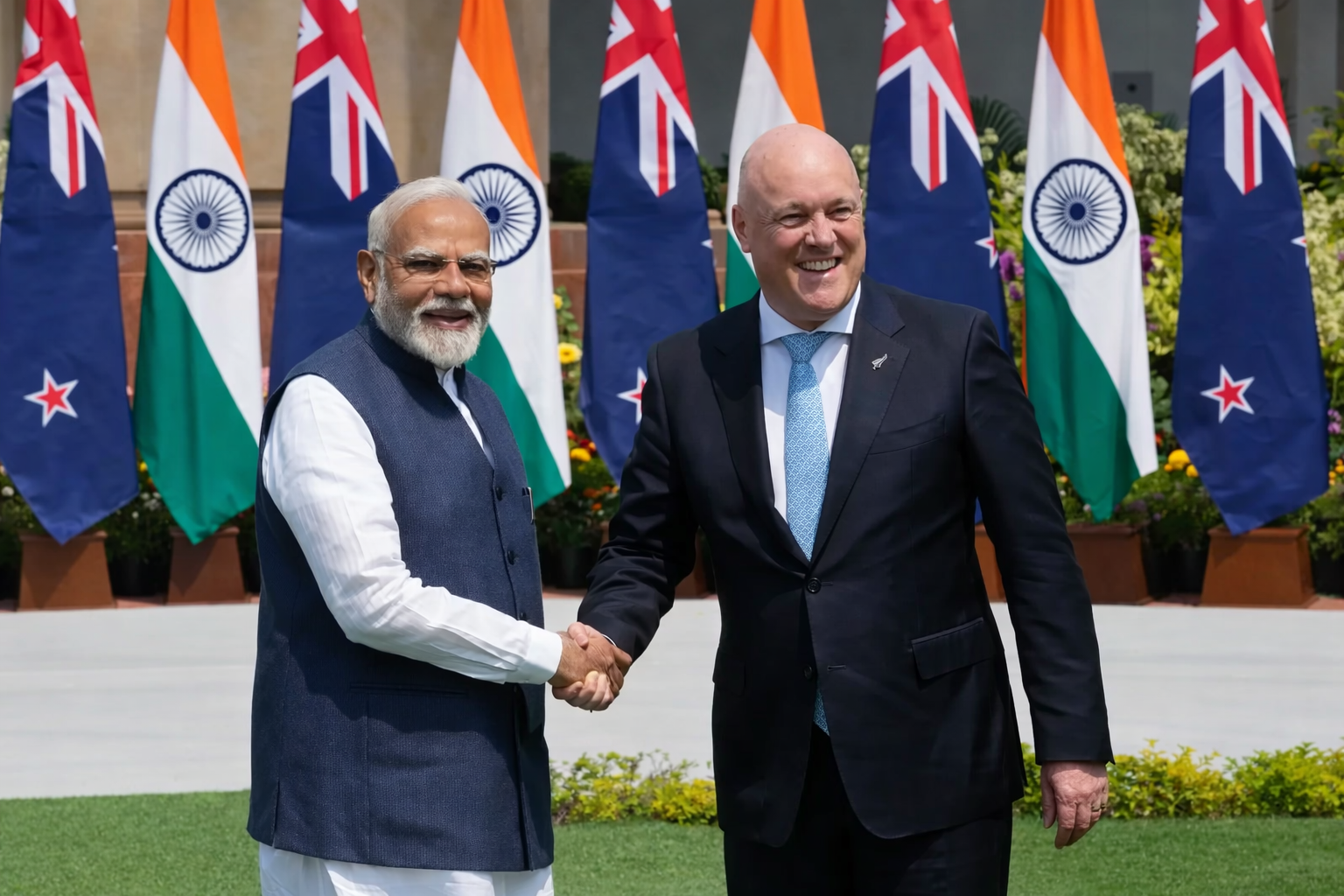
India and New Zealand have successfully concluded negotiations on a comprehensive free trade agreement marking a major step forward in bilateral economic relations.
The agreement is expected to be formally signed in the first half of 2026 and is designed to significantly expand trade investment and people to people ties while carefully protecting sensitive domestic sectors in both countries.
The announcement followed a high level conversation between Indian Prime Minister Narendra Modi and New Zealand Prime Minister Christopher Luxon.
Both leaders described the pact as historic ambitious and mutually beneficial reflecting strong political commitment and shared economic priorities.
A Third Major Trade Pact for India in 2025
The India New Zealand agreement is the third major free trade pact concluded by New Delhi in 2025 following similar agreements with the United Kingdom in July and Oman earlier this month.
Together these deals underline India broader strategy of expanding global trade partnerships while balancing domestic economic and social considerations.
Under the new agreement India will receive tariff free access to New Zealand markets across a wide range of goods and services.
In return New Zealand will gain expanded access to the Indian market although India has firmly protected politically and economically sensitive sectors including dairy agriculture and certain food products.
The agreement aims to double bilateral trade to USD 5 billion within the next five years.
Current merchandise trade between the two countries stood at USD 1.3 billion in the 2024 to 25 financial year while total trade in goods and services reached approximately USD 2.4 billion in 2024 driven largely by travel information technology and business services.
Investment Commitment of USD 20 Billion
One of the most significant outcomes of the agreement is New Zealand commitment to invest USD 20 billion in India over the next 15 years.
These investments are expected to flow into manufacturing infrastructure services innovation and job creation supporting India long term economic growth agenda.
Commerce and Industry Minister Piyush Goyal said the investment commitment would give a strong boost to domestic manufacturing and generate employment across multiple sectors.
He also noted that this agreement is the seventh trade pact finalised by the current NDA government highlighting India consistent focus on trade driven growth.
Market Access With Strong Domestic Safeguards
The free trade agreement will eliminate or reduce tariffs on around 95 percent of New Zealand exports to India.
These include products such as wool coal wood wine avocados blueberries cherries seafood manuka honey bulk infant formula and milk albumins.
New Zealand will also receive duty free access for sheep meat and the majority of forestry and wood products.
At the same time India has drawn clear red lines to protect its farmers and micro small and medium enterprises.
There will be no duty concessions on dairy products such as milk cream whey yoghurt and cheese.
Other excluded items include onions chana peas corn sugar artificial honey edible oils rubber arms and ammunition gems and jewellery copper aluminium and certain vegetable products.
This careful balance reflects India long standing trade policy approach of opening markets where competitive while safeguarding livelihoods in sensitive sectors.
Support for Indian Exporters Amid Global Uncertainty
The agreement is expected to provide timely relief to Indian exporters who have faced challenges due to higher tariffs imposed by the United States on Indian goods.
By expanding access to the Oceania region the pact will help diversify export destinations and reduce dependency on a limited number of markets.
India has already implemented a trade agreement with Australia and the New Zealand pact further strengthens its economic footprint in the region.
Officials believe the agreement will enhance supply chain resilience and improve export opportunities for Indian manufacturers and service providers.
Expanded Opportunities in Services and Employment
A key highlight of the agreement is improved access for Indian professionals in the New Zealand services sector.
New Zealand has agreed to introduce a temporary employment entry visa pathway for Indian professionals with an annual quota of 5000 visas and a stay of up to three years.
The visa pathway will cover skilled occupations including information technology engineering healthcare education and construction.
It will also include traditional and cultural professions such as AYUSH practitioners yoga instructors Indian chefs music teachers and other creative roles.
This provision is expected to strengthen workforce mobility and deepen services trade between the two countries.
Faster Entry for Indian Pharma and Medical Devices
The pharmaceutical and medical devices sector is set to benefit significantly from the agreement.
New Zealand will provide faster regulatory access by accepting Good Manufacturing Practice and Good Clinical Practice inspection reports from comparable regulators including approvals by the United States Food and Drug Administration the European Medicines Agency and the United Kingdom Medicines and Healthcare products Regulatory Agency.
This move will reduce duplicative inspections lower compliance costs and speed up product approvals making it easier for Indian pharmaceutical and medical device companies to enter the New Zealand market.
Agriculture Technology Cooperation and Farmer Support
Beyond trade liberalisation the agreement places strong emphasis on cooperation in agriculture technology.
New Zealand will establish a dedicated Agri Technology Action Plan focused on kiwifruit apples and honey to help Indian farmers improve productivity quality and sustainability.
The cooperation will include setting up Centres of Excellence providing improved planting material capacity building for growers and technical support for orchard management post harvest practices supply chain efficiency and food safety standards.
This initiative reflects a partnership approach aimed at long term value creation rather than short term market access alone.
Protection of Geographical Indications and Traditional Knowledge
New Zealand has committed to strengthening protection for Indian Geographical Indications including amending its laws to facilitate the registration of Indian wines and spirits.
Cooperation has also been agreed in areas such as AYUSH culture fisheries audio visual media tourism forestry horticulture and traditional knowledge systems.
These provisions are expected to support cultural exchange promote heritage based industries and create new opportunities for small producers and entrepreneurs.
Streamlined Regulations and Trade Facilitation
The agreement includes comprehensive measures to address non tariff barriers through enhanced regulatory cooperation streamlined customs procedures sanitary and phyto sanitary standards and technical barriers to trade disciplines.
These steps are designed to reduce delays improve predictability and lower transaction costs for businesses on both sides making trade smoother and more efficient.
Strategic and Diplomatic Significance
Prime Minister Christopher Luxon described the gains from the agreement as wide ranging and significant noting that India status as the world most populous country and fastest growing large economy creates major opportunities for New Zealand jobs exports and growth.
Commerce Minister Piyush Goyal highlighted that the India New Zealand agreement is notable for being the first pact where all key Indian negotiators were women with Joint Secretary Petal Dhillon serving as India chief negotiator.
He also noted that India has now finalised trade agreements with three members of the Five Eyes alliance namely Australia the United Kingdom and New Zealand.
India is currently in advanced negotiations for a bilateral trade agreement with the United States and is in the process of resuming talks with Canada further signalling its active global trade engagement.
Looking Ahead to Implementation
Negotiations for the agreement began during Prime Minister Luxon visit to India in March 2025.
Despite only five formal rounds both sides remained in continuous contact allowing talks to conclude in a record nine months.
The agreement is expected to be signed and implemented within the next seven to eight months.
Once in force it is expected to significantly deepen bilateral economic engagement promote investment flows strengthen strategic cooperation and open new opportunities for businesses farmers students innovators and young professionals in both countries.
With its balanced approach strong investment commitments and focus on long term cooperation the India New Zealand free trade agreement represents a meaningful step in India evolving trade strategy and a new chapter in relations between the two nations.
Edit Profile
Help improve @KR

Was this page helpful to you?
Contact Khogendra Rupini
Are you looking for an experienced developer to bring your website to life, tackle technical challenges, fix bugs, or enhance functionality? Look no further.
I specialize in building professional, high-performing, and user-friendly websites designed to meet your unique needs. Whether it’s creating custom JavaScript components, solving complex JS problems, or designing responsive layouts that look stunning on both small screens and desktops, I can collaborate with you.
Create something exceptional with us. Contact us today
Open for Collaboration
If you're looking to collaborate, I’m available for a variety of professional services, including -
- Website Design & Development
- Advertisement & Promotion Setup
- Hosting Configuration & Deployment
- Front-end & Back-end Code Implementation
- Code Testing & Optimization
- Cybersecurity Solutions & Threat Prevention
- Website Scanning & Malware Removal
- Hacked Website Recovery
- PHP & MySQL Development
- Python Programming
- Web Content Writing
- Protection Against Hacking Attempts