
India and European Union Seal Historic Free Trade Agreement After Two Decades of Talks
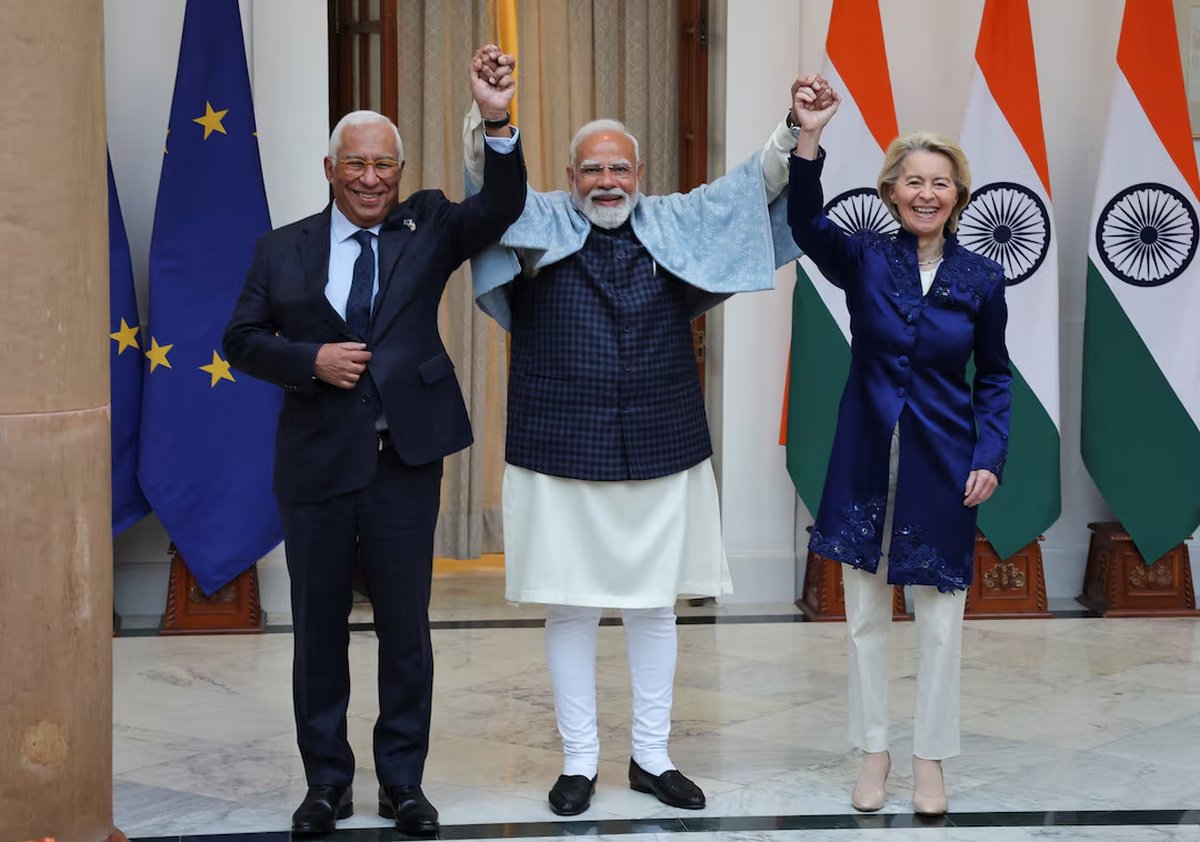
India and the European Union have announced a landmark free trade agreement, ending nearly twenty years of intermittent negotiations and marking one of the most significant trade developments in recent global economic history.
Leaders from both sides described the pact as historic, with the agreement set to reshape trade flows, investment and strategic cooperation between two of the world’s largest economic blocs.
A landmark pact reshapes India EU economic relations
Together, India and the EU represent almost a quarter of global GDP and a combined market of nearly two billion people.
The deal signals a decisive shift toward deeper economic integration at a time of rising global trade tensions and growing uncertainty around protectionist policies elsewhere.
Scope of the trade agreement
The agreement establishes free trade in goods across a wide range of sectors, alongside commitments on services, investment and supply chain cooperation.
According to the European Commission, tariffs will be eliminated or significantly reduced on most EU exports to India, including chemicals, machinery, electrical equipment, aircraft and spacecraft through phased reductions.
One of the most notable provisions involves the automobile sector.
Import duties on motor vehicles, currently as high as 110 percent, will be reduced to 10 percent under a quota of 250,000 vehicles.
This represents a substantially larger concession than similar quotas granted in previous trade deals and is expected to benefit European automotive manufacturers.
India has also agreed to lower tariffs on select agricultural and lifestyle products from Europe, including wine, beer and olive oil, opening new opportunities for European exporters in India’s growing consumer market.
Preferential access for Indian exporters
For India, the agreement offers expanded and preferential access to the European market for almost all major export categories.
Sectors expected to see significant gains include textiles, leather goods, marine products, handicrafts, gems and jewellery, all of which employ large numbers of workers and are critical to India’s export economy.
Tariff reductions will also apply to tea, coffee, spices and processed foods, strengthening India’s position in high value agricultural exports.
At the same time, Indian authorities have ensured protection for sensitive domestic sectors such as dairy, cereals, poultry, soy meal and certain fruits and vegetables, balancing export ambitions with internal food security and rural livelihoods.
Mobility and services cooperation
Beyond goods trade, the agreement introduces a new mobility framework designed to ease short term movement of professionals between India and EU member states.
This is expected to benefit technology professionals, engineers, researchers and service sector workers, reinforcing cooperation in knowledge based industries.
The pact is also expected to support greater investment flows and improve regulatory cooperation, helping integrate supply chains across manufacturing, technology and advanced services.
Strategic and geopolitical significance
The timing of the agreement underscores its broader geopolitical relevance.
Both India and the EU have faced economic pressure from the United States, including higher tariffs and trade disputes in recent years.
Against this backdrop, leaders framed the deal as a statement in favor of open trade and multilateral cooperation.
European Commission President Ursula von der Leyen described the agreement as a partnership between two global economic giants, emphasizing cooperation as the best response to global challenges.
Indian Prime Minister Narendra Modi called it India’s largest free trade agreement to date, highlighting its potential to boost manufacturing, services, innovation and opportunities for farmers and small businesses.
European Council President António Costa noted that the pact sends a strong political signal that India and the EU prioritize trade agreements over tariffs.
Market impact and sectoral implications
Economists expect the deal to provide meaningful relief to labour intensive Indian industries such as textiles, shrimp farming, gems and jewellery, many of which were adversely affected by recent US tariff measures.
Increased access to the European market could support job creation and export diversification.
However, analysts also caution that compliance with strict European regulatory standards may pose challenges for Indian manufacturers, particularly in areas such as environmental regulations and carbon related requirements.
Experts view this as both a challenge and an opportunity, pushing Indian industry toward higher sustainability and quality benchmarks.
For Europe, major economies such as Germany and France are projected to be among the key beneficiaries, particularly in advanced manufacturing, automobiles, aerospace and machinery.
The agreement is widely seen as a foundation for deeper engagement with one of the world’s fastest growing major economies rather than a final endpoint.
Security and defence cooperation
Alongside the trade agreement, India and the EU are advancing parallel discussions on security and defence cooperation.
Talks include maritime security, cyber threats, defence dialogue and integration of supply chains to develop trusted defence ecosystems.
These discussions reflect a growing convergence of strategic interests amid shifting global security dynamics.
Approval process and next steps
While the agreement has been announced, formal signing is expected later this year following approval by the European Parliament and EU member states.
Although recent EU trade deals have faced political hurdles, analysts suggest the India agreement is less contentious due to its balanced approach to sensitive sectors on both sides.
Conclusion
The India EU free trade agreement marks a decisive step toward deeper economic, strategic and political cooperation between two major global actors.
By lowering trade barriers, expanding market access and reinforcing shared commitments to open trade, the pact is poised to influence global commerce at a time of heightened uncertainty.
If successfully implemented, it could redefine India EU relations for decades to come and serve as a model for future trade partnerships in a rapidly evolving global economy.

Edit Profile
Help improve @KR
Was this page helpful to you?
Contact Khogendra Rupini
Are you looking for an experienced developer to bring your website to life, tackle technical challenges, fix bugs, or enhance functionality? Look no further.
I specialize in building professional, high-performing, and user-friendly websites designed to meet your unique needs. Whether it’s creating custom JavaScript components, solving complex JS problems, or designing responsive layouts that look stunning on both small screens and desktops, I can collaborate with you.
Create something exceptional with us. Contact us today
Open for Collaboration
If you're looking to collaborate, I’m available for a variety of professional services, including -
- Website Design & Development
- Advertisement & Promotion Setup
- Hosting Configuration & Deployment
- Front-end & Back-end Code Implementation
- Code Testing & Optimization
- Cybersecurity Solutions & Threat Prevention
- Website Scanning & Malware Removal
- Hacked Website Recovery
- PHP & MySQL Development
- Python Programming
- Web Content Writing
- Protection Against Hacking Attempts