
OpenAI launches ChatGPT workspace agents for teams, bringing shared AI automation to business workflows
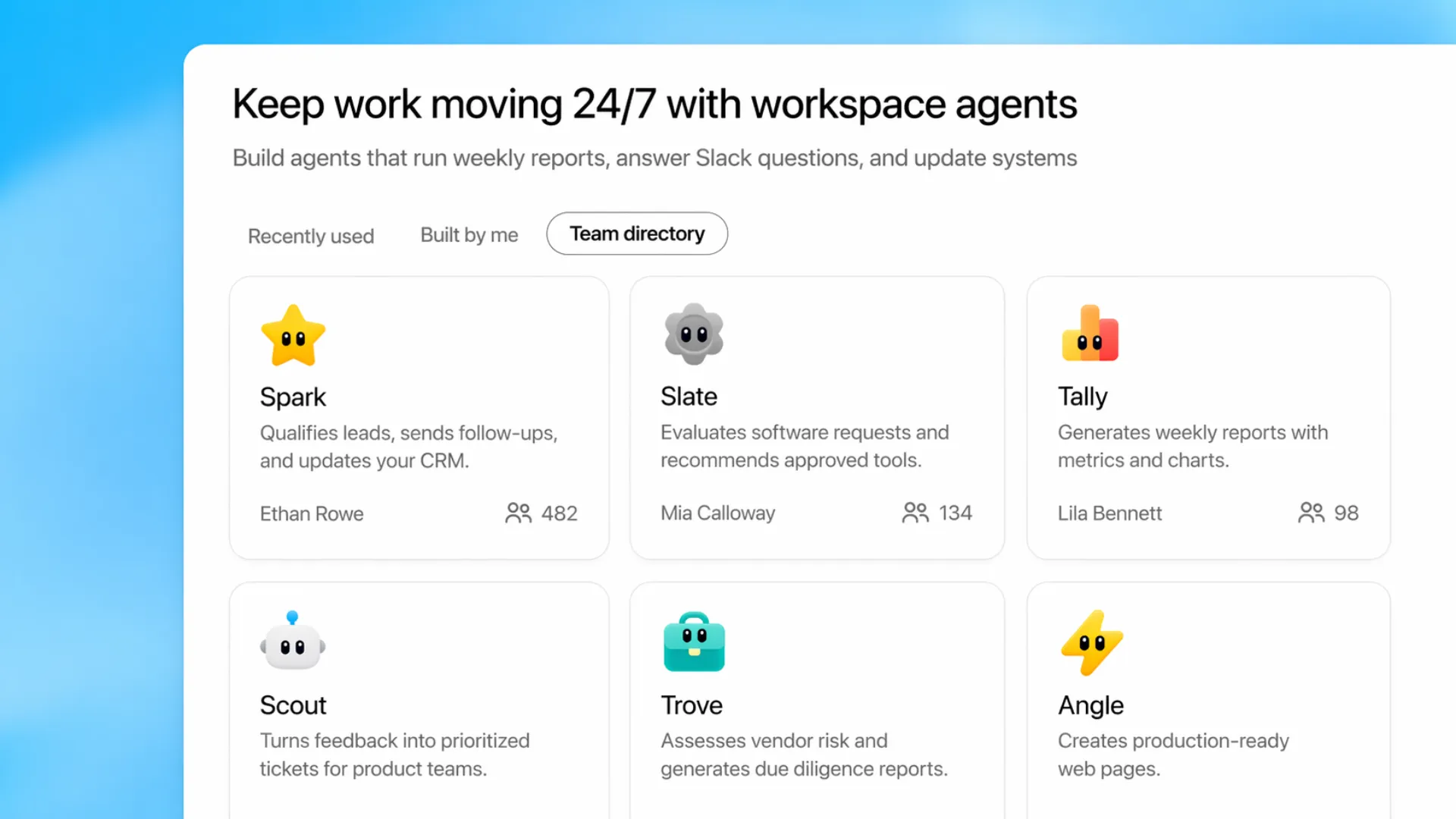
OpenAI has introduced a new feature called workspace agents in ChatGPT, expanding the platform’s role from individual productivity to team wide business operations. Announced on April 23, 2026, the new capability is designed to help organisations automate recurring work, manage long running processes, and build shared AI systems that operate within company controls.
The launch marks another major step in the evolution of ChatGPT for enterprise use. Instead of relying only on one person chatting with AI at a time, companies can now create shared agents that assist multiple teams with tasks such as coding, drafting reports, handling internal messages, gathering information, and managing approvals.
According to OpenAI, these agents run in the cloud and can continue working even when employees are offline, allowing work to move forward beyond standard office hours.
Workspace agents aim to simplify complex team operations
The newly launched workspace agents are built to support organisations that manage ongoing workflows across departments. OpenAI said the feature allows teams to create AI systems once and reuse them for different projects, reducing repeated manual effort.
For example, a company could build one shared agent to prepare weekly performance reports, another to review support requests, and another to help software teams write or test code. Because the agents are shared across an organisation, teams can maintain consistency while scaling operations more efficiently.
OpenAI explained that these agents are an extension of its GPT based tools and are powered by Codex. This means they are built not only for writing text, but also for technical tasks such as generating code, running workflows, and interacting with connected systems.
Built for collaboration across departments
One of the biggest challenges in modern workplaces is coordination between teams. Projects often require updates from multiple departments, approvals from managers, and information spread across different tools.
Workspace agents are designed to address that problem by helping teams coordinate tasks automatically. OpenAI said the agents can gather information, follow step by step workflows, and request approvals when needed.
This could be useful in areas such as:
1. Software development progress tracking
2. Marketing report generation
3. Customer support message handling
4. Internal operations management
5. Data collection and documentation
6. Multi team project coordination
The company also said the agents can be accessed directly inside ChatGPT or integrated with external tools such as Slack, helping businesses connect AI workflows with their existing systems.
Cloud based operation allows work to continue offline
A standout feature of the new system is that workspace agents run in the cloud. This means the AI can continue processing assigned work even if the user who created the request is no longer online.
For businesses, this could improve efficiency in several ways. An employee might assign a reporting task before leaving for the day, and the completed work could be ready by the next morning. Teams working across time zones may also benefit, as tasks can continue running without waiting for someone to remain logged in.
This approach moves ChatGPT beyond instant chat responses and closer to autonomous task execution.
Code writing, connected apps and stored memory included
OpenAI said workspace agents are built to work across multiple tools and systems. The agents can write or run code, use connected applications, and store information for future use.
That broader functionality suggests the feature is aimed at practical workplace execution rather than simple conversation. Instead of only answering questions, the agents can help complete work that usually requires several software tools and repeated human input.
The company also said users can schedule agents to run at specific times or have them respond automatically when requests arrive.
This could allow businesses to automate daily updates, recurring checks, or response systems without constant supervision.
Admin controls and organisational permissions included
Security and control remain key concerns for businesses adopting AI. OpenAI said organisations using workspace agents will be able to control how the agents operate, including which tools they can access and when approvals are required.
Administrators can manage permissions and monitor how agents are being used across the organisation. This structure is especially important for larger companies where access to internal systems, customer data, or sensitive workflows must be carefully managed.
By adding admin oversight, OpenAI appears to be positioning workspace agents as a business ready feature rather than a consumer experiment.
Availability and pricing details announced
OpenAI said the feature is currently available in research preview for users on ChatGPT Business, Enterprise, Edu, and Teachers plans.
The company added that workspace agents will be free to use until May 6, 2026. After that date, pricing will shift to a credit based model.
That limited free preview period may encourage organisations to test how the feature fits into their workflows before paid usage begins.
Why this matters for the future of office work
The release of workspace agents highlights how quickly AI tools are moving into daily business operations. Many companies already use AI for writing assistance or data summaries, but shared autonomous agents represent a more advanced stage.
Instead of helping one employee at a time, these systems can support entire teams, operate continuously, and connect with workplace software.
For businesses trying to improve productivity while reducing repetitive workloads, the feature could become an important tool. For OpenAI, it strengthens ChatGPT’s position in the growing market for enterprise AI platforms.
As competition increases among major technology firms building AI workplace tools, the launch of workspace agents may be remembered as another key moment in how organisations begin delegating routine digital work to intelligent systems.
Edit Profile
Help improve @KR

Was this page helpful to you?
Contact Khogendra Rupini
Are you looking for an experienced developer to bring your website to life, tackle technical challenges, fix bugs, or enhance functionality? Look no further.
I specialize in building professional, high-performing, and user-friendly websites designed to meet your unique needs. Whether it's creating custom JavaScript components, solving complex JS problems, or designing responsive layouts that look stunning on both small screens and desktops, I can collaborate with you.
Create something exceptional with us. Contact us today
Open for Collaboration
If you're looking to collaborate, I'm available for a variety of professional services, including -
- Website Design & Development
- Advertisement & Promotion Setup
- Hosting Configuration & Deployment
- Front-end & Back-end Code Implementation
- Code Testing & Optimization
- Cybersecurity Solutions & Threat Prevention
- Website Scanning & Malware Removal
- Hacked Website Recovery
- PHP & MySQL Development
- Python Programming
- Web Content Writing
- Protection Against Hacking Attempts