Hubble Reveals the Largest Planet Forming Disk Ever Seen
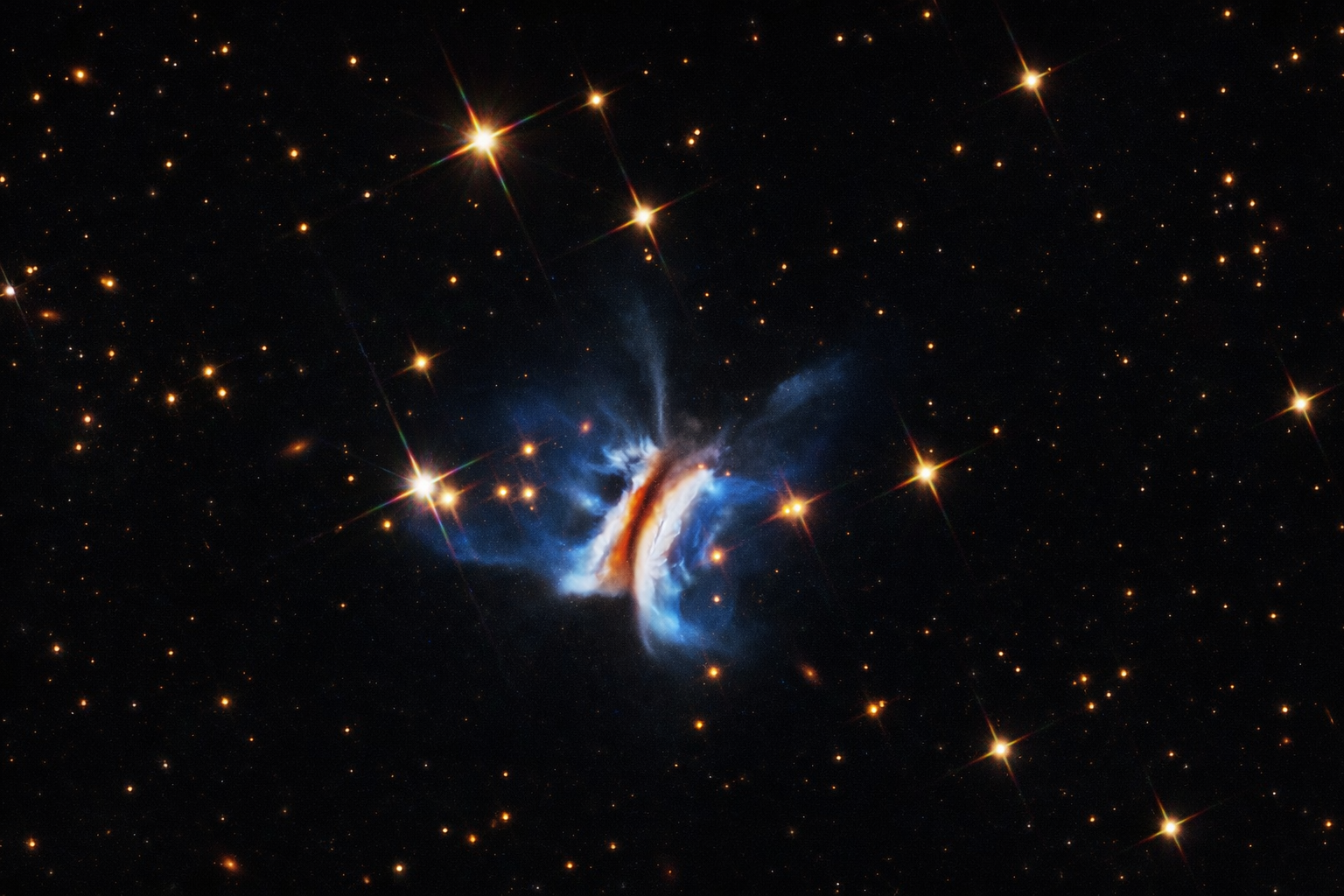
NASA’s Hubble Space Telescope has once again reshaped our understanding of the universe by capturing the most massive planet forming disk ever observed.
The extraordinary structure surrounds a young star and presents a scene of intense motion, disorder, and raw cosmic energy.
Far from the calm and orderly disks astronomers once expected, this discovery suggests that planets may often be born in environments far more turbulent than previously believed.
The finding stands as one of the most striking insights into early planetary formation in recent years and highlights why Hubble remains one of humanity’s most valuable scientific instruments.
A Colossal Birthplace of Planets
The newly observed disk encircles a young star known as IRAS 23077+6707, located roughly 1,000 light years away from Earth.
Astronomers have informally nicknamed the system “Dracula’s Chivito” because of its dramatic and uneven appearance.
While the nickname is informal, the science behind the discovery is deeply serious.
The disk stretches close to 400 billion miles across.
To put this into perspective, it is about 40 times larger than the Kuiper Belt in our own solar system.
The Kuiper Belt is the distant region beyond Neptune that contains icy bodies and remnants from the formation of the planets.
Seeing a structure so much larger has left scientists genuinely astonished.
This immense disk is composed of gas and dust, the basic ingredients from which planets are formed.
What makes it exceptional is not only its size, but also its extreme structure and behavior.
A Scene of Chaos Rather Than Calm
For decades, astronomers believed that planet forming disks were mostly flat, balanced, and relatively peaceful.
While minor disturbances were expected, the overall assumption was that planets slowly assembled within orderly environments.
The disk around IRAS 23077+6707 challenges that assumption at every level.
Hubble’s observations show a system that appears wild and unstable.
Dust streams rise far above and below the main disk plane.
Some structures appear on only one side of the disk, breaking the symmetry scientists normally expect.
Instead of neat rings, the disk looks twisted and uneven, suggesting powerful forces are shaping it from within.
Researchers describe the environment as violent and unpredictable.
Intense gravity, strong radiation from the young star, and internal turbulence appear to be interacting in complex ways.
These conditions may influence how material clumps together, how planets begin to form, and even what kinds of planets ultimately emerge.
Why This Discovery Matters
This observation forces scientists to reconsider long standing models of planetary formation.
If such massive and chaotic disks can exist, then the traditional picture of gentle planet building may be incomplete.
Astronomers now believe that planets can form under a much wider range of conditions than once thought.
Instead of slow and orderly growth alone, some planetary systems may be shaped by turbulence, instability, and dramatic shifts in material.
The disk may represent an early and exaggerated version of what our own solar system once looked like.
Studying it offers a rare window into the past, allowing researchers to explore how planets might emerge from disorder before settling into stable orbits.
It also raises important questions.
How common are such extreme disks?
Do chaotic environments lead to different types of planets?
Could turbulence influence whether rocky planets, gas giants, or entirely new classes of worlds form?
These are questions scientists are now eager to explore.
The Power of Hubble’s Vision
The discovery underscores the continued importance of the Hubble Space Telescope, even decades after its launch.
Hubble’s ability to capture fine details in visible and ultraviolet light allows astronomers to study structures that would otherwise remain hidden.
By observing how light interacts with the dust and gas in the disk, researchers can map its shape, thickness, and motion.
These details are crucial for understanding the physical processes at work.
The image released by NASA, ESA, and the Space Telescope Science Institute shows the disk silhouetted against a background of stars, highlighting its immense scale and unusual form.
It is a reminder that some of the most profound scientific insights come not from theory alone, but from careful observation.
A New Perspective on Planet Formation
One of the most important implications of this discovery is philosophical as much as scientific.
Humanity has long searched for patterns and order in the cosmos, often assuming that systems form in predictable ways.
This massive disk suggests that nature may be far less tidy.
Planet formation may be messy, uneven, and influenced by forces that are still not fully understood.
Yet from this chaos, stable worlds can still emerge.
That idea resonates deeply with the history of science.
Many breakthroughs come when observations challenge accepted beliefs.
In this case, the universe itself is reminding us that it still has many surprises to offer.
Looking Ahead
Future observations, including those from newer telescopes, will build on Hubble’s findings.
By combining data across different wavelengths, astronomers hope to uncover more details about the disk’s composition, motion, and long term evolution.
Understanding systems like IRAS 23077+6707 will help scientists piece together a more complete picture of how planets form across the galaxy.
It may also offer clues about how common planetary systems like our own truly are.
For now, this discovery stands as a powerful example of why exploration matters.
Each new image expands our understanding and deepens our sense of wonder.
The universe is still forming worlds in ways we are only beginning to grasp, and thanks to Hubble, we are privileged to witness it.
Edit Profile
Help improve @KR
Was this page helpful to you?
Contact Khogendra Rupini
Are you looking for an experienced developer to bring your website to life, tackle technical challenges, fix bugs, or enhance functionality? Look no further.
I specialize in building professional, high-performing, and user-friendly websites designed to meet your unique needs. Whether it’s creating custom JavaScript components, solving complex JS problems, or designing responsive layouts that look stunning on both small screens and desktops, I can collaborate with you.
Create something exceptional with us. Contact us today
Open for Collaboration
If you're looking to collaborate, I’m available for a variety of professional services, including -
- Website Design & Development
- Advertisement & Promotion Setup
- Hosting Configuration & Deployment
- Front-end & Back-end Code Implementation
- Code Testing & Optimization
- Cybersecurity Solutions & Threat Prevention
- Website Scanning & Malware Removal
- Hacked Website Recovery
- PHP & MySQL Development
- Python Programming
- Web Content Writing
- Protection Against Hacking Attempts