
Meta, Microsoft job cuts spark fresh fears as AI boom reshapes hiring across tech industry
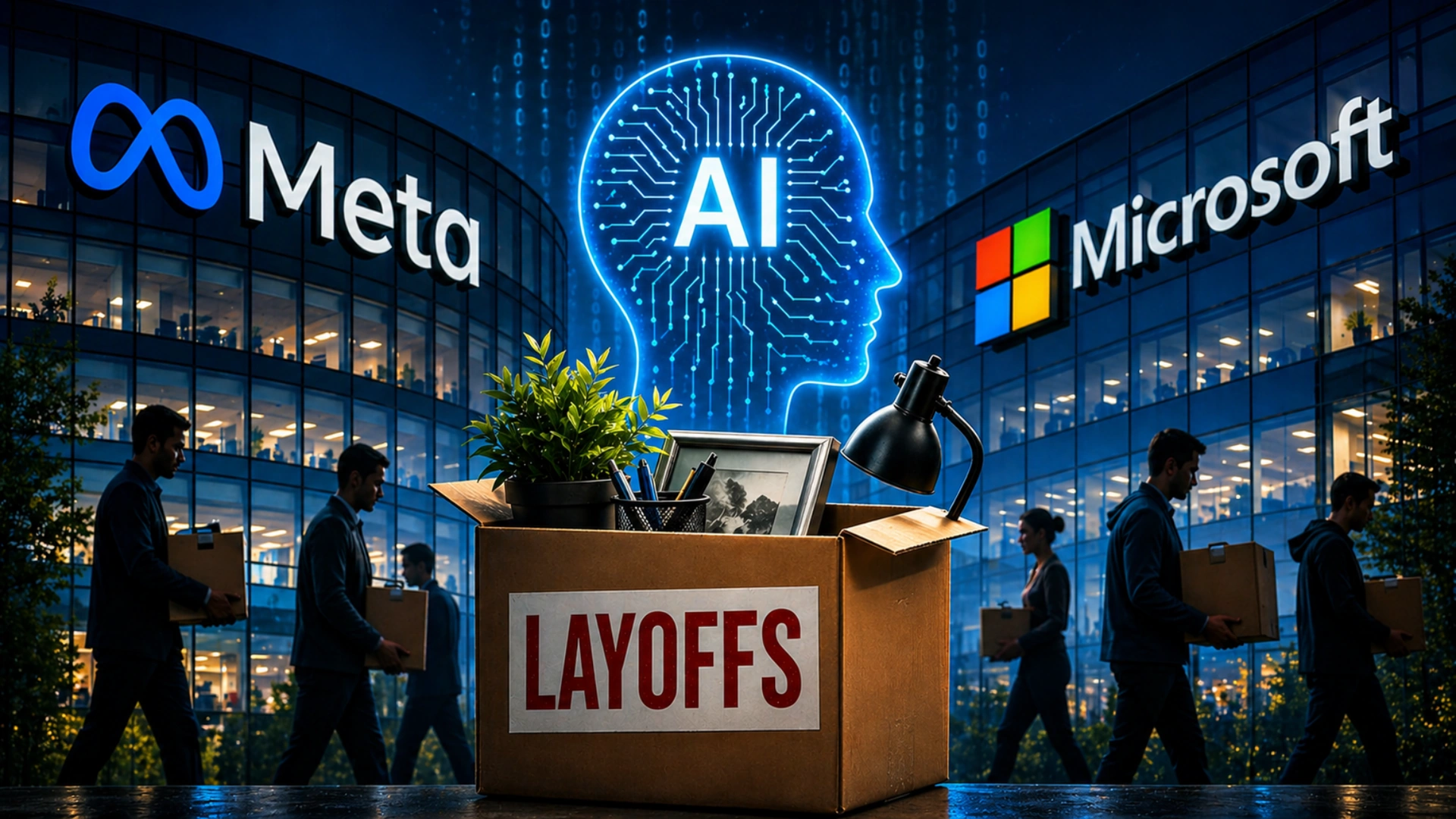
The rapid rise of artificial intelligence is creating fresh anxiety across the global technology sector after major layoffs at some of the world’s biggest companies added to concerns that automation is already changing the future of work.
Meta and Microsoft together revealed plans on Thursday that could affect more than 20,000 jobs, while several other major firms including Amazon, Snap, Oracle, Salesforce and Nike have also announced workforce reductions in recent months. The trend is raising new questions about whether the AI revolution is delivering growth at the cost of traditional employment.
Layoffs grow as AI spending surges
The latest moves come at a time when technology giants are investing record amounts to expand AI infrastructure, data centers and next generation software tools.
Meta said it will reduce around 10 percent of its workforce, equal to roughly 8,000 positions, with cuts beginning on May 20. The company is also cancelling plans to hire for around 6,000 open roles. In an internal message, Meta described the move as part of efforts to operate more efficiently while supporting other strategic investments.
Microsoft also confirmed it will offer voluntary buyouts to eligible employees in the United States, marking the first such programme in the company’s 51 year history. Around 7 percent of its US workforce may qualify, which could translate to approximately 8,750 jobs.
These announcements arrived only months after Amazon disclosed its broadest round of layoffs yet. The company has cut at least 30,000 roles since October, representing about 10 percent of its corporate and technology staff.
AI efficiency becomes a new business strategy
Many analysts believe companies are no longer reducing headcount only because of economic caution. Increasingly, businesses are using AI systems to automate tasks, streamline operations and reduce the need for large teams.
Anthony Tuggle, an executive coach and leadership expert with experience in AI, said the current moment represents a structural transformation rather than a temporary slowdown.
His view reflects growing concern among workers who see automation spreading quickly through coding, customer support, administration, research and data handling roles.
Since the launch of OpenAI's ChatGPT in late 2022, businesses across sectors have accelerated experimentation with AI tools. More advanced systems released afterward have further increased pressure on traditional office roles.
Nearly 92,000 tech jobs lost in 2026 so far
According to Layoffs.fyi, more than 92,000 technology workers have already lost jobs in 2026. Since 2020, the total number of layoffs tracked across the sector has approached 900,000.
That scale has led many economists to warn that the labor impact of AI may already be underway rather than remaining a future risk.
At the same time, hiring is not collapsing everywhere. Demand remains strong for machine learning engineers, data scientists, AI product leaders and infrastructure specialists. However, entry level and general IT hiring has slowed sharply, according to a 2026 study by Motion Recruitment.
This suggests a widening divide in the labor market. Workers with specialised AI skills are seeing opportunity, while broader support and junior roles are becoming harder to secure.
Fear spreads beyond Silicon Valley
The impact is not limited to pure technology companies.
Nike announced a fresh round of layoffs affecting around 1,400 employees, with many cuts focused on its technology division. This indicates that AI related efficiency drives are now influencing retailers, manufacturers and consumer brands as well.
Snap Inc. said last month it would reduce about 16 percent of its workforce, roughly 1,000 jobs, while also closing hundreds of open positions. Chief executive Evan Spiegel cited AI enabled efficiencies in communication with staff.
Salesforce previously eliminated around 4,000 customer support roles, while Oracle has also reportedly cut thousands of positions as it increases AI spending.
Startups are growing with smaller teams
One of the clearest signs of change is emerging in the startup world, where investors say companies can now scale revenue with far fewer employees than in previous decades.
Venture capital firms report that AI powered startups are building products faster, generating sales sooner and operating with leaner teams.
Some investors believe companies can now reach $50 million in annual revenue with only around 50 employees. In earlier years, similar growth often required teams of 200 to 250 people.
This has led to growing belief that future billion dollar startups may employ only a fraction of the workers once considered necessary.
Worker confidence declines
Job platform Glassdoor said the technology sector recorded the sharpest yearly drop in employee confidence among all industries. Its recent index showed confidence falling 6.8 percentage points in March compared with a year earlier.
Economists say workers are becoming less willing to resign voluntarily because they fear a difficult hiring market. That means companies looking to reduce staff may rely more heavily on layoffs, stricter performance reviews and buyout offers.
The result is a workforce that feels uncertain, even inside companies benefiting from the AI boom.
Billions more still set to be spent
Despite the job cuts, investment momentum remains powerful.
Alphabet Inc., Microsoft, Meta Platforms and Amazon are expected to spend nearly $700 billion combined this year on AI infrastructure.
That includes chips, cloud systems, data centers and software tools designed to support growing demand for generative AI services.
Analysts now expect company earnings calls in the coming week to focus not only on spending plans, but also whether further layoffs are likely.
New jobs may come, but timing remains uncertain
Supporters of AI argue that every major technology shift creates disruption before producing new categories of work. Just as smartphones created app developers and cloud computing created IT administrators, AI may generate roles that are difficult to predict today.
However, many experts say the transition period may be painful.
Companies are finding immediate savings through automation, while replacement jobs may take years to fully emerge. That gap could define the next chapter of the labor market.
A turning point for the tech workforce
For years, the technology industry was viewed as one of the safest paths to stable, high paying employment. The latest wave of layoffs suggests that assumption is changing.
AI is opening enormous commercial opportunities, but it is also forcing companies to rethink how many people they need and what skills matter most.
For workers across the sector, the message is becoming clear: adapt quickly, specialise deeply and prepare for a market where growth no longer guarantees job security.
Edit Profile
Help improve @KR

Was this page helpful to you?
Contact Khogendra Rupini
Are you looking for an experienced developer to bring your website to life, tackle technical challenges, fix bugs, or enhance functionality? Look no further.
I specialize in building professional, high-performing, and user-friendly websites designed to meet your unique needs. Whether it's creating custom JavaScript components, solving complex JS problems, or designing responsive layouts that look stunning on both small screens and desktops, I can collaborate with you.
Create something exceptional with us. Contact us today
Open for Collaboration
If you're looking to collaborate, I'm available for a variety of professional services, including -
- Website Design & Development
- Advertisement & Promotion Setup
- Hosting Configuration & Deployment
- Front-end & Back-end Code Implementation
- Code Testing & Optimization
- Cybersecurity Solutions & Threat Prevention
- Website Scanning & Malware Removal
- Hacked Website Recovery
- PHP & MySQL Development
- Python Programming
- Web Content Writing
- Protection Against Hacking Attempts