
Meta Strikes Major AWS CPU Deal as AI Infrastructure Race Intensifies and Investors Watch Costs
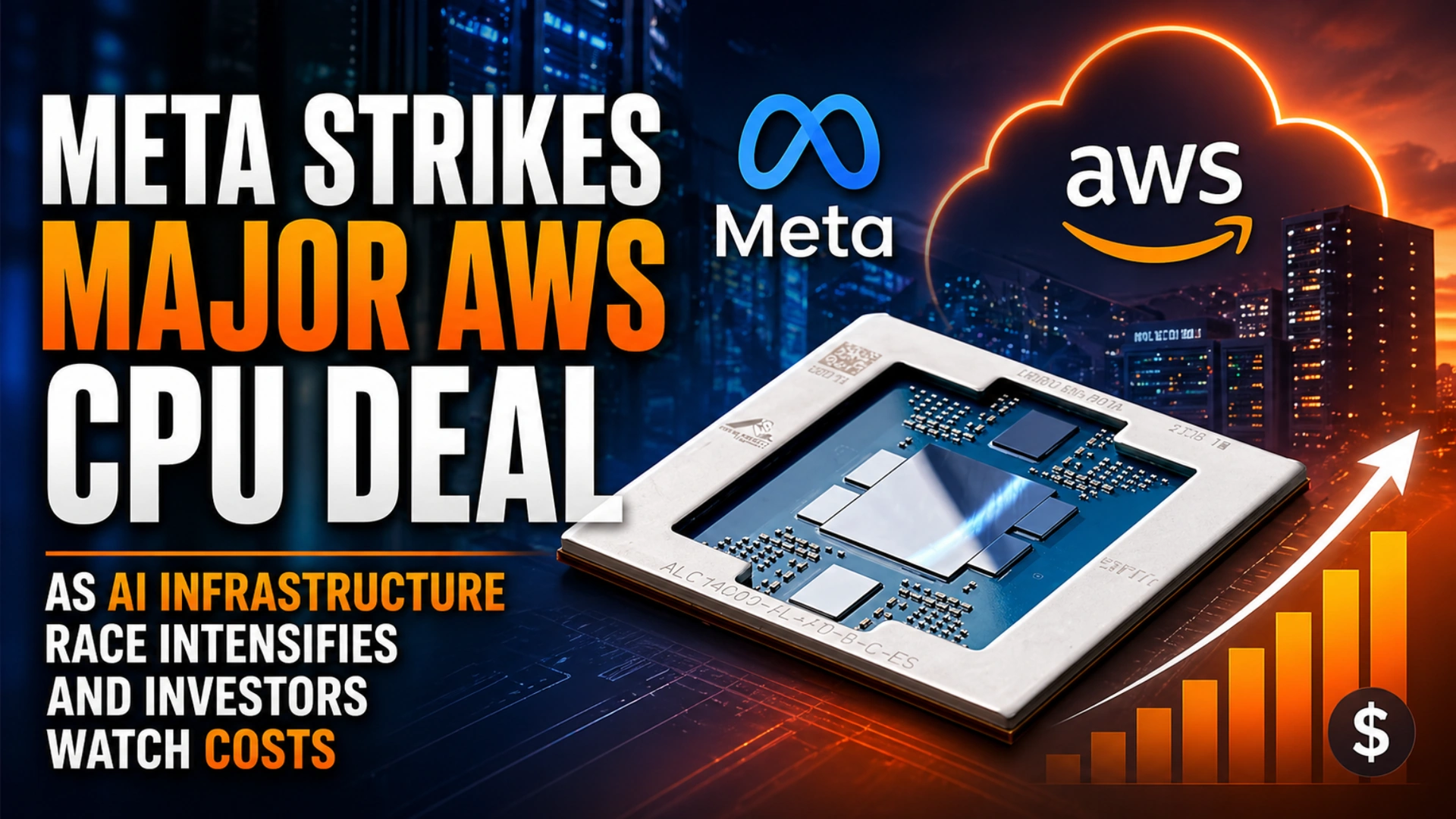
Meta Platforms has entered a major long term infrastructure partnership with Amazon Web Services, signing a multi year, multi billion dollar agreement to deploy tens of millions of AWS Graviton CPU cores. The move marks one of Meta’s largest external compute commitments in recent years and signals a broader shift in how the company is preparing for the next phase of artificial intelligence.
The agreement positions Meta among the largest global customers of AWS Graviton processors, Amazon’s Arm based server chips designed for performance and energy efficiency. According to the disclosed details, the new capacity will support next generation AI systems, especially advanced agentic AI workloads that require large scale computing power, lower latency, and high bandwidth operations.
Meta Expands Beyond GPU Focus in AI Buildout
For years, the global AI race has largely centered on graphics processing units, or GPUs, which remain critical for training and running large language models. Meta has also invested in its own in house silicon through the Meta Training and Inference Accelerator, known as MTIA.
This latest AWS partnership shows Meta is broadening that strategy. Instead of relying only on GPUs and internal chips, the company is adding a vast CPU layer to its compute stack. That diversified approach could give Meta more flexibility in managing workloads across different systems.
Industry analysts note that not every AI task requires expensive GPU resources. Many workloads, including data processing, orchestration, recommendation systems, and parts of inference operations, can be handled more efficiently through CPUs. By scaling Graviton deployments, Meta may be seeking to optimize costs while preserving GPU capacity for the most demanding tasks.
Why Agentic AI Needs More Than Just GPUs
The agreement specifically references support for agentic AI workloads. That term is increasingly used to describe AI systems capable of taking actions, making decisions, and completing multi step tasks with greater autonomy.
Unlike conventional chatbots or simple assistants, agentic systems often require rapid access to memory, data retrieval, planning engines, tool usage, and continuous coordination across multiple services. Those operations can create heavy demand for low latency compute infrastructure beyond standard model training.
In that context, CPUs play an important role. They can manage distributed systems, coordinate workflows, and handle supporting operations around AI models. Meta’s latest deal suggests the company expects these more advanced AI experiences to become central to its future products.
Strategic Value for Meta’s Core Platforms
Meta owns some of the world’s largest consumer platforms, including Facebook, Instagram, WhatsApp, and Threads. Any major AI rollout across those services would require enormous computing capacity.
From personalized feeds and ad targeting to business messaging tools and intelligent assistants, Meta’s future revenue strategy is increasingly tied to AI powered experiences. A stronger compute backbone could improve speed, reliability, and scalability across these products.
The AWS agreement may also help Meta launch new AI features faster by accessing mature cloud infrastructure rather than depending solely on internal buildouts.
What the Deal Means for Amazon Web Services
The partnership is also significant for Amazon Web Services. While AWS remains a dominant force in cloud computing, competition in AI infrastructure has intensified as rivals push specialized chips and enterprise AI services.
Securing Meta as a major Graviton customer strengthens AWS’s position in the battle for next generation workloads. It also showcases Amazon’s growing confidence in Graviton chips as a viable large scale alternative for many compute intensive tasks.
For AWS, high profile customers adopting Graviton at this scale can encourage broader enterprise demand and reinforce its custom silicon strategy.
Investor Focus Turns to Costs and Returns
For investors, the announcement highlights a central question facing large technology companies in 2026: how much spending is justified in pursuit of AI leadership?
Meta has already committed billions of dollars to AI research, data centers, networking, and chips. Adding a large CPU partnership may improve efficiency over time, but it also represents another substantial infrastructure commitment.
Shareholders are likely to watch future earnings calls for updates on three major areas:
Capital expenditure trends: Whether Meta increases spending further to support AI expansion.
Unit economics: How efficiently the company converts infrastructure spending into usable products and revenue.
Monetization progress: Whether agentic AI tools, advertising improvements, or subscription products generate meaningful returns.
If AI driven revenue grows faster than costs, investors may view the spending positively. If returns lag, questions about fixed commitments could intensify.
Broader Industry Signal
Meta’s decision may influence how other technology companies structure their own AI stacks. Rather than relying on a single chip type, many firms may increasingly combine GPUs, CPUs, and custom accelerators depending on workload needs.
That blended model could become the new standard for large scale AI operations, especially as demand for compute continues to rise globally.
The race is no longer only about building bigger models. It is also about building smarter infrastructure that balances speed, cost, power efficiency, and reliability.
Meta’s Next Test
The AWS Graviton pact gives Meta more tools for its AI ambitions, but infrastructure alone does not guarantee success. The next test will be execution: shipping products users value, controlling costs, and turning AI investment into long term earnings growth.
For now, the message from Meta is clear. The company intends to compete aggressively in artificial intelligence, and it is willing to spend heavily to build the systems needed to do it.
Edit Profile
Help improve @KR

Was this page helpful to you?
Contact Khogendra Rupini
Are you looking for an experienced developer to bring your website to life, tackle technical challenges, fix bugs, or enhance functionality? Look no further.
I specialize in building professional, high-performing, and user-friendly websites designed to meet your unique needs. Whether it's creating custom JavaScript components, solving complex JS problems, or designing responsive layouts that look stunning on both small screens and desktops, I can collaborate with you.
Create something exceptional with us. Contact us today
Open for Collaboration
If you're looking to collaborate, I'm available for a variety of professional services, including -
- Website Design & Development
- Advertisement & Promotion Setup
- Hosting Configuration & Deployment
- Front-end & Back-end Code Implementation
- Code Testing & Optimization
- Cybersecurity Solutions & Threat Prevention
- Website Scanning & Malware Removal
- Hacked Website Recovery
- PHP & MySQL Development
- Python Programming
- Web Content Writing
- Protection Against Hacking Attempts