
DeepSeek slashes prices on newest AI model, intensifying pressure on OpenAI, Google and Anthropic amid rising China US tech rivalry
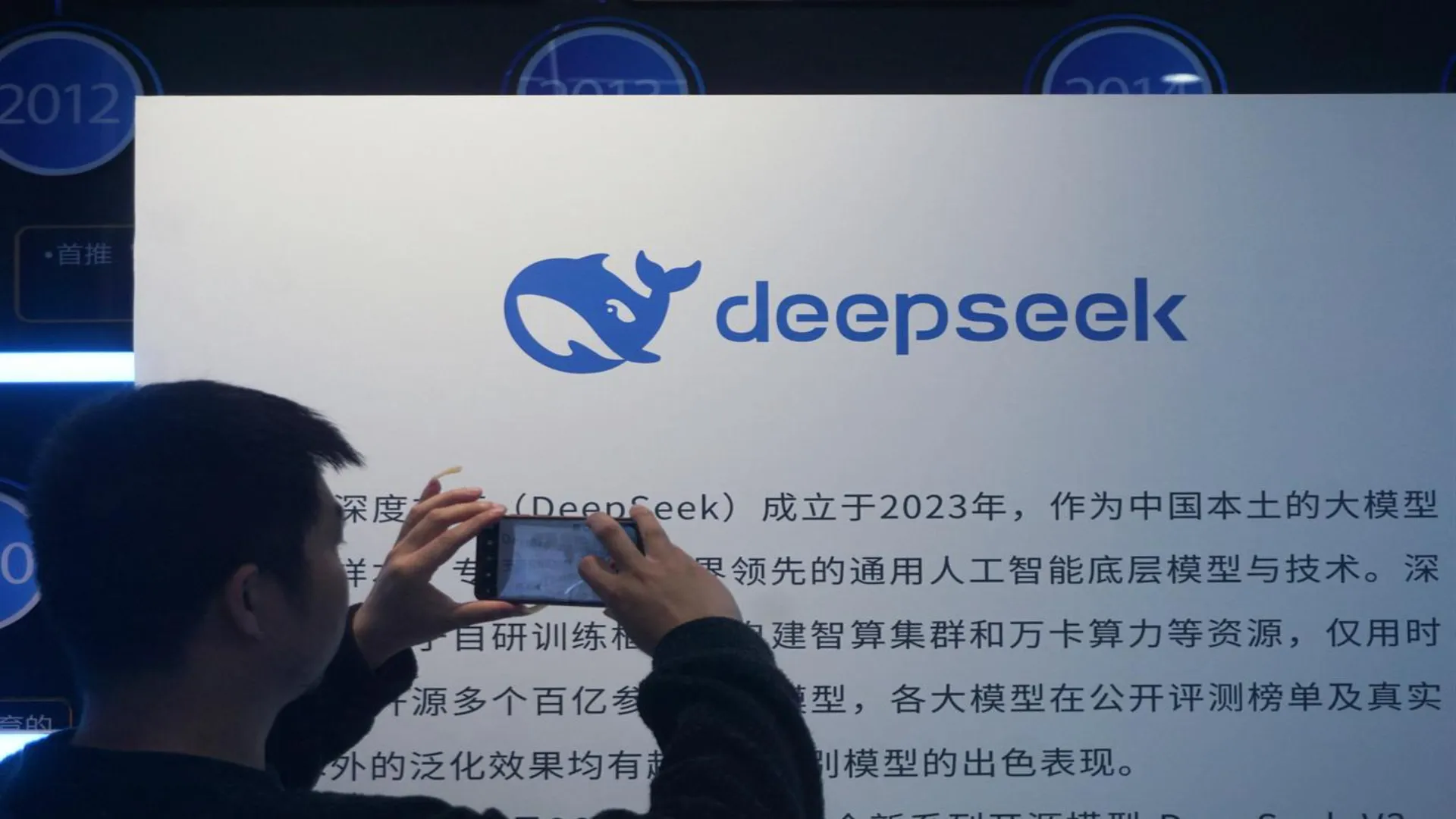
Chinese artificial intelligence startup DeepSeek has announced sharp price reductions for its latest AI models, escalating competition in the global generative AI market and putting fresh pressure on major American rivals including OpenAI, Google and Anthropic.
The move comes at a time when the battle over advanced AI technology is no longer only commercial. It is increasingly tied to national strategy, chip supply chains, open source ecosystems and the broader rivalry between the United States and China.
DeepSeek said developers will receive a 75 percent promotional discount on its newly introduced DeepSeek V4 Pro model through May 5. Alongside that offer, the company has also reduced the cost of input cache hits across its API portfolio to one tenth of previous pricing, effective immediately.
The cuts could make DeepSeek one of the most aggressive pricing players in the AI sector, especially for startups and enterprises seeking lower cost alternatives to premium Western models.
New pricing strategy targets developers and enterprise users
According to reported pricing details, DeepSeek V4 Pro previously cost $0.145 per million input tokens and $3.48 per million output tokens. After the temporary discount, the input token price falls to around $0.036 per million tokens.
Its smaller sibling, DeepSeek V4 Flash, is priced at $0.14 per million input tokens and $0.28 per million output tokens at standard rates.
These numbers are significant because token pricing directly affects the cost of running chatbots, coding assistants, search tools and AI agents at scale. Lower pricing can influence which model developers choose, especially when products require millions of daily requests.
For companies building AI services with tight budgets, cost differences of even a few cents per million tokens can become decisive when multiplied across large workloads.
Why cache pricing matters in the AI race
DeepSeek’s separate reduction in cache hit pricing may be even more strategic than the headline discount.
A cache hit typically occurs when repeated or nearly identical prompts can reuse earlier computations instead of processing everything from scratch. This is especially valuable for AI agents, customer service bots and automated workflows where similar questions appear constantly.
By cutting cache hit pricing to one tenth of earlier levels, DeepSeek is directly targeting production use cases where efficiency matters most. That could make the platform more attractive for businesses deploying always on AI systems.
Industry analysts increasingly view pricing innovation, not just model intelligence, as the next major battleground in artificial intelligence.
Inside DeepSeek V4 Pro and V4 Flash
DeepSeek launched a preview of its V4 model family recently, highlighting major upgrades in scale and performance.
DeepSeek V4 Pro reportedly uses a mixture of experts architecture with 1.6 trillion total parameters, while about 49 billion are active during any one inference task. This design allows large model capacity while controlling computing costs.
The lighter V4 Flash model contains 284 billion total parameters with around 13 billion active.
Both models reportedly support a one million token context window, enabling long document analysis, large codebase reasoning and advanced enterprise workflows that require persistent memory across extensive inputs.
DeepSeek has also claimed V4 Pro leads open source competitors on world knowledge benchmarks, with only Google’s Gemini 3.1 Pro reportedly scoring higher in certain evaluations.
Pressure builds on US AI leaders
The price war presents a challenge for established American AI providers.
Microsoft backed OpenAI has built enterprise momentum through premium AI integrations, while Google has pushed Gemini across consumer and cloud products. Anthropic has positioned Claude as a business focused assistant with strong reasoning and coding capabilities.
But if developers can access competitive Chinese models at substantially lower cost, some workloads may shift toward open or lower priced alternatives.
This does not automatically mean DeepSeek will dominate the premium market. Many enterprises still prioritize reliability, data controls, legal safeguards, ecosystem support and long term vendor trust. However, aggressive pricing can force rivals to rethink margins and packaging strategies.
Geopolitical tensions shadow AI expansion
The announcement arrives during heightened political tensions around advanced AI technology.
Last week, White House science and technology policy chief Michael Kratsios warned that foreign actors, particularly concerns centered on China, may be replicating frontier AI capabilities by using outputs from larger models to train smaller systems more cheaply.
Though no company was explicitly named, DeepSeek has previously faced public allegations of model distillation from competitors and commentators. Distillation refers to training a smaller model using responses generated by a stronger one.
Those accusations remain part of a wider industry debate over how knowledge transfer, benchmarking and model imitation should be governed in a rapidly evolving sector.
DeepSeek’s earlier rise shook Silicon Valley
DeepSeek first drew global attention after releasing its R1 reasoning model in January 2025.
The company said the model was built in roughly two months at a cost below $6 million, using less powerful chips than those commonly used by major US laboratories. Those claims triggered debate over whether American tech giants were overspending on hardware and infrastructure.
The announcement also rattled investors who had assumed only companies with massive budgets and top tier chip access could compete at the frontier of AI development.
Since then, Chinese technology groups including Alibaba and ByteDance have accelerated their own model launches, intensifying domestic competition.
Shift away from Nvidia hardware
Another notable development is DeepSeek’s adaptation of V4 models for Huawei Ascend AI processors.
That shift suggests China’s AI ecosystem is steadily building alternatives to Nvidia hardware, which has long dominated training and inference markets.
As export controls and chip restrictions reshape global supply chains, local processor ecosystems may become increasingly important for Chinese AI firms.
Chinese open models gain global reach
Chinese open weight AI models are becoming more visible in international developer ecosystems, cloud marketplaces and software tools.
Major cloud providers including Amazon, Microsoft and Google have made various third party models available through their platforms, giving customers more options beyond domestic US providers.
Some market estimates suggest Chinese open source or open weight models are already embedded in a large share of startup experimentation and cost sensitive production systems.
Their appeal is often straightforward: lower operating cost combined with increasingly competitive capability.
What happens next in the AI market
DeepSeek’s latest move signals that the next phase of the AI race may be shaped as much by economics as by benchmark scores.
The first wave of competition focused on who had the smartest chatbot. The next wave may center on who can deliver powerful AI at a price businesses can justify.
For OpenAI, Google, Anthropic and other Western leaders, the challenge is now twofold: keep advancing model quality while proving premium pricing remains worth paying.
For DeepSeek, the opportunity is clear. If it can pair lower cost with strong performance and dependable infrastructure, it may emerge as one of the most disruptive forces in global AI.
The broader message to the industry is unmistakable: AI competition is no longer confined to Silicon Valley, and price pressure from China is now impossible to ignore.
Edit Profile
Help improve @KR

Was this page helpful to you?
Contact Khogendra Rupini
Are you looking for an experienced developer to bring your website to life, tackle technical challenges, fix bugs, or enhance functionality? Look no further.
I specialize in building professional, high-performing, and user-friendly websites designed to meet your unique needs. Whether it's creating custom JavaScript components, solving complex JS problems, or designing responsive layouts that look stunning on both small screens and desktops, I can collaborate with you.
Create something exceptional with us. Contact us today
Open for Collaboration
If you're looking to collaborate, I'm available for a variety of professional services, including -
- Website Design & Development
- Advertisement & Promotion Setup
- Hosting Configuration & Deployment
- Front-end & Back-end Code Implementation
- Code Testing & Optimization
- Cybersecurity Solutions & Threat Prevention
- Website Scanning & Malware Removal
- Hacked Website Recovery
- PHP & MySQL Development
- Python Programming
- Web Content Writing
- Protection Against Hacking Attempts