
Meta backs AWS Graviton at massive scale as AI workloads shift beyond GPUs in major cloud infrastructure move
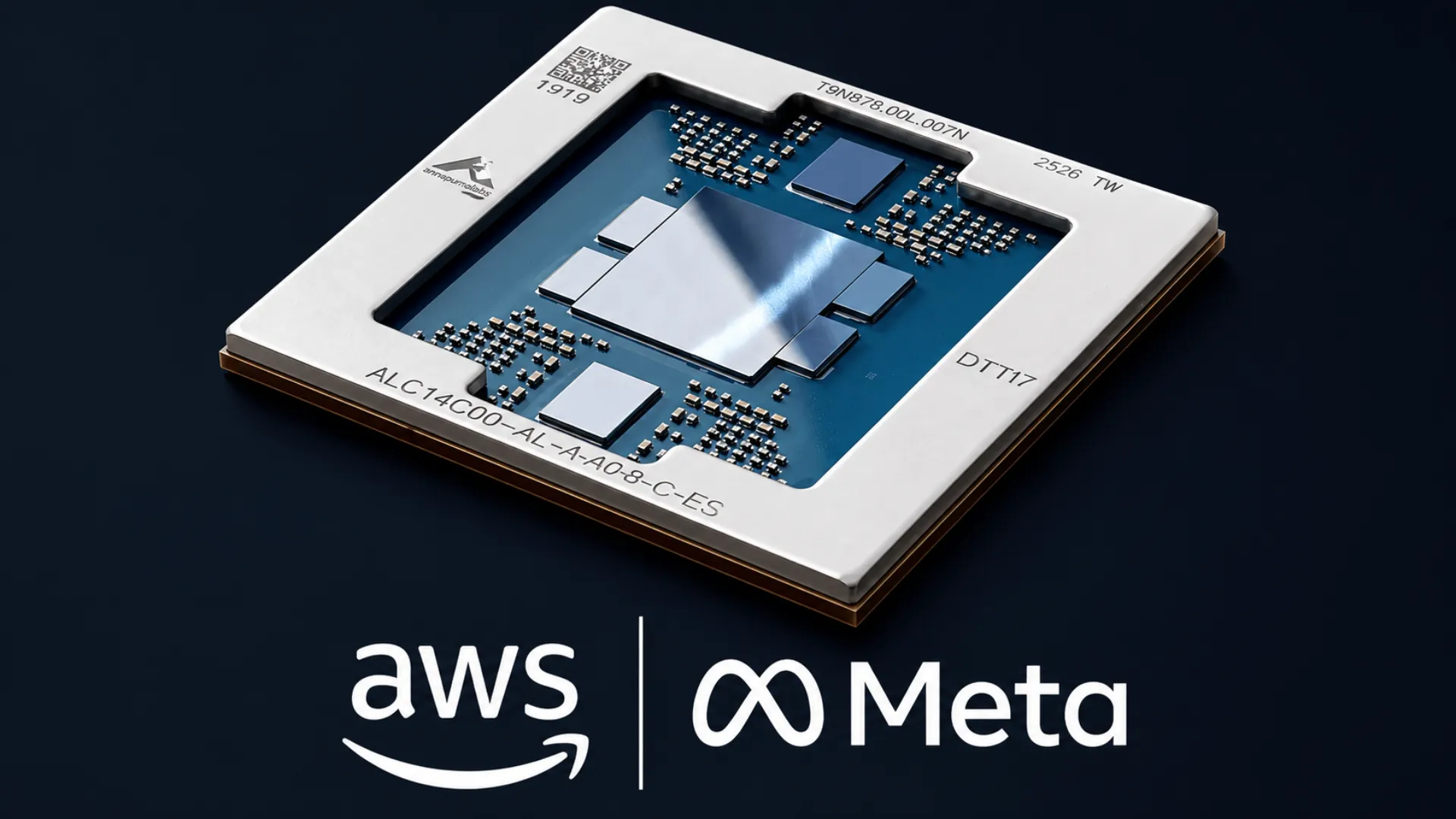
Meta has signed a large scale agreement with Amazon Web Services to deploy AWS Graviton processors, marking one of the biggest public endorsements yet for Arm based cloud CPUs in the artificial intelligence era. The move signals a broader change in how leading technology companies are building AI systems, where not every workload depends on expensive graphics processors.
The agreement begins with tens of millions of Graviton cores and allows expansion as Meta’s AI operations grow. According to the announcement, the processors will support several internal workloads, including infrastructure tied to Meta’s agentic AI efforts, where systems must manage billions of user interactions while coordinating complex multi step tasks.
The deal also deepens a long standing relationship between Meta Platforms and Amazon Web Services, as Meta already uses Amazon Bedrock services in parts of its AI stack.
Meta signals a new chapter in AI infrastructure planning
For the past two years, investor attention across the AI industry has focused heavily on GPUs used to train large language models. But Meta’s latest decision suggests the next phase of AI growth may depend just as much on powerful and efficient CPUs.
Agentic AI systems often require continuous reasoning, search, recommendation generation, content ranking, code execution and workflow orchestration. These tasks need sustained processing across many cores rather than only the parallel acceleration GPUs are known for.
That makes CPUs increasingly important in production environments where AI tools must respond quickly to users in real time.
Meta’s head of infrastructure Santosh Janardhan said compute diversification is now a strategic priority, adding that Graviton offers the performance and efficiency needed for CPU intensive AI workloads at Meta’s scale.
Why AWS Graviton is gaining attention
AWS Graviton5 is built on advanced 3 nanometer manufacturing technology and includes 192 cores, according to the report. AWS says the new generation also offers a significantly larger cache and lower inter core communication delays than previous versions.
Those changes are important for AI inference tasks where speed, bandwidth and low latency can directly affect user experience.
AWS has spent years developing its own custom chips through Annapurna Labs and integrating them with its Nitro system architecture. That allows the company to optimize hardware, networking and software together rather than relying only on off the shelf processors.
Industry analysts say this vertical model is becoming a competitive advantage as cloud providers race to win enterprise AI demand.
CPUs and GPUs are no longer competing in a simple way
The Meta agreement does not mean GPUs are losing relevance. Graphics processors remain essential for training frontier AI models and many high performance workloads.
Instead, the industry is moving toward a mixed compute model where CPUs and GPUs handle different parts of the stack.
Training massive models may continue on GPU clusters, while day to day reasoning, recommendations, code generation, moderation systems and interactive AI agents may increasingly rely on CPU fleets.
That creates a more balanced infrastructure strategy for companies trying to scale AI profitably.
For hyperscalers, it also reduces dependence on a single chip category or supplier.
Meta expands its multi vendor strategy
Meta has already invested heavily across several chip ecosystems. The company has used NVIDIA GPUs, expanded work with AMD processors, partnered with Broadcom on custom accelerators and worked with Arm technologies.
Adding AWS Graviton at this scale strengthens Meta’s multi vendor strategy.
This approach gives the company greater supply chain flexibility, stronger negotiating power and the ability to match specific workloads with the most efficient hardware.
For investors and competitors, the message is clear. The biggest AI companies no longer want to depend on one architecture or one supplier.
Energy efficiency becomes a boardroom issue
Power consumption has become one of the most serious challenges in AI expansion. Data centers running advanced AI models require enormous electricity, cooling and operating budgets.
At Meta’s scale, even small gains in performance per watt can translate into major savings across millions of processors.
That is why efficient custom silicon is gaining importance. A processor that lowers energy use while maintaining performance can improve margins and help companies meet sustainability goals at the same time.
As regulators and investors pay closer attention to the environmental cost of AI, infrastructure efficiency is becoming more than a technical detail. It is now a strategic business factor.
What this means for AWS
Winning Meta as a major Graviton customer is a symbolic and commercial victory for AWS.
It validates years of investment in custom Arm based chips and shows that large cloud customers are willing to trust in house silicon for mission critical AI workloads.
It may also increase pressure on rivals including Google and Microsoft to sharpen their own custom chip strategies.
Cloud competition is no longer only about storage prices or basic compute. It is increasingly about who can offer the most efficient full stack AI infrastructure.
What markets will watch next
Analysts are likely to track whether Graviton5 widens performance advantages in real world AI tests, how manufacturing capacity develops at advanced semiconductor nodes and whether Meta expands commitments beyond the initial deployment.
They will also watch whether other hyperscale customers follow Meta’s lead and move more AI workloads to custom CPU fleets.
If that happens, the AI hardware race could widen from a GPU story into a broader battle involving CPUs, networking, memory and energy optimized cloud design.
Bottom line
Meta’s decision to deploy AWS Graviton processors at massive scale reflects a turning point in the AI market. The first wave of AI spending centered on training models. The next wave may be defined by how efficiently those models run every day for billions of users.
In that environment, CPUs are no longer background hardware. They are becoming frontline AI infrastructure.
Edit Profile
Help improve @KR

Was this page helpful to you?
Contact Khogendra Rupini
Are you looking for an experienced developer to bring your website to life, tackle technical challenges, fix bugs, or enhance functionality? Look no further.
I specialize in building professional, high-performing, and user-friendly websites designed to meet your unique needs. Whether it's creating custom JavaScript components, solving complex JS problems, or designing responsive layouts that look stunning on both small screens and desktops, I can collaborate with you.
Create something exceptional with us. Contact us today
Open for Collaboration
If you're looking to collaborate, I'm available for a variety of professional services, including -
- Website Design & Development
- Advertisement & Promotion Setup
- Hosting Configuration & Deployment
- Front-end & Back-end Code Implementation
- Code Testing & Optimization
- Cybersecurity Solutions & Threat Prevention
- Website Scanning & Malware Removal
- Hacked Website Recovery
- PHP & MySQL Development
- Python Programming
- Web Content Writing
- Protection Against Hacking Attempts