
China blocks Meta’s $2 billion Manus takeover, orders Zuckerberg company to withdraw AI startup deal amid tighter US investment scrutiny
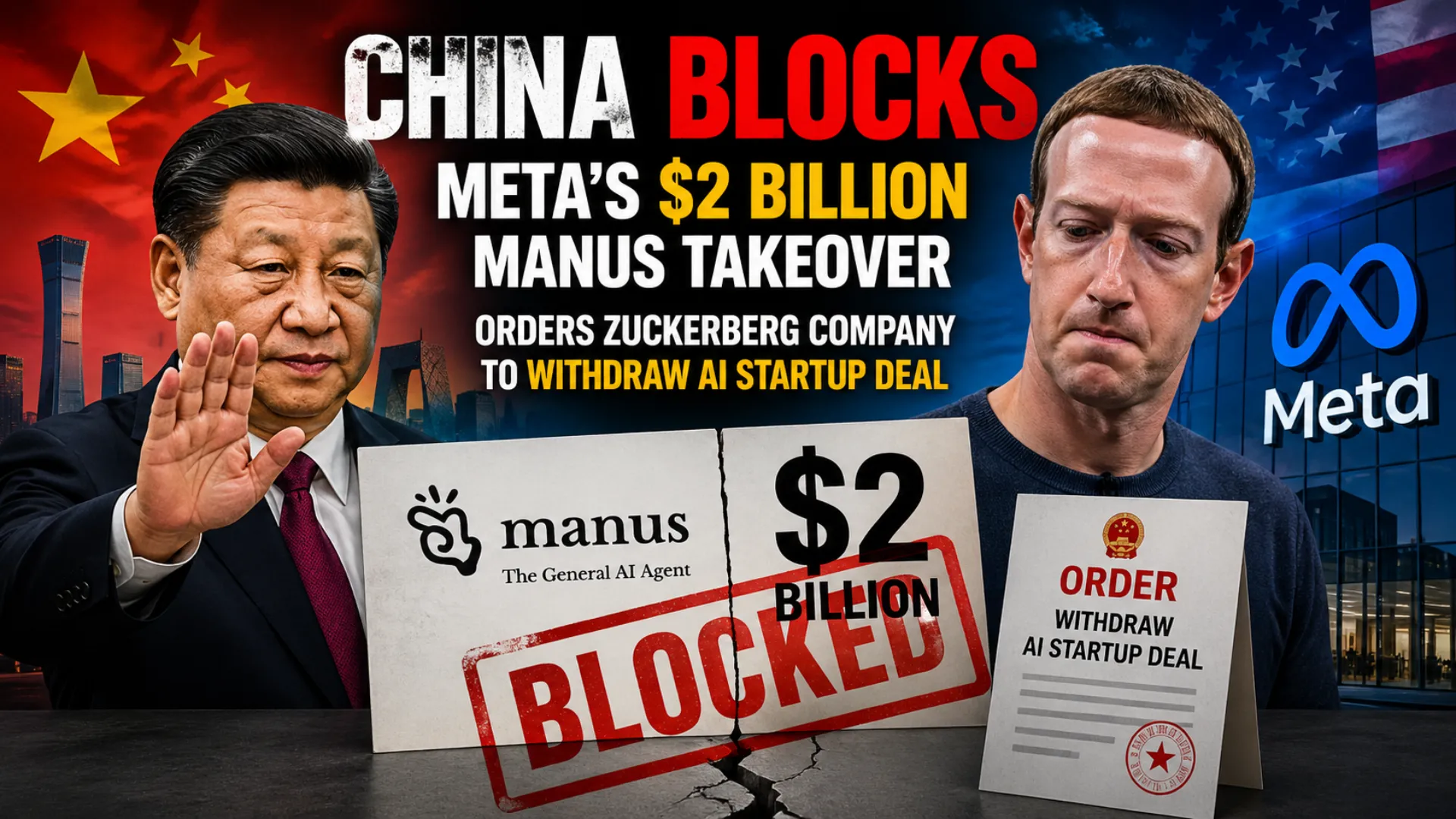
China has officially blocked Meta Platforms planned $2 billion acquisition of Manus, escalating tensions over foreign investment in strategic technology sectors and highlighting the growing rivalry between China and the United States in artificial intelligence.
The decision was announced on Monday by China’s top economic planning agency, the National Development and Reform Commission, which said it had cancelled the transaction and instructed both sides to unwind the deal.
The move represents one of the clearest signals yet that Beijing is tightening oversight of domestic AI assets and limiting access by American companies to Chinese innovation in one of the world’s most sensitive technology races.
Beijing orders Meta to withdraw Manus acquisition
Meta Platforms, parent company of Facebook, Instagram and WhatsApp, had announced the Manus acquisition in December as part of its aggressive expansion into AI powered products and next generation automation tools.
However, Chinese regulators said the foreign investment would not be permitted. In its statement, the National Development and Reform Commission said it would prohibit the foreign acquisition of the Manus project and required all parties to withdraw the transaction.
The order effectively halts Meta’s attempt to secure a promising AI startup whose technology had drawn international attention.
Why Manus became valuable in the AI race
Manus gained recognition after promoting itself as a developer of advanced AI agents. These systems are designed to complete multi step tasks with minimal human involvement.
Unlike traditional chatbots that mainly respond to prompts, AI agents aim to act independently by handling tasks such as travel planning, customer support, scheduling, research preparation and workflow management.
Industry leaders increasingly see AI agents as the next major commercial layer of artificial intelligence because they promise real productivity gains for businesses and consumers.
Manus was praised by some Chinese commentators last year as a potential rival to DeepSeek, another Chinese company that gained attention for rapid progress in AI development.
While Manus does not reportedly build its own foundational model, it focuses on agent frameworks that can operate on top of existing large language models developed elsewhere.
Meta’s AI ambitions face a major setback
For Meta Platforms, the blocked takeover is a strategic setback. Chief executive Mark Zuckerberg has committed billions of dollars to AI infrastructure, talent recruitment and consumer products as the company competes with rivals including OpenAI, Google, Microsoft and Amazon.
When the deal was first announced, Meta said Manus technology could help bring advanced AI agents to billions of users across its platforms and create new business opportunities.
That vision now faces uncertainty unless regulators reverse course or both companies restructure the agreement in another form.
Meta responded by saying the transaction complied with applicable laws and that it expected an appropriate resolution to the inquiry.
China increases scrutiny of US capital in technology
Reports in recent days suggested Chinese authorities were preparing broader restrictions on domestic technology firms seeking American capital. Several private companies were reportedly warned to avoid accepting US investment unless they first secured explicit approval from Beijing.
If accurate, the policy shift indicates China is treating advanced AI technology as strategically sensitive infrastructure rather than ordinary startup activity.
That would place AI companies in a category similar to semiconductors, telecommunications and national data assets, where state oversight is significantly stronger.
US China AI rivalry intensifies
The decision comes during a period of intensifying competition between the world’s two largest AI powers.
Many of the strongest performing AI models globally are currently produced by developers based in either China or the United States. Both governments increasingly view leadership in artificial intelligence as central to future economic power, military capability and global influence.
Earlier this year, Donald Trump said the United States was ahead of China in the AI race by a substantial margin. Chinese officials, meanwhile, continue to back domestic innovation while reducing reliance on foreign technology.
Against that backdrop, blocking a high profile US acquisition of a Chinese linked AI startup carries political as well as commercial significance.
Rare intervention sends strong market message
China does not frequently force completed or announced corporate transactions to be unwound after the fact. That makes the Manus case especially notable for global investors, venture funds and multinational technology companies.
The message to markets is clear: deals involving strategic AI assets may now face tougher review, especially when foreign ownership or American capital is involved.
Investors seeking access to Chinese AI growth may need to rely more on partnerships, minority stakes or locally approved structures rather than outright acquisitions.
What happens next for Meta and Manus
Several outcomes remain possible. Meta could challenge the decision through regulatory channels, renegotiate terms, or pursue collaboration without ownership. Manus may also continue independently while seeking alternative funding aligned with Chinese policy requirements.
For now, the blocked takeover underlines how geopolitics is reshaping the technology industry. In earlier years, startup acquisitions were often judged mainly on valuation and market fit. Today, national strategy, data control and technological sovereignty increasingly determine whether deals proceed.
Bigger than one deal
The collapse of the Meta Manus agreement is about more than a single transaction. It reflects a new era in which AI companies are no longer viewed simply as startups, but as strategic national assets.
As China and the United States compete for leadership in next generation intelligence systems, cross border deals involving critical AI technologies are likely to face deeper scrutiny, longer delays and higher political risk.
For Meta, it is a costly roadblock. For Manus, it is a reminder of how valuable AI agent technology has become. And for the global industry, it is another sign that the future of artificial intelligence will be shaped as much by governments as by engineers.
Edit Profile
Help improve @KR

Was this page helpful to you?
Contact Khogendra Rupini
Are you looking for an experienced developer to bring your website to life, tackle technical challenges, fix bugs, or enhance functionality? Look no further.
I specialize in building professional, high-performing, and user-friendly websites designed to meet your unique needs. Whether it's creating custom JavaScript components, solving complex JS problems, or designing responsive layouts that look stunning on both small screens and desktops, I can collaborate with you.
Create something exceptional with us. Contact us today
Open for Collaboration
If you're looking to collaborate, I'm available for a variety of professional services, including -
- Website Design & Development
- Advertisement & Promotion Setup
- Hosting Configuration & Deployment
- Front-end & Back-end Code Implementation
- Code Testing & Optimization
- Cybersecurity Solutions & Threat Prevention
- Website Scanning & Malware Removal
- Hacked Website Recovery
- PHP & MySQL Development
- Python Programming
- Web Content Writing
- Protection Against Hacking Attempts