
Beeple’s robot dogs with Musk and Zuckerberg heads roam Berlin museum, turning AI power into provocative art statement
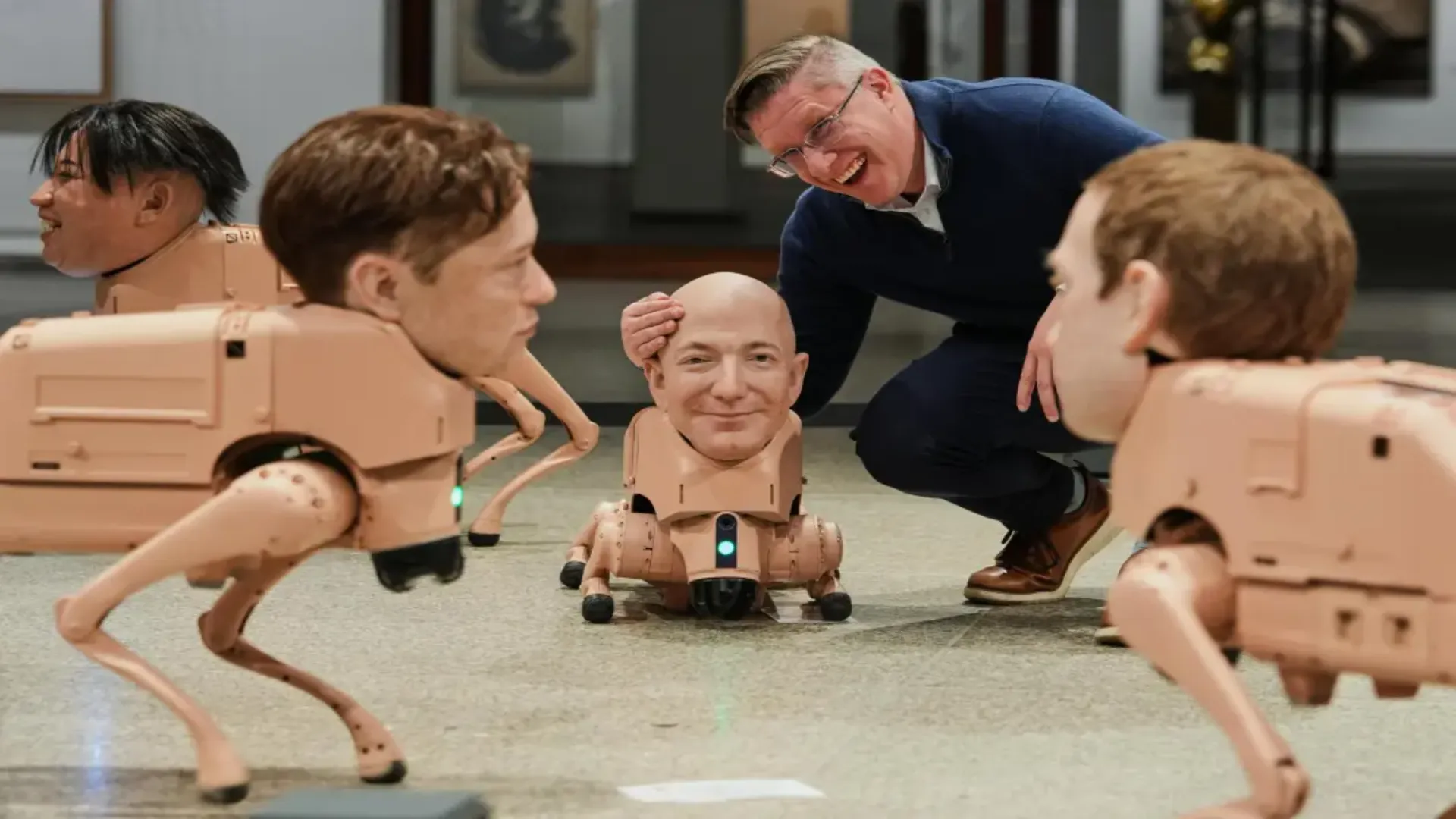
A striking new installation by American digital artist Beeple has transformed one of Germany’s leading museums into a sharp commentary on artificial intelligence, algorithmic influence and the growing power of tech billionaires.
At Berlin’s Neue Nationalgalerie, visitors are being greeted by roaming robotic dogs fitted with hyper realistic silicone heads modeled after globally known figures including Elon Musk, Mark Zuckerberg, Jeff Bezos, Andy Warhol and Pablo Picasso. The exhibition, titled Regular Animals, blends technology, satire and cultural criticism in a way that has quickly drawn international attention.
Created by Beeple, whose real name is Mike Winkelmann, the interactive work explores how technology platforms increasingly shape what people see, believe and understand about the world.
Robot dogs that “digest” reality and print altered images
The robotic animals do more than move around gallery spaces. Equipped with cameras, they capture scenes from their surroundings and later “poo” printed images generated from what they recorded.
Those prints are not simple photographs. Each one is transformed through artificial intelligence to reflect the personality or worldview associated with the figure represented by the dog’s head.
A robot carrying the likeness of Pablo Picasso may produce imagery inspired by Cubism. A dog wearing Andy Warhol’s face may generate pop art style visuals focused on consumer culture. A machine modeled after Elon Musk or Mark Zuckerberg may produce entirely different interpretations shaped by themes linked to technology, power and digital influence.
The result is an unusual but thought provoking artistic process that asks a direct question: if algorithms mediate reality, whose version of reality are we seeing?
Beeple says algorithms now shape public perception
Speaking about the project, Beeple explained that artists once played a major role in changing how society viewed the world.
He said painters such as Picasso changed visual language, while figures like Warhol altered how people thought about consumerism and pop culture.
Today, Beeple argues, that role has shifted toward technology leaders who control platforms and recommendation systems used by billions of people.
His concern is not only cultural but political. According to the artist, platform owners can reshape public attention simply by changing algorithms, often without the lengthy democratic processes required in governments or international institutions.
That message sits at the center of Regular Animals. The exhibition suggests that invisible digital systems now carry enormous influence over public conversation, entertainment, commerce and even civic life.
Why Berlin museum chose this exhibition
Lisa Botti, curator of the exhibition in Berlin, said artificial intelligence is among the most important forces affecting daily life today.
She noted that museums should remain places where society reflects on major transformations, especially when new technologies begin changing how people think, work and communicate.
By bringing Beeple’s work into a major public institution, the museum positions contemporary digital art not as novelty, but as serious cultural commentary.
The exhibition also reflects a broader shift in the art world, where museums increasingly engage with subjects such as AI ethics, surveillance, data ownership and machine creativity.
From internet creator to one of the world’s most expensive living artists
Beeple is one of the most recognized names in digital art. Based in South Carolina, he built a large global following through his “Everydays” project, in which he created and posted one new image every single day for years without interruption.
That consistency helped establish him as a pioneer in 3D digital art and internet era creativity.
His global fame surged in 2021 when Christie’s sold his digital collage Everydays: The First 5000 Days for more than $69 million. The sale became one of the most significant moments in modern art market history.
Christie’s described the work as a critique of modern society, politics and social media, often featuring famous public figures and dystopian imagery.
The auction was also historic because it marked one of the first times a major auction house sold a purely digital artwork authenticated through a non fungible token, or NFT, with cryptocurrency used for payment.
A return to spectacle with sharp criticism
While Beeple became closely associated with the NFT boom, Regular Animals shows a broader artistic direction. Instead of focusing only on digital ownership, the Berlin installation uses robotics, AI image generation and physical performance to question how modern influence works.
The robotic dogs are entertaining at first glance, but their deeper message is unsettling.
They wander freely, gather data, reinterpret what they see and produce outputs shaped by embedded identities. That mirrors the real digital systems many people interact with every day.
Social media feeds, search rankings, recommendation engines and AI tools often observe user behavior, process data and return personalized versions of reality.
Beeple’s installation turns that process into something visible, absurd and impossible to ignore.
Public reaction and cultural relevance
The exhibit arrives at a time of intense debate over artificial intelligence and the concentration of technological power.
Governments across Europe, the United States and Asia are discussing regulation of AI systems, platform competition, privacy protections and misinformation risks. At the same time, companies led by figures such as Musk and Zuckerberg are investing billions into next generation AI products.
Against that backdrop, Beeple’s work resonates far beyond the museum world.
Visitors are not only looking at sculpture or robotics. They are confronting a modern dilemma: when algorithms determine what news, art, products and opinions people encounter, who ultimately controls perception?
Why this matters now
Art has often reflected the anxieties of its time. In previous eras, painters responded to war, industrialization or mass consumer culture. Today, artists increasingly grapple with data, automation and machine intelligence.
Regular Animals stands out because it makes abstract concerns tangible. Instead of reading policy papers or academic essays, audiences can watch robot dogs with billionaire faces roam a gallery and literally produce distorted versions of reality.
That theatrical image captures a serious truth about the digital age.
The systems guiding modern attention are powerful, largely invisible and constantly evolving.
Final word
Beeple’s Berlin exhibition is humorous, bizarre and deeply timely. Beneath the spectacle of robotic dogs and celebrity faces lies a pointed warning about influence in the algorithm era.
As artificial intelligence becomes more embedded in everyday life, the installation asks whether society is still seeing the world directly or through systems designed by a small group of powerful actors.
For museum visitors in Berlin, that question arrives not as a lecture, but as a robot dog quietly wandering past.
Edit Profile
Help improve @KR

Was this page helpful to you?
Contact Khogendra Rupini
Are you looking for an experienced developer to bring your website to life, tackle technical challenges, fix bugs, or enhance functionality? Look no further.
I specialize in building professional, high-performing, and user-friendly websites designed to meet your unique needs. Whether it's creating custom JavaScript components, solving complex JS problems, or designing responsive layouts that look stunning on both small screens and desktops, I can collaborate with you.
Create something exceptional with us. Contact us today
Open for Collaboration
If you're looking to collaborate, I'm available for a variety of professional services, including -
- Website Design & Development
- Advertisement & Promotion Setup
- Hosting Configuration & Deployment
- Front-end & Back-end Code Implementation
- Code Testing & Optimization
- Cybersecurity Solutions & Threat Prevention
- Website Scanning & Malware Removal
- Hacked Website Recovery
- PHP & MySQL Development
- Python Programming
- Web Content Writing
- Protection Against Hacking Attempts