
Google breaks ground on $15 billion India AI Hub in Visakhapatnam, signaling new era for jobs, cloud growth and digital infrastructure
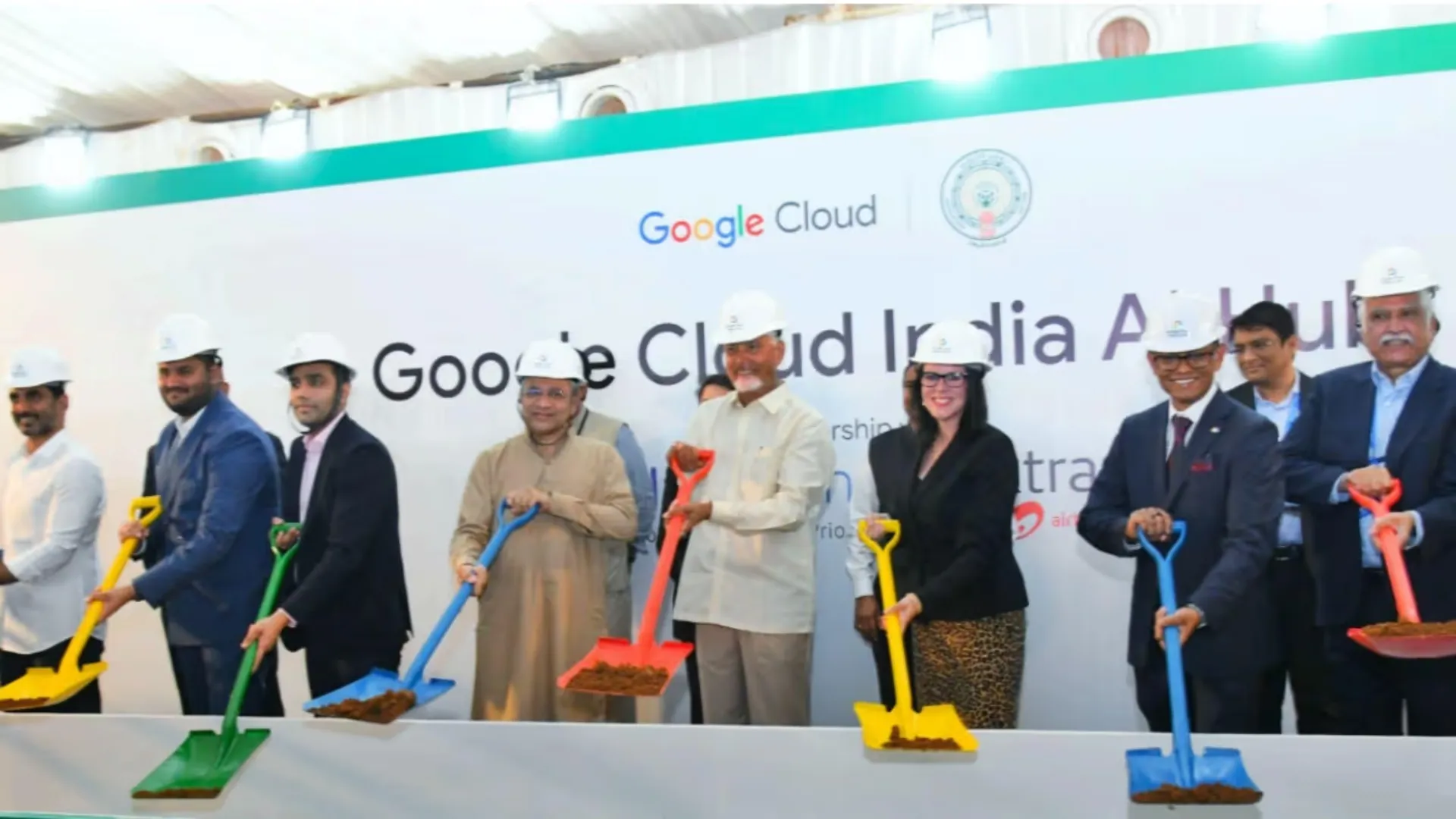
Visakhapatnam: Google has officially begun construction of its landmark India AI Hub in Visakhapatnam, launching what is set to become one of the largest technology infrastructure investments in the country’s history. The project, valued at $15 billion over five years from 2026 to 2030, is expected to strengthen India’s ambitions to become a global center for artificial intelligence, cloud computing and next generation digital services.
The groundbreaking ceremony in Andhra Pradesh brought together senior leaders from government and industry, including Union Minister Ashwini Vaishnaw, Andhra Pradesh Chief Minister N Chandrababu Naidu, state minister Nara Lokesh, executives from Google Cloud, Adani Group and Bharti Airtel. The scale of participation reflected how strategically important the project is for India’s long term technology roadmap.
India’s first gigawatt scale AI hub takes shape
At the center of the initiative is India’s first gigawatt scale AI hub, planned as a three campus data center ecosystem in Visakhapatnam. The facility is designed to provide high performance computing capacity for AI workloads, cloud services, enterprise applications and digital platforms that require low latency and large scale processing power.
Google said the campuses will help Indian businesses, startups, research institutions and public sector organizations build and deploy AI powered solutions faster and at scale. The infrastructure is also expected to support rising demand for generative AI tools, enterprise automation and secure cloud storage across sectors.
AdaniConnex and Nxtra by Airtel will lead construction of data center buildings and connectivity systems, helping deliver a large scale foundation for Google’s India expansion.
Why Visakhapatnam was chosen
Visakhapatnam has increasingly emerged as one of India’s most promising technology and logistics cities. With access to ports, land availability, industrial connectivity and a growing talent pool, the coastal city offers strategic advantages for a project of this size.
The plan also includes three subsea cable landings in Visakhapatnam, which could significantly improve international data connectivity between India and global markets. Better subsea connectivity can reduce latency, improve reliability and support faster movement of data for cloud and AI services.
Industry observers believe the project could transform Visakhapatnam into one of Asia’s key digital infrastructure destinations over the next decade.
Strong backing from Centre and state governments
Union Minister Ashwini Vaishnaw said the project aligns with Prime Minister Narendra Modi’s vision of making India a global technology leader. He noted that the AI hub and cable infrastructure would become important assets for India’s growth journey.
Chief Minister Chandrababu Naidu described Andhra Pradesh as an emerging investment destination built on speed, trust and ease of doing business. He said Google’s investment would strengthen the state’s technology corridor, create opportunities for youth and help local enterprises participate in the digital economy.
The public endorsement from both central and state leadership highlights growing policy support for AI manufacturing, cloud infrastructure and advanced computing ecosystems in India.
Google sees an inflection point for India’s AI future
Google Cloud CEO Thomas Kurian called the groundbreaking a major milestone for India’s AI native future. According to Google, the investment is not only about servers and data centers, but about building the foundation for innovation, economic expansion and new digital capabilities across the country.
The company has been increasing its India presence across payments, cloud services, Android, search, digital skilling and developer ecosystems. This AI Hub now becomes one of its most ambitious infrastructure commitments in the market.
Jobs, skills and local economic impact
Beyond technology infrastructure, the project includes large scale community and workforce programs aimed at creating long term local benefits.
Google announced that more than 1,000 people are expected to receive training through the Skills Trade and Readiness program in areas such as construction, welding and facility operations. These skills are directly linked to the needs of modern data center development and maintenance.
In parallel, Google is partnering with ICT Academy to train over 1,200 students and educators in cloud computing and generative AI. This could help create a pipeline of local talent ready for future technology jobs.
For many young people in Andhra Pradesh, the project could open new pathways into high value employment without needing to relocate to traditional tech hubs.
Women entrepreneurship and grassroots development
The company also unveiled the NARI Shakti initiative in partnership with Learning Links Foundation. The program aims to support more than 10,000 women from lower income backgrounds through training in digital tools, business planning and financial literacy.
Google said the goal is to help participants turn home based work into sustainable micro enterprises and long term livelihoods.
Through ChangeX, the company is also launching grants for schools and social enterprises in the Visakhapatnam region. These grants will support AI skilling labs, entrepreneurship programs, digital literacy efforts and climate related community projects.
Focus on water, fisheries and sustainability
Large data center projects often face scrutiny over environmental impact, especially water and energy usage. Google addressed those concerns by announcing a water stewardship program with Sponge Collaborative.
The plan includes watershed management, drinking water systems, reverse osmosis plants and community water access programs. The company said it wants growth in infrastructure to be matched by investment in resource resilience.
Google is also working with Sambhav Foundation to support more than 1,000 people from fishing communities through GPS navigation tools, weather forecasting access, cold chain training and financial inclusion initiatives linked to UPI and welfare schemes.
These efforts suggest the company is attempting to integrate local communities into the benefits of industrial growth rather than limiting gains to urban corporate sectors.
Clean energy at the core
Google said the AI Hub includes a long term clean energy strategy that supports India’s national target of reaching 500 GW of non fossil fuel capacity by 2030.
This is significant because AI data centers require enormous electricity capacity. Linking future growth with renewable and cleaner power sources could become essential for India if it wants to scale AI infrastructure without increasing environmental stress.
Executives from Adani Group and Bharti Airtel also highlighted the importance of green power, fiber networks and next generation connectivity for making India globally competitive in AI infrastructure.
Bharat AI Shakti Conclave aims to build wider ecosystem
Alongside the groundbreaking ceremony, stakeholders gathered for the Bharat AI Shakti Conclave, a conference focused on translating Google’s anchor investment into a broader industrial ecosystem.
The event explored how local suppliers, SMEs, contractors and infrastructure partners can be integrated into the project through procurement, safety standards and long term capability building.
That approach matters because mega projects often create the most value when surrounding industries also grow alongside them.
Why this matters for India
The Google India AI Hub arrives at a moment when nations are competing for leadership in semiconductors, cloud capacity, AI talent and digital sovereignty. Countries that control computing infrastructure may gain an edge in innovation, productivity and economic influence.
For India, the Visakhapatnam project could become more than a regional investment. It may signal that global technology companies increasingly see India not just as a consumer market, but as a core builder of the world’s next digital systems.
If execution matches ambition, the project could reshape eastern India’s economy, deepen India’s cloud ecosystem and create a template for future AI corridors across the country.
With shovels now in the ground, India’s race to become an AI infrastructure powerhouse has entered a new phase.
Edit Profile
Help improve @KR

Was this page helpful to you?
Contact Khogendra Rupini
Are you looking for an experienced developer to bring your website to life, tackle technical challenges, fix bugs, or enhance functionality? Look no further.
I specialize in building professional, high-performing, and user-friendly websites designed to meet your unique needs. Whether it's creating custom JavaScript components, solving complex JS problems, or designing responsive layouts that look stunning on both small screens and desktops, I can collaborate with you.
Create something exceptional with us. Contact us today
Open for Collaboration
If you're looking to collaborate, I'm available for a variety of professional services, including -
- Website Design & Development
- Advertisement & Promotion Setup
- Hosting Configuration & Deployment
- Front-end & Back-end Code Implementation
- Code Testing & Optimization
- Cybersecurity Solutions & Threat Prevention
- Website Scanning & Malware Removal
- Hacked Website Recovery
- PHP & MySQL Development
- Python Programming
- Web Content Writing
- Protection Against Hacking Attempts