
Billionaires become robot dogs in Berlin museum as Beeple turns Musk, Bezos and Zuckerberg into AI art spectacle
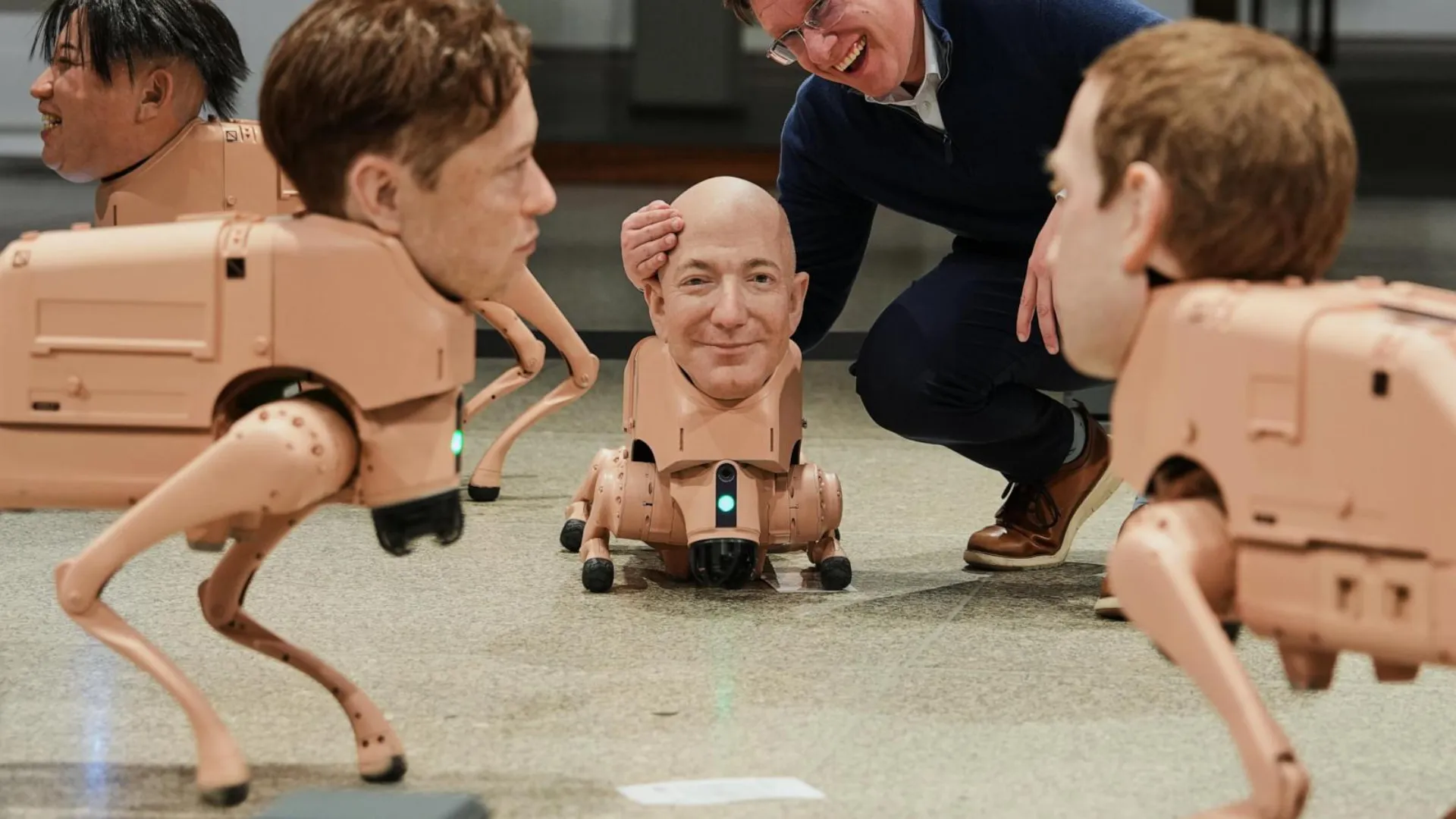
Visitors entering Berlin’s Neue Nationalgalerie are being met by an unusual sight: robotic dogs carrying hyper realistic silicone faces modeled after Elon Musk, Jeff Bezos and Mark Zuckerberg. The machines roam through the gallery, scan their surroundings, and generate printed AI styled images in real time.
The installation, titled Regular Animals, is the latest work from American digital artist Mike Winkelmann, better known globally as Beeple. The exhibition blends robotics, artificial intelligence, celebrity symbolism and social commentary into one of the most talked about museum displays in Europe this week.
Inside the Berlin exhibition drawing global attention
The robotic dogs are built on quadruped style platforms similar to advanced research robots. Each machine moves independently through the gallery space using embedded cameras and sensors. As visitors watch, the robots capture images of people, walls, movement and nearby objects.
Those visuals are then processed through generative AI systems that reinterpret the scenes before instantly printing them. Instead of delivering plain photographs, the output changes depending on the identity represented by each robot dog.
Some units are designed around historic artists rather than billionaires. A dog inspired by Pablo Picasso creates Cubist style imagery, while another modeled after Andy Warhol produces bright pop art inspired visuals.
The billionaire faced dogs, however, carry a different meaning. Rather than representing art movements, they symbolize data filtering, platform control and the invisible systems that increasingly shape what billions of people see online.
Why Beeple used Musk, Bezos and Zuckerberg
Beeple’s choice of tech leaders is deliberate. Elon Musk owns the social platform X, Mark Zuckerberg leads platforms including Facebook and Instagram, and Jeff Bezos built one of the world’s most powerful digital ecosystems.
Together, these figures represent the concentration of influence inside modern technology. Their companies affect communication, shopping, cloud computing, advertising, public conversation and access to information at a global scale.
By transforming them into robotic dogs that wander, watch and generate new interpretations of reality, Beeple appears to ask a direct question: who now shapes public perception more strongly, artists or algorithms?
The message about algorithms and modern life
The core idea behind Regular Animals is not simply shock value or humor. It is a critique of how recommendation systems, ranking models and automated feeds influence what people read, watch and believe.
In earlier generations, newspapers, broadcasters and artists often guided public narratives. Today, invisible digital systems decide what trends, what gets recommended and what disappears from attention.
A slight change in an algorithm can affect political debate, cultural trends, business success or the spread of misinformation. Unlike traditional institutions, those changes can happen instantly and often without public visibility.
By giving those systems a physical body inside a museum, Beeple turns something abstract into something visible. Visitors are no longer looking at hidden code. They are watching it move across the floor.
Why the strange design matters
Many viewers have focused on the bizarre appearance of the robots. That reaction is part of the artwork itself.
The combination of lifelike human faces and machine bodies creates discomfort. It blurs the line between authority and automation, between personality and programming. The billionaire faces are recognizable, but the bodies are mechanical and impersonal.
That contrast mirrors modern digital life, where decisions that feel personal are often guided by automated systems behind the scenes.
The exaggerated format also forces attention. In daily life, people scroll through algorithmically selected content without thinking much about how it arrived there. Inside the museum, the process becomes impossible to ignore.
Beeple’s rise from internet artist to global name
Beeple became one of the most recognized names in digital art after his landmark 2021 sale of Everydays: The First 5000 Days, which sold for more than $69 million at Christie's.
That sale marked a turning point for NFTs and digitally native art, pushing blockchain authenticated works into mainstream headlines.
Since then, Beeple has continued exploring themes around politics, technology, media power and internet culture. Regular Animals shows an expansion of that practice from static digital images into live interactive systems.
Instead of placing a screen on a wall, Beeple has created machines that move, observe and respond.
AI, blockchain and the merging of worlds
Some printed outputs from the exhibition reportedly include QR codes linked to blockchain backed assets. That means the artwork exists both physically and digitally.
Visitors can see the robot in the museum, collect printed material in the gallery and potentially connect those works to online ownership systems.
This dual presence reflects a wider shift in culture. Experiences increasingly begin in physical spaces and continue online, or begin online and influence the physical world.
The exhibition captures that tension clearly. The robots exist in front of the audience, but their meaning extends into networks, data systems and digital economies.
Why museums are hosting technology debates
Major museums are increasingly becoming spaces for public reflection on artificial intelligence, privacy, machine creativity and digital power.
Rather than treating AI only as a business story, institutions like Neue Nationalgalerie are presenting it as a cultural and social issue.
That shift matters because AI is no longer confined to labs or corporate offices. It influences hiring, entertainment, education, search results, communication and creative industries.
By presenting these questions through art, museums allow visitors to engage emotionally as well as intellectually.
What visitors are left thinking about
The Berlin exhibition does not offer easy answers. Instead, it leaves audiences with a series of difficult questions.
How much of modern reality is selected by algorithms before people ever see it?
Who controls those systems?
Can technology amplify creativity without reducing human agency?
And when machines increasingly interpret the world for us, where does human judgment stand?
That is why Regular Animals is attracting global attention. It is visually absurd, instantly shareable and deeply relevant to the AI era.
Final word
Beeple’s billionaire robot dogs may look playful at first glance, but the message underneath is serious. In a world shaped by feeds, rankings and recommendation engines, power often operates quietly.
By putting famous faces on machines and letting them roam through a museum, the artist has created a memorable symbol of the digital age: technology that watches, decides and influences, often in ways people barely notice.
Edit Profile
Help improve @KR
Was this page helpful to you?
Contact Khogendra Rupini
Are you looking for an experienced developer to bring your website to life, tackle technical challenges, fix bugs, or enhance functionality? Look no further.
I specialize in building professional, high-performing, and user-friendly websites designed to meet your unique needs. Whether it's creating custom JavaScript components, solving complex JS problems, or designing responsive layouts that look stunning on both small screens and desktops, I can collaborate with you.
Create something exceptional with us. Contact us today
Open for Collaboration
If you're looking to collaborate, I'm available for a variety of professional services, including -
- Website Design & Development
- Advertisement & Promotion Setup
- Hosting Configuration & Deployment
- Front-end & Back-end Code Implementation
- Code Testing & Optimization
- Cybersecurity Solutions & Threat Prevention
- Website Scanning & Malware Removal
- Hacked Website Recovery
- PHP & MySQL Development
- Python Programming
- Web Content Writing
- Protection Against Hacking Attempts