
Elon Musk Faces Intense Scrutiny in OpenAI Trial as Judge Weighs Nonprofit Mission Against AI Industry Stakes
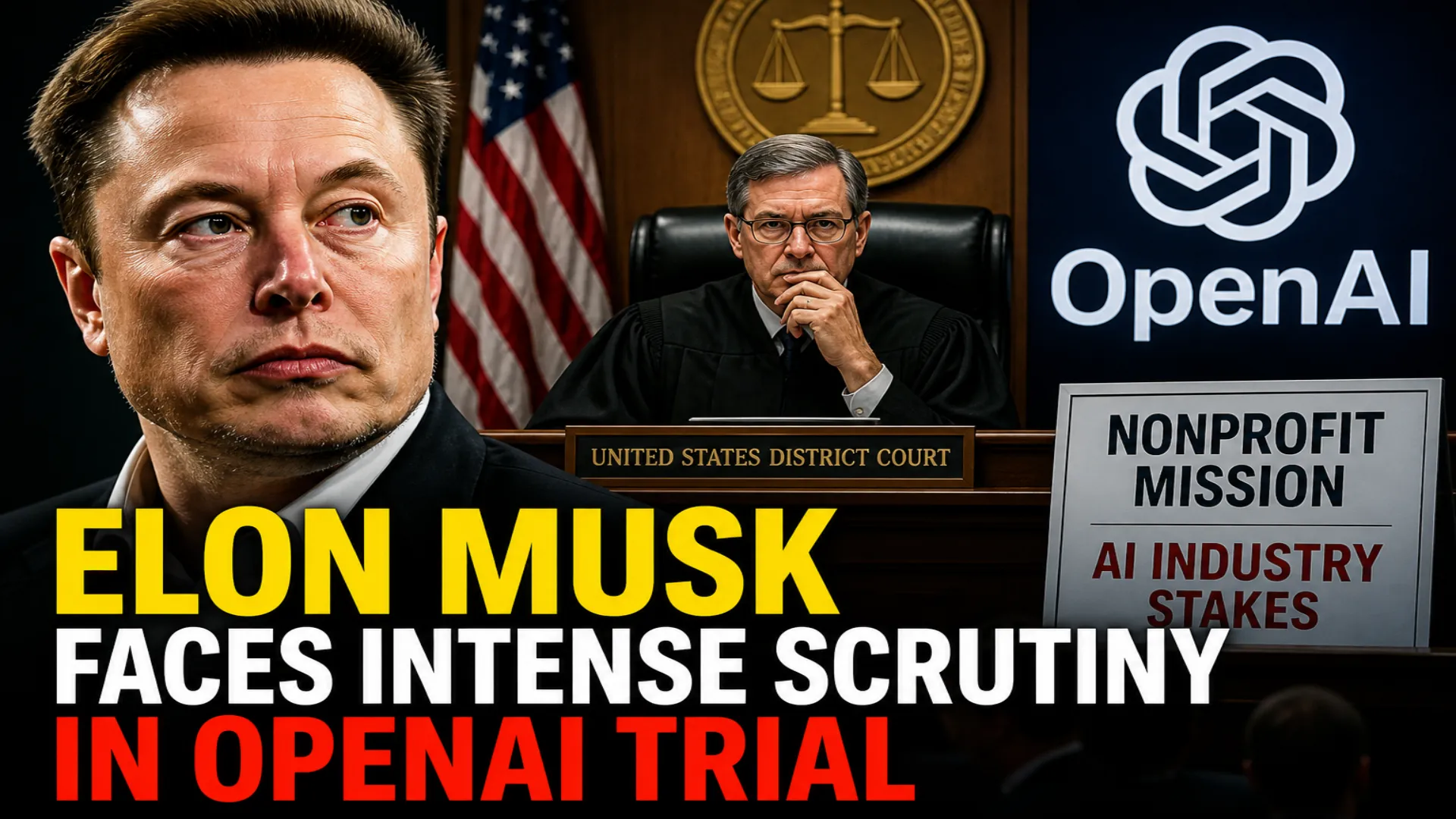
A high-stakes courtroom battle over the future of artificial intelligence took a sharper turn this week as faced sustained questioning in a U.S. federal trial examining whether abandoned its founding nonprofit principles. The proceedings, overseen by Judge , have drawn attention not only for their legal implications but also for what they may signal about the governance and commercialization of advanced AI systems.
Courtroom Tensions Expose Core Dispute
Musk’s third day on the witness stand unfolded with visible friction between the billionaire entrepreneur and OpenAI’s legal team. At the center of the exchange was a fundamental contradiction: Musk, who has built multiple for-profit ventures in the technology sector, is challenging OpenAI’s transition into a commercially driven entity.
During questioning by OpenAI’s attorney, Musk appeared frustrated, at times pushing back on the structure of the interrogation itself. His responses prompted repeated interventions from Judge Gonzalez Rogers, who pressed him to provide direct answers rather than challenge the form of the questions.
The judge’s involvement underscored the complexity of the case, which is not merely a contractual dispute but a broader examination of whether a pioneering AI organization deviated from its original public-interest mission.
Origins of the Conflict
The dispute traces back to OpenAI’s early years, when Musk played a financial and strategic role in supporting the organization. Between 2015 and 2017, he contributed approximately $38 million to help launch the initiative, which was initially positioned as a nonprofit dedicated to ensuring that artificial intelligence benefits humanity as a whole.
Musk now contends that OpenAI’s leadership—particularly CEO and co-founder —shifted the organization away from that founding vision. According to his argument, the company’s transformation into a high-value commercial enterprise represents a departure from its original purpose.
The stakes are substantial. OpenAI is currently valued at more than $850 billion and is considered one of the leading forces in the global AI race, alongside competitors such as Anthropic and Google. The company’s trajectory toward potential public listing has further intensified scrutiny over its structure and governance.
Legal Strategy and Counterarguments
OpenAI’s defense has sought to challenge Musk’s position by highlighting his own business practices. The company’s attorney argued that Musk’s portfolio—including ventures such as , , , and his AI-focused firm —operates within a for-profit framework while claiming to serve broader societal goals.
This line of questioning aimed to draw a parallel between Musk’s criticism of OpenAI and his own approach to building technology companies. The implication was clear: if profit-oriented structures can coexist with public benefit in Musk’s ventures, the same could apply to OpenAI.
Musk did not dispute the legitimacy of for-profit organizations. Instead, he framed his argument around the organization’s origin. According to his testimony, the issue is not the existence of a commercial model but the transition from a nonprofit foundation into a profit-driven entity.
“You just can’t steal a charity,” he said, emphasizing that OpenAI should have been established as a conventional company from the outset if that was its intended direction.
Judicial Oversight and Courtroom Dynamics
Judge Gonzalez Rogers has played a central role in maintaining the focus of the proceedings. Her interventions during Musk’s testimony highlighted the challenges of navigating a case that blends legal, ethical, and technological dimensions.
At one point, she remarked on the apparent contradiction between Musk’s warnings about the risks of artificial intelligence and his involvement in developing competing AI technologies. The observation reflected a broader tension that has come to define the case: the coexistence of cautionary rhetoric and aggressive innovation within the industry.
Musk himself acknowledged the limits of his legal expertise during the exchange, responding to the judge’s remarks with a brief moment of levity. While the comment drew laughter in the courtroom, it also reinforced the unusual nature of the proceedings, where one of the world’s most influential technology figures is navigating a highly technical legal challenge.
The Broader Context of AI Development
The trial arrives at a pivotal moment for the artificial intelligence sector. Companies are racing to develop increasingly powerful systems, with applications ranging from consumer tools to enterprise solutions. At the same time, concerns about safety, governance, and long-term societal impact have intensified.
Musk’s testimony touched on these concerns, albeit briefly. In a remark that drew attention, he referenced a worst-case scenario in which artificial intelligence could pose an existential threat. While the comment was delivered with a degree of humor, it echoed longstanding debates within the field about the potential risks associated with advanced AI systems.
Judge Gonzalez Rogers had previously indicated a preference to avoid such digressions, emphasizing the need to keep the proceedings grounded in the legal questions at hand. Nonetheless, the exchange highlighted how discussions of AI’s future often blur the line between technical analysis and speculative risk.
Implications for Industry Governance
At its core, the case raises fundamental questions about how artificial intelligence should be governed. If the court determines that OpenAI violated its nonprofit commitments, the decision could have far-reaching consequences for the organization and the broader industry.
A ruling in Musk’s favor could force OpenAI to reconsider its corporate structure, potentially reshaping its approach to funding, development, and commercialization. It could also set a precedent for how similar organizations navigate the transition from nonprofit initiatives to profit-driven enterprises.
Conversely, if the court sides with OpenAI, the decision may reinforce the legitimacy of hybrid or evolving organizational models in the technology sector. Such an outcome could provide greater flexibility for companies seeking to balance public-interest goals with the demands of scaling complex technologies.
Personal and Professional Rivalries
Beyond the legal and technical dimensions, the trial also reflects a deeply personal rivalry. Musk and Altman, once collaborators, now find themselves on opposing sides of a high-profile dispute. Their relationship, which began during OpenAI’s formative years, has since evolved into a contentious dynamic shaped by differing visions for the future of AI.
Altman was present in the courtroom during Musk’s testimony, observing the proceedings before departing shortly after the session concluded. His own testimony is expected in the coming weeks, followed by that of Brockman.
These upcoming appearances are likely to provide further insight into the internal decisions that shaped OpenAI’s evolution, as well as the perspectives of its current leadership.
The Role of Financial Scale
The scale of OpenAI’s current valuation has added another layer of complexity to the case. With an estimated worth exceeding $850 billion, the organization has become a central player in the global technology landscape.
This financial dimension underscores the broader stakes of the trial. The outcome will not only affect the parties involved but could also influence investor confidence, regulatory approaches, and the competitive dynamics of the AI industry.
Musk’s argument that OpenAI’s transformation represents a deviation from its original mission is, in part, a response to this rapid growth. The transition from a nonprofit initiative to a highly valued commercial entity raises questions about accountability, transparency, and the alignment of incentives.
Ongoing Proceedings and Next Steps
Musk’s testimony concluded after three days, though he may be recalled before the trial reaches its midpoint later in May. The court is expected to hear from additional witnesses, including OpenAI’s leadership, before moving toward a decision.
Judge Gonzalez Rogers is anticipated to issue a ruling on the merits of the case in mid-May. The decision will likely address not only the specific claims raised by Musk but also the broader legal framework governing nonprofit organizations and their evolution.
A Defining Moment for Artificial Intelligence
As the trial continues, it has become clear that the case represents more than a dispute between individuals or organizations. It is a reflection of the challenges facing an industry that is advancing at unprecedented speed.
Artificial intelligence has already begun to reshape economies, industries, and daily life. The question of who controls its development—and under what principles—remains one of the most pressing issues of the modern era.
The outcome of this case may not resolve all of those questions, but it will provide a significant marker in the ongoing effort to define the boundaries of innovation, responsibility, and profit in the age of AI.
Frequently Asked Questions
What is the central issue in the Elon Musk vs OpenAI trial?
The case focuses on whether OpenAI abandoned its original nonprofit mission by transitioning into a highly valued commercial company.
Why is Elon Musk challenging OpenAI in court?
Musk argues that OpenAI was founded as a nonprofit and later shifted to a for-profit model, which he claims violates its original purpose.
What role did Elon Musk play in OpenAI’s early development?
Musk was an early supporter and contributed about $38 million between 2015 and 2017 to help establish the organization.
How did the judge respond during Musk’s testimony?
U.S. federal Judge Yvonne Gonzalez Rogers intervened multiple times, urging Musk to directly answer questions and maintain focus during the proceedings.
What argument did OpenAI’s legal team present against Musk?
OpenAI’s lawyers argued that Musk himself runs for-profit companies and questioned why he criticizes OpenAI for operating under a similar model.
What is Elon Musk’s main defense regarding for-profit organizations?
Musk stated that there is nothing wrong with for-profit companies, but emphasized that OpenAI should not have transitioned from a nonprofit structure.
Who are the key figures involved in OpenAI’s leadership mentioned in the case?
CEO Sam Altman and co-founder Greg Brockman are central figures, with Musk accusing them of changing the organization’s original mission.
Why is this trial significant for the AI industry?
The outcome could influence how AI companies are structured and governed, especially regarding the balance between public benefit and commercial interests.
What is OpenAI’s current market position according to the case?
OpenAI is valued at over $850 billion and is considered a leading player in the global artificial intelligence industry.
What could happen if the court rules in Musk’s favor?
OpenAI could be required to reconsider or revert its corporate structure, potentially affecting its operations and future growth strategy.
What is expected to happen next in the trial?
Testimony from OpenAI executives, including Sam Altman and Greg Brockman, is expected before a ruling is anticipated in mid-May.
How does this case reflect broader concerns about artificial intelligence?
The trial highlights ongoing debates about AI ethics, control, and the risks of prioritizing profit over public interest in advanced technologies.
Edit Profile
Help improve @KR

Was this page helpful to you?
Contact Khogendra Rupini
Are you looking for an experienced developer to bring your website to life, tackle technical challenges, fix bugs, or enhance functionality? Look no further.
I specialize in building professional, high-performing, and user-friendly websites designed to meet your unique needs. Whether it's creating custom JavaScript components, solving complex JS problems, or designing responsive layouts that look stunning on both small screens and desktops, I can collaborate with you.
Create something exceptional with us. Contact us today
Open for Collaboration
If you're looking to collaborate, I'm available for a variety of professional services, including -
- Website Design & Development
- Advertisement & Promotion Setup
- Hosting Configuration & Deployment
- Front-end & Back-end Code Implementation
- Code Testing & Optimization
- Cybersecurity Solutions & Threat Prevention
- Website Scanning & Malware Removal
- Hacked Website Recovery
- PHP & MySQL Development
- Python Programming
- Web Content Writing
- Protection Against Hacking Attempts