OpenAI co founder Greg Brockman reveals $30 billion stake as financial ties with Sam Altman surface in Elon Musk lawsuit trial
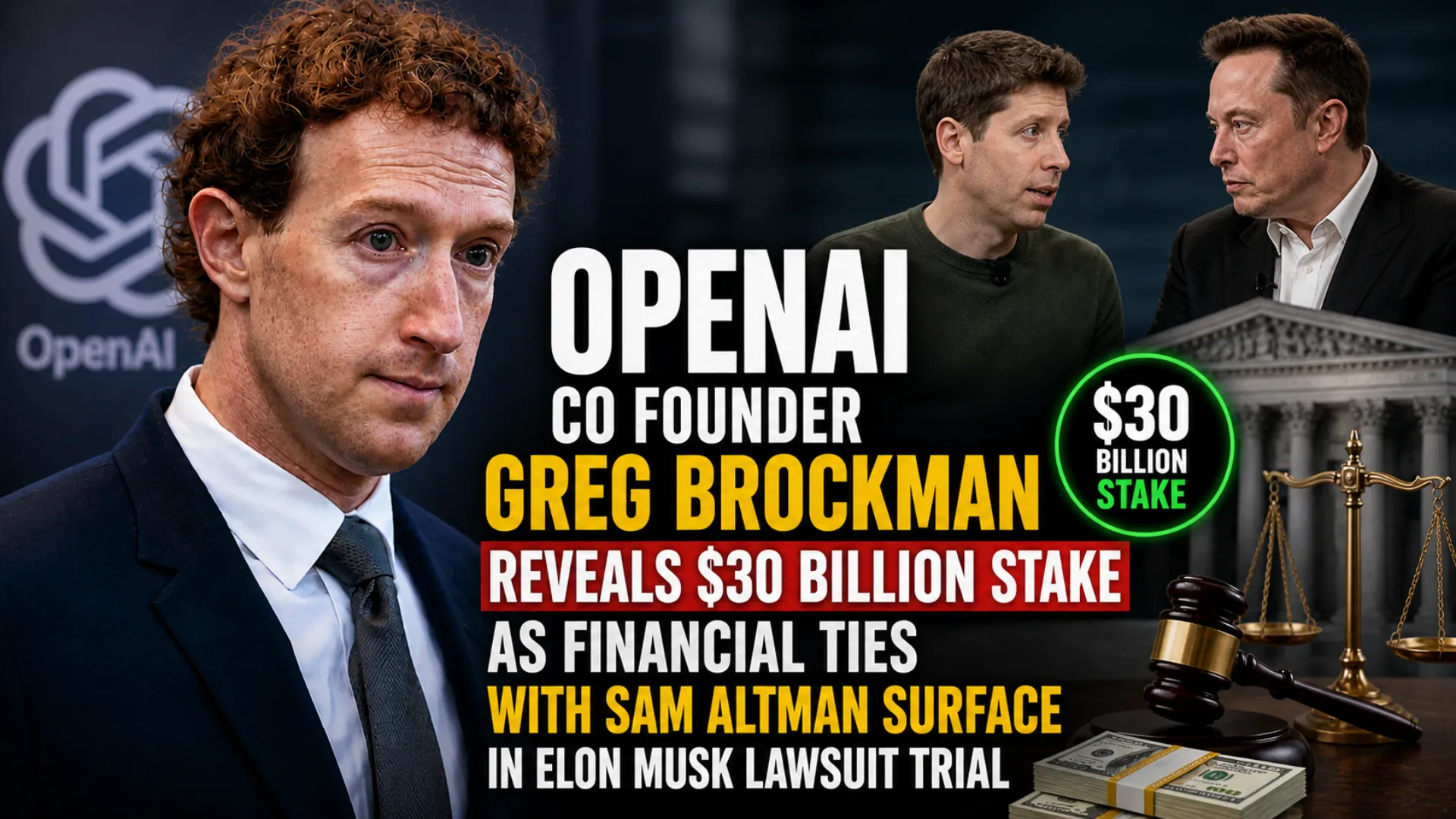
In a high stakes legal battle unfolding in California, , co founder and president of , disclosed in court that his personal stake in the company is valued at nearly 30 billion dollars. The revelation has added a new dimension to the ongoing lawsuit brought by , who is challenging the company’s transition from its original nonprofit mission to a profit driven structure.
The testimony also brought to light previously undisclosed financial connections between Brockman and OpenAI Chief Executive Officer , raising questions about governance, influence, and potential conflicts of interest at one of the world’s most influential artificial intelligence companies.
A landmark disclosure that reshapes the narrative
Brockman’s statement that his equity in OpenAI is worth close to 30 billion dollars places him among the wealthiest individuals globally, highlighting the extraordinary financial growth of the company since the launch of ChatGPT in 2022. This valuation underscores how rapidly OpenAI has evolved from a research focused nonprofit initiative into a central force in the global AI economy.
The disclosure was made under questioning by Musk’s legal team, which has been attempting to establish whether financial incentives and personal relationships influenced the company’s strategic direction. Brockman confirmed that he holds significant equity in OpenAI and acknowledged financial ties to Altman that extend beyond their professional roles within the organization.
These details are likely to play a crucial role in shaping the court’s understanding of OpenAI’s internal dynamics and whether its leadership acted in alignment with its founding principles.
Financial ties between leadership come under scrutiny
Central to the courtroom discussion were Brockman’s financial links with Altman. Evidence presented in court included references to investments in startups backed by Altman and Brockman’s involvement in Altman’s family investment fund.
According to court documents, emails dating back to 2017 indicated that Altman had granted Brockman a stake in his family office, valued at around 10 million dollars at the time. The correspondence also included internal concerns raised by Musk’s aide Jared Birchall, who suggested that such arrangements could influence Brockman’s alignment with Altman’s decisions.
Musk himself reportedly forwarded the message to Brockman seeking clarification. When questioned directly in court about whether these financial ties affected his loyalty, Brockman declined to characterize the relationship in those terms, maintaining a neutral stance.
The issue of overlapping financial interests has become a focal point in the trial, as Musk’s legal team seeks to demonstrate that personal financial relationships may have played a role in shaping corporate decisions.
Investments linked to OpenAI operations raise further questions
Beyond personal financial ties, Brockman also disclosed investments in companies that intersect with OpenAI’s operational interests. Among these was his stake in AI chip startup Cerebras, a company whose technology has been considered by OpenAI for its computing needs.
This revelation is particularly significant given OpenAI’s plans to invest heavily in AI infrastructure and hardware. The overlap between Brockman’s personal investments and the company’s procurement considerations has prompted further scrutiny over potential conflicts of interest.
Additionally, Brockman confirmed holding a stake in Helion Energy, a fusion energy company that has received substantial investment from Altman. The connection deepened when it emerged that Altman stepped down from Helion’s board in March, coinciding with discussions between the two companies regarding potential collaboration.
These interconnected financial relationships highlight the increasingly complex ecosystem in which major AI companies operate, where leadership roles, investments, and strategic partnerships often intersect.
Elon Musk’s allegations against OpenAI leadership
At the heart of the case is Musk’s claim that OpenAI has deviated from its founding mission. As a co founder of the organization, Musk argues that the company was originally established as a nonprofit entity focused on ensuring that artificial intelligence benefits humanity as a whole.
The lawsuit alleges that Altman and Brockman redirected OpenAI toward a profit oriented model, leveraging early donations and support to build a highly valuable commercial enterprise. Musk is seeking significant remedies, including the removal of key leaders and damages estimated at 150 billion dollars.
Musk’s argument reflects a broader debate within the technology sector about the balance between innovation, profitability, and ethical responsibility. His legal challenge is not merely about corporate governance but also about the philosophical direction of one of the most powerful AI organizations in the world.
OpenAI’s response and counterclaims
OpenAI has strongly rejected Musk’s allegations, presenting a different narrative of events. The company maintains that Musk’s lawsuit is driven by dissatisfaction following his departure from OpenAI’s board in 2018.
According to OpenAI, Musk’s actions are influenced by competitive interests, particularly his involvement in other AI ventures. The company has suggested that the lawsuit may be an attempt to strengthen his position in the rapidly evolving AI landscape.
OpenAI has also pushed back against claims regarding safety priorities, stating that Musk did not emphasize safety concerns during his time with the organization. This counterargument seeks to challenge Musk’s credibility as a defender of OpenAI’s original mission.
A trial with far reaching implications
Now in its second week, the trial is expected to continue for an extended period, given the complexity of the issues involved and the high stakes for all parties. Legal experts suggest that the outcome could have significant implications not only for OpenAI but also for the broader AI industry.
The case raises fundamental questions about how AI companies should be structured and governed, especially as they grow in scale and influence. It also highlights the challenges of maintaining original missions in the face of rapid technological advancement and commercial opportunity.
OpenAI’s transformation since the release of ChatGPT has been remarkable. The company has secured more than 100 billion dollars in funding and is widely seen as a contender for a trillion dollar valuation in the future. This rapid growth has intensified scrutiny over its governance and strategic decisions.
The broader context of AI power and responsibility
The trial comes at a time when artificial intelligence is reshaping industries, economies, and societies. As one of the leading players in this space, OpenAI’s decisions carry significant weight.
The intersection of massive financial stakes, influential leadership, and transformative technology has created a situation where legal disputes are no longer confined to corporate matters but extend into global conversations about ethics, accountability, and the future of innovation.
Brockman’s testimony, particularly the disclosure of his 30 billion dollar stake and his financial ties to Altman, has brought these issues into sharp focus. It underscores the reality that the leaders of major AI companies are not only shaping technology but also navigating complex financial and ethical landscapes.
What lies ahead for OpenAI
As the trial progresses, attention will remain firmly fixed on how the court interprets the evidence and arguments presented by both sides. The outcome could determine whether OpenAI continues operating under its current structure or faces significant changes in leadership and governance.
For now, the case serves as a reminder of the delicate balance between innovation and accountability. It also reflects the growing importance of transparency in organizations that wield immense technological and economic power.
In many ways, this trial represents a defining moment not just for OpenAI but for the entire artificial intelligence industry. The decisions made in this courtroom could influence how future AI companies are built, funded, and governed for years to come.
Frequently Asked Questions
What did Greg Brockman disclose during the OpenAI trial?
Greg Brockman revealed that his equity stake in OpenAI is worth nearly $30 billion and confirmed financial ties with CEO Sam Altman during testimony in a California court.
Why is Elon Musk suing OpenAI?
Elon Musk alleges that OpenAI has moved away from its original nonprofit mission and transformed into a profit driven company, which he claims violates its founding purpose.
What financial links between Greg Brockman and Sam Altman were revealed?
Brockman acknowledged investments in startups backed by Sam Altman and confirmed he holds a stake in Altman’s family investment fund, originally valued at around $10 million.
How could Brockman’s investments raise conflict of interest concerns?
Brockman disclosed stakes in companies like Cerebras and Helion Energy, which have links to OpenAI’s operations or partnerships, raising questions about overlapping financial interests.
What is Elon Musk seeking through this lawsuit?
Musk is seeking the removal of OpenAI’s leadership and damages estimated at $150 billion, arguing that the company deviated from its original mission.
How has OpenAI responded to Musk’s allegations?
OpenAI has denied the claims, stating that Musk’s lawsuit is driven by dissatisfaction after leaving the board and may be linked to his competing AI ventures.
Why is this trial significant for the AI industry?
The case could influence how major AI companies are structured and governed, especially regarding the balance between nonprofit missions and commercial growth.
What role did past communications play in the trial?
Emails from 2017 showed that Sam Altman granted Brockman a stake in his family office, and internal messages raised concerns about potential influence on decision making.
How valuable is OpenAI today based on recent developments?
OpenAI has secured over $100 billion in funding and is considered a potential trillion dollar company, reflecting its rapid growth since launching ChatGPT.
What could be the outcome of the OpenAI trial?
The trial could lead to changes in OpenAI’s leadership or governance structure, depending on how the court rules on Musk’s claims.
Edit Profile
Help improve @KR

Was this page helpful to you?
Contact Khogendra Rupini
Are you looking for an experienced developer to bring your website to life, tackle technical challenges, fix bugs, or enhance functionality? Look no further.
I specialize in building professional, high-performing, and user-friendly websites designed to meet your unique needs. Whether it's creating custom JavaScript components, solving complex JS problems, or designing responsive layouts that look stunning on both small screens and desktops, I can collaborate with you.
Create something exceptional with us. Contact us today
Open for Collaboration
If you're looking to collaborate, I'm available for a variety of professional services, including -
- Website Design & Development
- Advertisement & Promotion Setup
- Hosting Configuration & Deployment
- Front-end & Back-end Code Implementation
- Code Testing & Optimization
- Cybersecurity Solutions & Threat Prevention
- Website Scanning & Malware Removal
- Hacked Website Recovery
- PHP & MySQL Development
- Python Programming
- Web Content Writing
- Protection Against Hacking Attempts