OpenAI rolls out GPT 5.5 Instant as ChatGPT’s new default model with focus on speed, accuracy and lower AI hallucinations
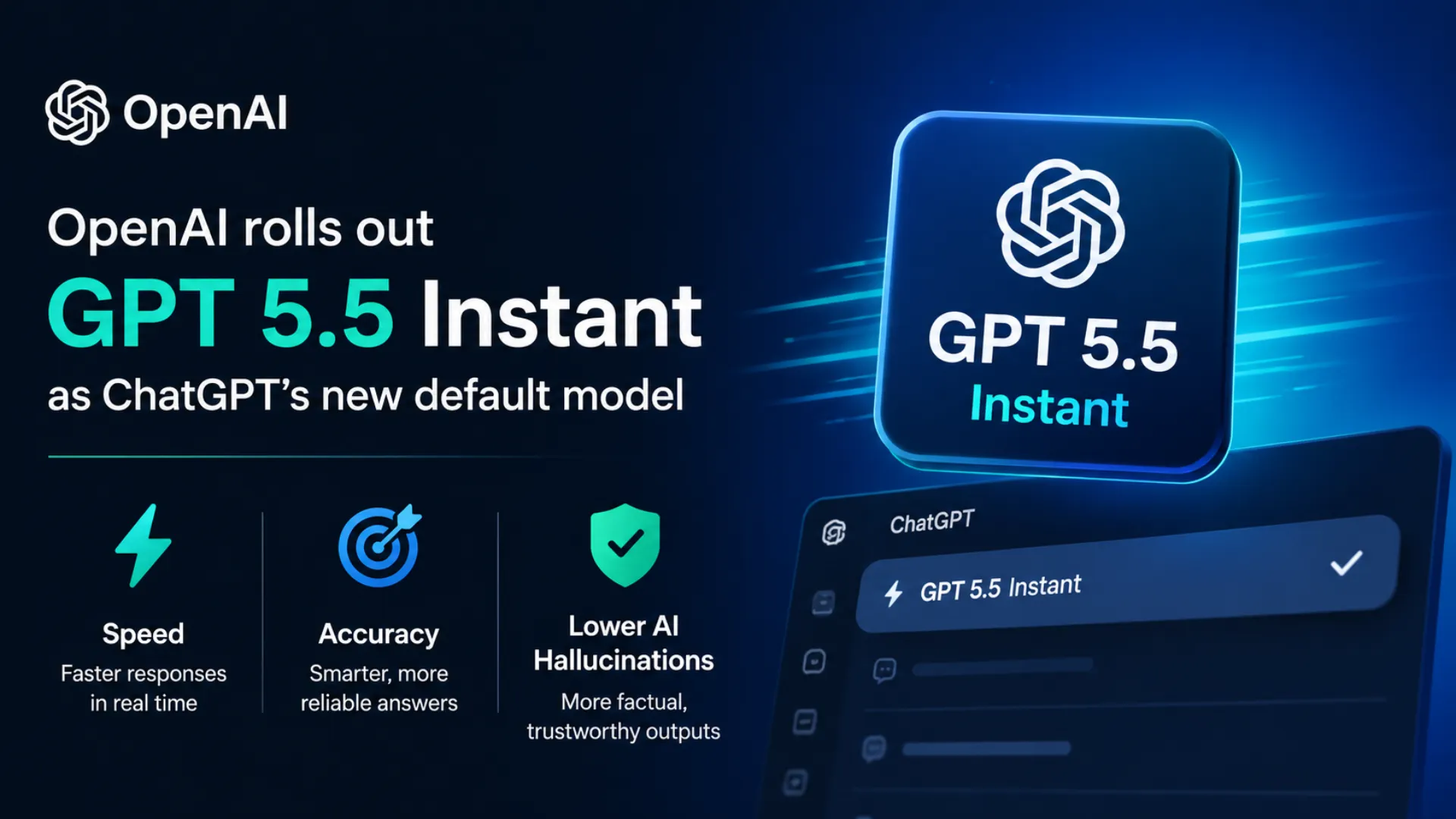
OpenAI has officially introduced GPT 5.5 Instant as the new default model powering ChatGPT, replacing GPT 5.3 Instant in what appears to be one of the company’s most important reliability upgrades so far. The announcement marks another major step in the rapidly evolving artificial intelligence race, where companies are no longer competing only on speed and creativity, but increasingly on trust, factual accuracy and practical usefulness in everyday tasks.
The latest model arrives with a clear promise from OpenAI. ChatGPT should now respond faster while also making fewer factual mistakes, particularly in sensitive fields such as medicine, finance and law where incorrect answers can carry serious consequences. The company says GPT 5.5 Instant has been engineered to reduce AI hallucinations while preserving the responsiveness that helped earlier Instant models become popular among mainstream users.
The rollout also reflects a broader industry shift. Artificial intelligence products are moving beyond novelty and becoming integrated into professional workflows, education systems, software development and personal productivity tools. As users increasingly rely on AI for critical decisions and research, expectations around reliability have risen sharply. OpenAI’s newest update appears designed to address those concerns directly.
OpenAI shifts focus from creativity alone to dependable AI responses
For years, AI companies largely focused on building systems that could generate impressive and human like responses. However, as adoption expanded globally, another issue became impossible to ignore. AI tools often delivered answers confidently even when the information was incorrect or misleading.
OpenAI’s launch of GPT 5.5 Instant signals a stronger emphasis on dependable performance rather than only conversational fluency. According to details shared by the company, the new model significantly lowers hallucination rates while maintaining low latency response times.
This balance is particularly important because faster AI systems have traditionally struggled with accuracy. Larger and more powerful reasoning models can produce more reliable outputs, but they often take longer to respond. Instant models are intended to solve that challenge by offering quick answers suitable for everyday use while still maintaining acceptable levels of precision.
The company’s latest upgrade suggests OpenAI is attempting to narrow the gap between speed and trustworthiness, an area that has become central to competition among leading AI developers.
GPT 5.5 Instant shows strong gains in mathematics and reasoning benchmarks
OpenAI also highlighted benchmark improvements as part of the rollout announcement. The company revealed that GPT 5.5 Instant scored 81.2 on the AIME 2025 mathematics benchmark, a notable jump from the 65.4 achieved by GPT 5.3 Instant.
The AIME benchmark is widely viewed as a demanding mathematics evaluation that tests reasoning capabilities rather than simple memorisation. Stronger performance on this benchmark suggests that the new model may be better equipped to handle structured problem solving and analytical tasks.
The company additionally reported gains on the MMMU Pro multimodal reasoning benchmark. Improvements in multimodal performance indicate stronger capabilities across both text and visual understanding tasks, an increasingly important feature as AI systems become more integrated with image analysis, document interpretation and productivity workflows.
These benchmark improvements are likely to matter for developers, students, researchers and professionals who rely on ChatGPT for coding assistance, technical explanations, summarisation and analytical work.
Personalised AI responses become a major part of ChatGPT’s future
One of the most significant changes introduced alongside GPT 5.5 Instant is OpenAI’s growing push toward personalised AI experiences.
The updated ChatGPT system can now draw from previous conversations, uploaded documents and connected Gmail data through its search tools to generate more contextual and tailored responses. Rather than treating every interaction as isolated, the AI can reference relevant information from a user’s history to improve continuity and usefulness.
This feature is initially rolling out to Plus and Pro users on the web version of ChatGPT. OpenAI says mobile support and wider availability are expected over the coming weeks.
The move reflects a broader trend across the technology industry where AI systems are becoming increasingly memory aware and context driven. Instead of acting purely as chatbots, these systems are evolving into long term digital assistants capable of remembering preferences, ongoing projects and prior discussions.
For users, the potential benefits are substantial. Developers may receive coding suggestions that align with previous projects. Writers may get assistance that better matches their tone and style. Business users could see more relevant summaries and productivity support based on earlier workflows.
At the same time, the introduction of memory based AI features also raises new questions around privacy, transparency and user control.
OpenAI introduces memory transparency features inside ChatGPT
To address concerns around AI traceability, OpenAI has also introduced a new “memory sources” feature across ChatGPT models.
This addition allows users to view where certain information in a response originates from. If the AI references earlier conversations or stored details, users can now identify those sources directly. OpenAI says users will also have the ability to delete or correct stored memory references.
The company’s decision to prioritise transparency reflects growing public scrutiny over how AI systems collect, retain and utilise personal information. As AI assistants become more personalised, users increasingly expect clear visibility into what information is being stored and how it is influencing responses.
OpenAI also noted that shared chats will not expose memory references to other users, an important privacy safeguard intended to prevent accidental disclosure of personal context.
The transparency update could help improve user trust at a time when concerns about AI accountability and data usage continue to shape global conversations around artificial intelligence regulation.
Developers gain access through API as OpenAI accelerates upgrade cycles
OpenAI confirmed that GPT 5.5 will also be accessible to developers through its API under the “chat latest” label.
Meanwhile, GPT 5.3 Instant will remain available as a paid option for approximately three months before being phased out. The transition period suggests OpenAI is attempting to provide developers with enough time to adapt applications and workflows built around earlier model behaviour.
The company’s increasingly rapid update cycle has become a defining feature of the AI industry. Major model improvements are now arriving within months rather than years, forcing businesses and developers to continuously adjust to evolving capabilities.
For startups and enterprise users, this pace presents both opportunities and challenges. Faster innovation delivers better tools and more capable AI systems, but it also creates concerns around long term consistency, compatibility and operational stability.
Still, OpenAI’s aggressive rollout strategy demonstrates how fiercely competitive the artificial intelligence market has become, particularly as companies race to dominate consumer and enterprise AI ecosystems.
User reactions remain an important challenge for OpenAI
Despite technological improvements, OpenAI continues to face challenges around user attachment to older AI models.
Earlier this year, the company encountered backlash after retiring GPT 4o, with many users expressing emotional attachment to the model’s tone, personality and conversational behaviour. Some users argued that newer systems, while technically stronger, sometimes felt less natural or less engaging.
This highlights a unique challenge in artificial intelligence development. Users often form preferences not only around accuracy and speed, but also around communication style, personality and emotional familiarity.
GPT 5.5 Instant therefore enters an environment where technical progress alone may not determine user satisfaction. OpenAI will likely need to balance measurable improvements with preserving the conversational qualities that users value in long term AI interactions.
The company’s emphasis on personalisation and contextual memory may partly reflect efforts to strengthen that relationship between users and AI systems.
AI competition enters a new phase focused on reliability and trust
The launch of GPT 5.5 Instant also reflects a larger shift happening across the global artificial intelligence industry.
In earlier stages of the AI boom, much of the competition revolved around generating more creative content, handling larger prompts and producing more human sounding conversations. Now, the focus is rapidly moving toward reliability, transparency and practical integration into daily life.
Technology companies increasingly understand that mainstream adoption depends on user confidence. Businesses, educators, healthcare professionals and financial institutions require systems that are not only impressive, but consistently dependable.
Reducing hallucinations has therefore become one of the most important priorities in modern AI development. While no major AI model is fully free from factual errors, improvements in reliability can significantly influence how widely these systems are trusted for professional and high stakes use cases.
OpenAI’s latest rollout suggests the company sees trustworthy AI as a defining battleground for the next stage of industry growth.
GPT 5.5 Instant signals OpenAI’s broader vision for everyday AI assistants
With GPT 5.5 Instant becoming the default ChatGPT model, OpenAI appears to be refining its long term vision for artificial intelligence.
Rather than positioning AI purely as an experimental technology, the company is steadily shaping ChatGPT into an always available digital assistant capable of supporting users across communication, research, productivity, coding, education and professional workflows.
The emphasis on faster responses, stronger reasoning, contextual memory and transparency indicates a future where AI systems become more deeply integrated into daily digital experiences.
For millions of users worldwide, the upgrade may initially feel like a smoother and more reliable version of ChatGPT. But at a broader level, it represents another step toward AI systems that are expected to function as dependable companions rather than occasional tools.
As competition intensifies among leading AI companies, the ability to combine speed, trust, personalisation and transparency could ultimately determine which platforms achieve lasting dominance in the global artificial intelligence market.
Frequently Asked Questions
What is GPT 5.5 Instant?
GPT 5.5 Instant is OpenAI’s latest default ChatGPT model designed to deliver faster responses with improved accuracy and reduced AI hallucinations across everyday and professional tasks.
Why did OpenAI replace GPT 5.3 Instant with GPT 5.5 Instant?
OpenAI introduced GPT 5.5 Instant to improve reliability, reasoning performance, and response quality while maintaining the fast interaction speed users expect from ChatGPT.
What are AI hallucinations in ChatGPT?
AI hallucinations are incorrect or misleading answers generated confidently by an artificial intelligence model, even when the information is inaccurate or unsupported.
How does GPT 5.5 Instant reduce hallucinations?
OpenAI says GPT 5.5 Instant has been trained and optimized to improve factual reliability, especially in sensitive subjects such as law, finance, medicine, and analytical reasoning.
Which industries could benefit most from GPT 5.5 Instant?
Industries including healthcare, legal services, finance, education, software development, and research could benefit from the model’s improved accuracy and reasoning capabilities.
What benchmark improvements were announced for GPT 5.5 Instant?
OpenAI reported that GPT 5.5 Instant scored 81.2 on the AIME 2025 mathematics benchmark, compared to 65.4 for GPT 5.3 Instant, showing stronger reasoning performance.
What is the AIME 2025 benchmark?
The AIME 2025 benchmark is a mathematics reasoning evaluation used to measure how effectively AI systems solve structured and analytical mathematical problems.
What does improved multimodal reasoning mean in GPT 5.5 Instant?
Improved multimodal reasoning means the model can better understand and process both text and visual information, helping with tasks involving documents, images, and complex analysis.
Can GPT 5.5 Instant remember previous conversations?
Yes. OpenAI says the new model can use past conversations, uploaded files, and connected data sources to provide more contextual and personalized responses.
What is the new memory sources feature in ChatGPT?
The memory sources feature allows users to see where ChatGPT is drawing information from in a response, improving transparency and giving users more control over stored memory.
Can users delete or correct ChatGPT memory references?
Yes. OpenAI says users can review, delete, or correct stored memory references used by ChatGPT to improve personalization and privacy control.
Will shared ChatGPT conversations expose personal memory data?
No. OpenAI stated that shared chats will not reveal memory references or personal contextual information to other users.
Who will receive GPT 5.5 Instant personalization features first?
The personalization features are initially rolling out to ChatGPT Plus and Pro users on the web platform before expanding to mobile and broader user groups.
How does GPT 5.5 Instant improve developer access?
Developers can access GPT 5.5 through OpenAI’s API under the ‘chat latest’ label, allowing integration into applications, services, and AI powered tools.
Will GPT 5.3 Instant still remain available?
Yes. OpenAI says GPT 5.3 Instant will remain accessible as a paid option for a limited transition period of approximately three months.
Why are users emotionally attached to older AI models?
Many users develop preferences for a model’s conversational tone, personality, response style, and interaction behavior, making transitions to newer models emotionally noticeable.
Why is reliability becoming important in the AI industry?
As AI tools are increasingly used in professional, educational, and business environments, users expect systems to provide trustworthy and dependable information consistently.
How does GPT 5.5 Instant fit into OpenAI’s broader AI strategy?
The launch reflects OpenAI’s goal of building faster, more personalized, transparent, and reliable AI assistants capable of supporting everyday productivity and professional workflows.
Could GPT 5.5 Instant influence the future of AI adoption?
Yes. Improved speed, reasoning, personalization, and reduced hallucinations may increase user trust and encourage broader adoption of AI tools across industries and daily life.
Why is GPT 5.5 Instant significant for everyday ChatGPT users?
The update aims to make ChatGPT more useful, accurate, and context aware for regular conversations, research, coding, learning, productivity, and professional assistance.
Edit Profile
Help improve @KR

Was this page helpful to you?
Contact Khogendra Rupini
Are you looking for an experienced developer to bring your website to life, tackle technical challenges, fix bugs, or enhance functionality? Look no further.
I specialize in building professional, high-performing, and user-friendly websites designed to meet your unique needs. Whether it's creating custom JavaScript components, solving complex JS problems, or designing responsive layouts that look stunning on both small screens and desktops, I can collaborate with you.
Create something exceptional with us. Contact us today
Open for Collaboration
If you're looking to collaborate, I'm available for a variety of professional services, including -
- Website Design & Development
- Advertisement & Promotion Setup
- Hosting Configuration & Deployment
- Front-end & Back-end Code Implementation
- Code Testing & Optimization
- Cybersecurity Solutions & Threat Prevention
- Website Scanning & Malware Removal
- Hacked Website Recovery
- PHP & MySQL Development
- Python Programming
- Web Content Writing
- Protection Against Hacking Attempts