India Condemns Demolition of Lord Vishnu Statue at Thailand Cambodia Border Urges Dialogue and Restraint
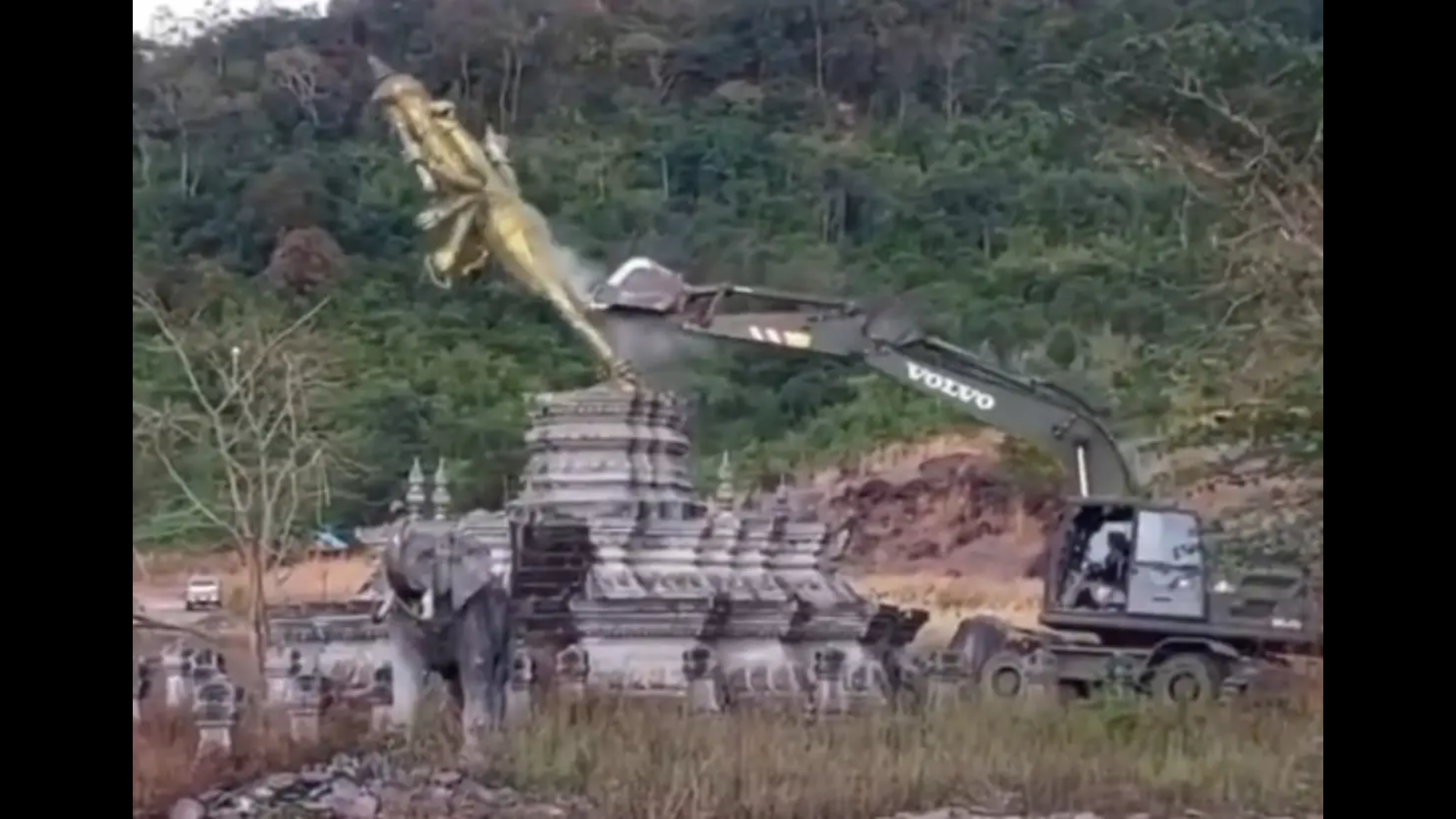
India has strongly condemned the demolition of a statue of Lord Vishnu at the Thailand Cambodia border, calling the act deeply disrespectful and hurtful to religious sentiments across the world.
The incident, which took place amid renewed tensions between the two Southeast Asian neighbours, has triggered diplomatic concern and public outrage after videos of the demolition circulated widely on social media.
In a carefully worded statement issued by the Ministry of External Affairs, New Delhi underlined the shared civilisational and cultural heritage of the region while urging both Thailand and Cambodia to step back from confrontation and return to dialogue and diplomacy.
India’s official response
Reacting to reports of the statue’s destruction, the Ministry of External Affairs said it had taken note of the incident involving a Hindu religious deity located in an area affected by the ongoing border dispute.
The ministry emphasised that Hindu and Buddhist deities are deeply revered and worshipped by people across South and Southeast Asia and form an integral part of a shared civilisational legacy.
The statement added that such actions, regardless of territorial claims, hurt the sentiments of followers around the world and should not take place.
India called on both sides to resume peaceful engagement and avoid further loss of life as well as damage to property and cultural heritage.
The remarks were formally conveyed by MEA spokesperson Randhir Jaiswal, who reiterated India’s consistent position of restraint and dialogue in regional disputes.
Details of the demolition
According to multiple reports, the statue of Lord Vishnu was erected in 2013 or 2014 within a temple complex in a contested area near the Chong An Ma region of Ubon Ratchathani province, close to the Thailand Cambodia border.
The statue was reportedly toppled using a bulldozer by Thai military engineers after Thai forces regained control of the area.
Videos showing the statue being demolished began circulating online earlier this week, sparking anger among devotees and criticism from Cambodian officials.
Cambodian authorities have claimed that the structure was located within their territory, while Thailand maintains that the land falls under its sovereignty.
Thai officials have so far not issued a detailed public response addressing the religious concerns raised by the demolition, though reports suggest the action was linked to asserting control over the disputed land rather than targeting religious belief.
Border tensions between Thailand and Cambodia
The incident comes against the backdrop of recurring border tensions between Thailand and Cambodia, which have flared intermittently over the years due to overlapping territorial claims.
The current phase of clashes reportedly began in July, when armed confrontations broke out in disputed border zones.
Although both countries had earlier agreed to a ceasefire, fighting resumed in recent weeks, raising concerns about regional stability and civilian safety.
Cambodian officials have accused Thai forces of crossing into disputed areas and damaging cultural sites, while Thailand has argued that it is acting within its own territory.
The demolition of the Vishnu statue has now added a sensitive religious dimension to an already complex geopolitical dispute.
Cambodia’s reaction
Cambodia has sharply criticised the demolition, with local officials stating that the statue was located within Cambodian territory in the An Ses area of Preah Vihear province.
A Cambodian provincial spokesperson described the action as unjustified and accused Thai forces of violating cultural and religious norms.
The Cambodian government has also highlighted the importance of protecting religious symbols and heritage sites, particularly in regions where historical and cultural identities are deeply intertwined.
India urges restraint and diplomacy
Notably, India’s statement avoided taking sides on the territorial dispute itself.
Instead, New Delhi focused on the broader implications of the act and its impact on religious harmony.
India urged both countries to return to dialogue and diplomacy, stressing the need to restore peace along the border and prevent further damage to heritage sites.
The ministry warned that continued escalation would only deepen mistrust and risk further loss of life and property.
Earlier, the Indian Embassy in Bangkok had also issued a travel advisory cautioning Indian nationals against visiting areas near the Thailand Cambodia border due to the security situation.
Regional and international efforts
Amid the rising tensions, diplomatic efforts are underway to defuse the situation.
China has indicated its willingness to assist in facilitating dialogue between the two sides.
Beijing’s special envoy for Asian affairs has reportedly visited both Thailand and Cambodia, expressing readiness to help create conditions for negotiations and rebuild mutual trust.
Talks between Thai and Cambodian officials began on December 24 at a border checkpoint in Thailand’s Chanthaburi province.
While no major breakthrough has been announced so far, the discussions signal a tentative step towards de escalation.
Cultural heritage at the centre of conflict
The demolition of the Vishnu statue has once again highlighted how cultural and religious heritage often becomes collateral damage during territorial conflicts.
In Southeast Asia, where Hindu and Buddhist traditions have historically influenced art, architecture and belief systems, religious symbols are not merely places of worship but markers of shared history.
India’s response reflects a long held diplomatic approach rooted in respect for tradition and civilisation.
By focusing on heritage and sentiment rather than political positioning, New Delhi has sought to underline the importance of preserving what generations before have built.
The road ahead
As Thailand and Cambodia navigate yet another chapter in their border dispute, the international community will be watching closely.
The challenge for both governments lies not only in resolving territorial differences but also in ensuring that actions taken on the ground do not inflame religious or cultural sensitivities.
India’s call for dialogue serves as a reminder that disputes rooted in geography should never come at the cost of shared heritage.
Whether the current talks lead to lasting calm remains to be seen, but the demolition of the Vishnu statue has already left a lasting mark on regional discourse.
For now, New Delhi has made its position clear.
Respect for faith, restraint in conflict, and a return to diplomacy are not just diplomatic preferences, but civilisational imperatives that must guide actions in times of tension.
Edit Profile
Help improve @KR
Was this page helpful to you?
Contact Khogendra Rupini
Are you looking for an experienced developer to bring your website to life, tackle technical challenges, fix bugs, or enhance functionality? Look no further.
I specialize in building professional, high-performing, and user-friendly websites designed to meet your unique needs. Whether it’s creating custom JavaScript components, solving complex JS problems, or designing responsive layouts that look stunning on both small screens and desktops, I can collaborate with you.
Create something exceptional with us. Contact us today
Open for Collaboration
If you're looking to collaborate, I’m available for a variety of professional services, including -
- Website Design & Development
- Advertisement & Promotion Setup
- Hosting Configuration & Deployment
- Front-end & Back-end Code Implementation
- Code Testing & Optimization
- Cybersecurity Solutions & Threat Prevention
- Website Scanning & Malware Removal
- Hacked Website Recovery
- PHP & MySQL Development
- Python Programming
- Web Content Writing
- Protection Against Hacking Attempts