
The Cockroach Janta Party Is the Funniest Joke Indian Social Media Has Played on Itself, and That Is Exactly the Problem
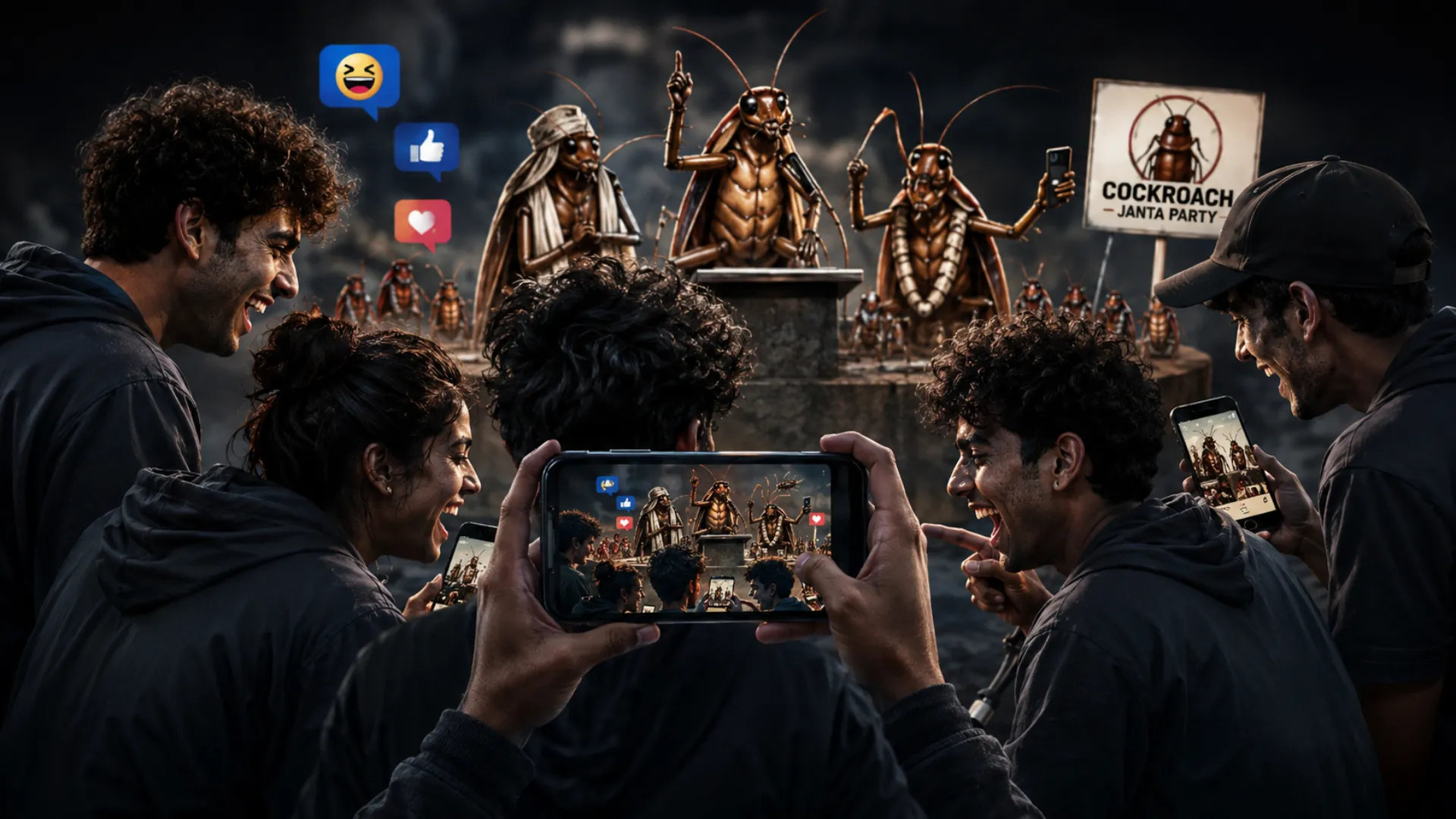
India is a country that has always had a peculiar relationship with outrage. It flares up suddenly, burns intensely, lights up every screen and every WhatsApp group, and then vanishes just as quickly, leaving behind nothing but the faint smell of smoke and a trending hashtag that nobody remembers three weeks later. The Cockroach Janta Party is the latest, most colourful, and arguably most entertaining episode in this long tradition of digital rebellion that looks enormous from the outside and amounts to very little once you look beneath the surface.
The party, if one can even call it that, was born out of genuine anger. Comments made by the Chief Justice of India, remarks widely described as disgraceful and deeply out of touch, ignited a spark across the country's youth. The response, as is increasingly the case with Generation Z, was not a march, not a petition, not a movement with a manifesto, but a meme. A cockroach. An Instagram page. A name that was equal parts absurdist humour and pointed protest. Within days, the Cockroach Janta Party's Instagram account had surpassed the Bharatiya Janata Party in follower count, a fact that was itself part of the joke and, for many, felt like a statement of something larger and more meaningful.
By May 2026, the account, now banned in India, had accumulated millions of followers. Its founder was appearing on national television, speaking about generational change, about the rights of young Indians, about a future that looks very different from the one their parents inherited. Fresh from the political earthquake that actor Vijay Thalapathy had delivered in Tamil Nadu, a state that had just witnessed the power of cultural celebrity colliding with electoral politics, commentators were already drawing comparisons. If rapper Balen Shah could become the Mayor of Kathmandu in Nepal, the argument went, why could a Gen Z movement in India not achieve something similar?
The answer, delivered with neither cruelty nor condescension but with the clarity that history demands, is quite simple. This is not a revolution. It is a joke. A very good joke, one that has tapped into something real and restless in the Indian youth psyche, but a joke nonetheless.
What the Cockroach Party Tells Us About the Fractures in Modern India
To dismiss the Cockroach Janta Party entirely would be to miss the point. The rage that gave birth to it is real. The frustration it channels is legitimate. India in 2026 is a country where the contracts that once held society together are visibly straining. The relationship between citizens and their courts has been shaken. The promise made to young Indians that hard work and aspiration would be rewarded has started to feel hollow in the face of unemployment numbers, a shrinking middle class, and institutions that appear increasingly remote from the lives of ordinary people.
Generation Z in India did not choose to be cynical. They became cynical because the world handed them reason after reason to be so. The BJP came to power in 2014 promising to drain the swamp, to build a new India, to answer the aspirations of a young, impatient, ambitious population. Over a decade later, the Cockroach Janta Party surpassing the BJP in Instagram followers is not a trivial data point. It is a quiet but damning referendum on unmet expectations. Even the outsider, it seems, has not delivered the transformation that was promised.
And so the anger finds its outlet in comedy. This is not a new phenomenon. This is what people do when the world is tragic but not yet uncomfortable enough to force them off their sofas and into the streets. Comedy is the pressure valve of fractured times, a way of saying that something is deeply wrong without having to do anything particularly difficult about it.
The Long History of Movements That Changed Nothing
India is not alone in this pattern. The 21st century has produced a remarkable number of mass movements that generated extraordinary energy and achieved extraordinarily little in terms of lasting political change.
Barack Obama swept into the White House in 2008 on a wave of youth mobilisation unlike anything American politics had seen in decades. "Yes We Can" became the defining slogan of a generation that believed, genuinely believed, that they were participating in something historic. They were, but not in the way they imagined. Obama measured his two terms in symbolism. The structural changes that young Americans marched and campaigned for remained mostly unmade.
Occupy Wall Street arrived in 2011, filled Zuccotti Park in New York with tents and drums and righteous anger, spread to dozens of cities around the world, and then dissolved within months, leaving behind little more than the slogan "We are the 99 percent" and a set of ideas that mainstream politics would not meaningfully absorb for another decade, and even then only partially.
The Arab Spring began with such hope in 2010 and 2011. Leaders fell. Gaddafi was dragged from a drain pipe. The world watched, electrified. And then the spring turned, country by country, into something far grimmer. The revolution that millions of young Arabs risked everything for is, in most of those countries, still waiting to arrive.
In India itself, Arvind Kejriwal rode winds of genuine popular anger against corruption into political office in Delhi and then in Punjab. The promise was transformational change at the level of the street, the school, the clinic. The results have been debated endlessly, but the sweeping structural transformation that the movement once promised did not materialise.
Ukraine elected Volodymyr Zelensky, a television comedian, in 2019 on a platform of change and anti-corruption. What followed was not the transformation Ukrainians voted for. It was a war.
Donald Trump won the American presidency twice, in 2016 and again in 2024, driven in significant part by the same kind of anti-establishment anger that drives every outsider candidate in every democracy in the world. The voters wanted something different. They got something entertaining. Whether they got something better is a question that divides entire nations.
The pattern across all of these is consistent and worth examining seriously. Balen Shah in Nepal. Peter Magyar in Hungary. Javier Milei in Argentina. Giorgia Meloni in Italy. Whenever the establishment has failed badly enough, voters reach for the outsider, the disruptor, the person who promises to remake everything. Sometimes the outsider delivers genuine change. Often they deliver theatre. Occasionally they deliver disaster. What they almost never deliver is the specific, structural, generational transformation that the youth who powered their rise was actually asking for.
Why Cultural Revolt Is Not the Same as Political Revolution
Eric Hobsbawm, one of the finest historians of the modern era, spent much of his intellectual life studying revolutions and political change. His conclusion, delivered with the authority of someone who had watched the 20th century unfold from beginning to end, was unambiguous. Cultural revolt and cultural dissidence are symptoms of deeper problems, not forces capable of solving them. Politically, he argued, they are not very important.
The Cockroach Janta Party is almost entirely a cultural phenomenon. It lives on Instagram. It communicates through memes and irony. Its language is the language of Gen Z, fluent in sarcasm and aesthetics and the particular grammar of digital protest. None of this is without value. But it is not politics.
The 1968 student protests are often cited as the great example of youth-driven political energy. They shook governments across the world. They produced some of the most memorable images of the 20th century. And even Hobsbawm, who watched them closely, was not impressed by their political consequences. Students alone, however numerous and however passionate, cannot make a revolution. Political change requires something harder to build and harder to sustain: a united front of ordinary people and intellectuals working together, over years and decades, with a plan.
That kind of coalition is what the RSS and the BJP spent decades building before they ever achieved national power. It is what Lalu Prasad Yadav and Mulayam Singh Yadav built, brick by brick, community by community, through years of unglamorous ground-level politics in Bihar and Uttar Pradesh. It is patient, difficult, often thankless work that has nothing to do with follower counts.
Swiping up on an Instagram reel and tapping a heart on a tweet is genuinely easy. Knocking on doors in a constituency that does not speak your language, building trust with communities that have been lied to by every previous generation of politicians, sitting through three-hour meetings about local water supply issues because that is where political legitimacy is actually built, these things are hard. They do not trend. They do not generate viral content. But they are the only things that have ever produced lasting political change.
The Soma of the Digital Age and What Comes Next
Aldous Huxley imagined a future in which populations were kept docile not through force but through pleasure, through a drug called Soma that made everything feel fine enough that nobody bothered to demand anything better. The infinite scroll of the contemporary digital world is, in its own way, a remarkable approximation of Huxley's vision. The world might be genuinely broken. The contracts between citizens and institutions might be coming apart. But the reels keep loading, the content keeps coming, and the discomfort never quite reaches the level that forces people to do something genuinely difficult about it.
The Cockroach Janta Party will follow the trajectory of every similar online-driven movement before it. It will peak, plateau, and fade. Its founder may continue making television appearances for a while. The Instagram account, banned in India, will continue to accumulate followers abroad. A few news cycles will pass. Something else will capture the collective attention. The cockroaches, to borrow the language of the movement itself, will skitter back to their daily lives, their exams and jobs and EMIs and chai, and the underlying problems that gave birth to the party will remain exactly where they were, waiting for someone with a strategy rather than a slogan to take them seriously.
This is not a reason for despair. The anger is real. The desire for something better is genuine and it deserves to be taken seriously. But desire without strategy is entertainment, not politics.
India's Generation Z is intelligent, creative, and more politically aware than any previous generation at the same age. The joke they have made with the Cockroach Janta Party is a genuinely good one. Laugh at it. It deserves the laugh. And then, when the laughter fades, ask the harder question about what comes next, who is willing to do the difficult work, and whether the energy that built millions of Instagram followers in a week can be redirected toward something that lasts longer than the next news cycle.
That is the real challenge of a fractured age. And comedy, for all its virtues, cannot answer it alone.
Frequently Asked Questions
What is the Cockroach Janta Party and how did it start?
The Cockroach Janta Party is a viral social media movement that began in India as a satirical protest in response to comments made by the Chief Justice of India that were widely described as disgraceful. It started as a joke but quickly grew into a massive online phenomenon.
How many followers did the Cockroach Janta Party gain and why was it banned in India?
The Cockroach Janta Party Instagram account surpassed the BJP in follower count within less than a week, accumulating millions of followers. The account was subsequently banned in India, though it continued to grow internationally.
Is the Cockroach Janta Party a real political party that can contest elections?
No. Despite its rapid viral growth and its founder appearing on national television, the Cockroach Janta Party is a social media driven cultural movement with no formal political structure, registered candidates, or electoral strategy.
Why do online youth movements in India and globally fail to create lasting political change?
Historians like Eric Hobsbawm have argued that cultural revolt alone is not a revolutionary force. Real political change requires years of ground level work, strategic coalition building between ordinary people and intellectuals, and a clear political plan, none of which digital movements typically develop.
What does the BJP losing Instagram followers to Cockroach Janta Party indicate about Indian politics?
It reflects deep dissatisfaction among Indian youth with the current political establishment. Despite the BJP coming to power in 2014 promising transformational change, a significant section of young Indians feel those promises remain unfulfilled over a decade later.
How does the Cockroach Janta Party compare to other global youth movements like Occupy Wall Street or the Arab Spring?
All three share the same pattern. They generated massive public energy and attention but achieved minimal lasting political change. Occupy Wall Street dissolved within months. The Arab Spring produced little democratic transformation. These movements lacked the strategic political foundations needed for durable impact.
Who is the founder of the Cockroach Janta Party and what are their stated goals?
The founder's full identity remains loosely defined in public discourse, but they have appeared on Indian television channels speaking about fighting for the rights of Generation Z and bringing about change in Indian society. No concrete political roadmap has been presented publicly.
What role does social media play in shaping political movements in India today?
Social media provides an instant platform for protest and satire but it has also become a substitute for real political action. The infinite scroll of digital content keeps frustration at a manageable level, preventing it from translating into organised, sustained political mobilisation.
What does Generation Z in India actually want from politics?
Indian Gen Z is dealing with genuine economic anxiety, institutional distrust, and a feeling that existing political structures do not represent their aspirations. Their anger is real, but their engagement tends to lean toward cultural expression rather than formal political organising.
Could the Cockroach Janta Party evolve into a serious political force like Balen Shah in Nepal or Vijay Thalapathy in Tamil Nadu?
The comparison is tempting but unlikely without structural change. Balen Shah and Vijay Thalapathy built real on-ground movements with local credibility. A viral Instagram page, however large its following, does not automatically translate into votes, coalitions, or governance capability.
Edit Profile
Help improve @KR

Was this page helpful to you?
Contact Khogendra Rupini
Are you looking for an experienced developer to bring your website to life, tackle technical challenges, fix bugs, or enhance functionality? Look no further.
I specialize in building professional, high-performing, and user-friendly websites designed to meet your unique needs. Whether it's creating custom JavaScript components, solving complex JS problems, or designing responsive layouts that look stunning on both small screens and desktops, I can collaborate with you.
Create something exceptional with us. Contact us today
Open for Collaboration
If you're looking to collaborate, I'm available for a variety of professional services, including -
- Website Design & Development
- Advertisement & Promotion Setup
- Hosting Configuration & Deployment
- Front-end & Back-end Code Implementation
- Code Testing & Optimization
- Cybersecurity Solutions & Threat Prevention
- Website Scanning & Malware Removal
- Hacked Website Recovery
- PHP & MySQL Development
- Python Programming
- Web Content Writing
- Protection Against Hacking Attempts