One Word Cracked Google's Biggest Bet on AI Search, and the Internet Had a Field Day Over It
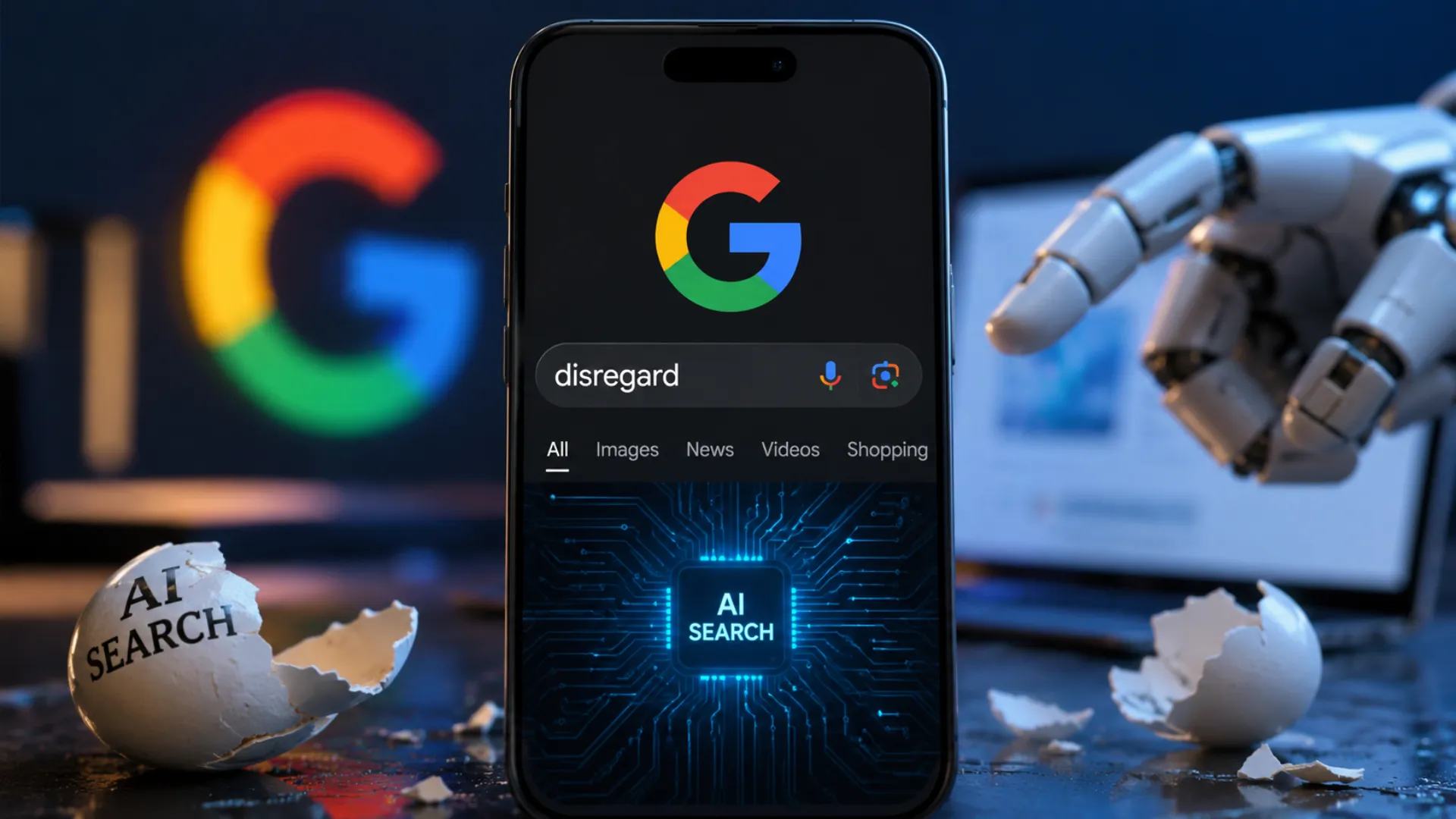
Google has been on an aggressive push to reshape the future of internet search. At its annual developer conference Google I/O 2026, held earlier this week, the company unveiled what it described as the single biggest transformation to Google Search in its 25-year history. The traditional blue links that have defined how billions of people access information online are gradually being replaced by an AI-first experience, one that puts an artificial intelligence assistant front and centre on the search results page. It was a bold, ambitious vision. Then someone typed the word "disregard" into the search bar, and everything went sideways.
On May 22, 2026, users on the social media platform X began noticing something deeply unusual about Google's AI Search mode. When a person searched for the ordinary English word "disregard," the AI component of the search engine stopped behaving like a search engine altogether. Instead of returning a definition, an etymology, or relevant web results highlighted by the AI, it responded as if it had just been given an instruction. The AI would reply with phrases such as "Message received. How can I help you today?" treating the search query not as a word to be looked up, but as a command directed at itself.
In a single, almost poetic irony, the word "disregard" caused Google's AI to disregard its own purpose.
What the Glitch Actually Revealed About How AI Search Works
To understand why this happened, it helps to understand the fundamental architecture of AI language systems. These models are trained with what are called system prompts or instruction sets, internal directives that tell the AI how to behave, what to prioritise, and how to respond to users. Words like "disregard," "ignore," "dismiss," "skip," "stop," and "quit" are commonly used in the world of AI prompting to tell a model to set aside its previous instructions and do something else.
When a person searched for "disregard" on Google, the AI mode appears to have interpreted the query not as a neutral word being researched, but as an instruction aimed at itself. This is a well-known vulnerability in AI systems, often discussed in technical circles under the concept of prompt injection, where user input bleeds into the instruction layer of an AI and alters its behaviour in unintended ways.
Google confirmed this in a statement provided to USA Today, acknowledging that AI Overviews were "misinterpreting some action-related queries." The company's language was measured and brief, but it was an admission that carried significant technical weight. The AI mode, which is now one of the most prominent features on one of the most visited websites on the planet, had momentarily confused a dictionary lookup with an internal command.
Reports confirmed that "disregard" was not an isolated trigger. Other words that produced similar results included "dismiss," "ignore," "skip," "start," "stop," and "quit." Each of these terms, unremarkable in everyday conversation, apparently held enough similarity to AI instruction language to confuse the system. In each case, the AI appeared to step out of its role as a search assistant and respond as though a person were addressing it directly, resetting or acknowledging the interaction rather than providing information.
It is worth noting that the traditional web links remained visible on the search results page during the glitch, appearing further down the page beneath the AI section. However, for the majority of users who now depend on the AI Overview at the top of the page as their first point of reference, the malfunction effectively broke the search experience entirely.
The Internet Responded With Sharp Wit and Sharper Criticism
News of the glitch spread rapidly across X, and the internet's reaction was swift, layered, and at times genuinely cutting. The response that drew the widest attention came from an unexpected but perfectly suited source: Merriam-Webster, the iconic American dictionary publisher. With characteristic deadpan precision, the institution posted on X: "disregard | verb | to pay no attention to: treat as unworthy of regard or notice." It was an understated dig, but it landed with considerable force. The world's most famous dictionary was essentially correcting the world's most powerful search engine on what a word means.
Beyond the humour, however, many users seized on the moment to express frustrations that run deeper than a single bug. One user wrote, "Disregard user intent long enough, and users will start disregarding your product. Google Search feels dangerously close to that line." The comment captured a sentiment that has been quietly building among longtime Google users: that the company's increasingly aggressive AI integration is not always improving the search experience, but rather complicating it in ways that feel disconnected from what people actually need when they turn to a search engine.
Others drew attention to the symbolic weight of a search engine failing to define a word, arguably the most basic task any search tool should be able to perform. For decades, Googling a word was the fastest, simplest way to get an instant definition. That this fundamental function broke under the pressure of AI integration was not lost on critics.
Google Fixes the Bug, But Questions Linger
As of May 23, 2026, the glitch has been resolved. Searching for "disregard," "skip," "ignore," or the other affected terms now correctly returns definitions and relevant information through the AI Overview. Google appears to have adjusted the way its AI mode processes certain query types, ensuring that action-related words are recognised as vocabulary being researched rather than commands being issued.
The fix was relatively swift, and the company acknowledged the problem publicly, which represents a reasonably transparent response to a public-facing error. In technical terms, this kind of issue is not entirely surprising. Large language models, the AI systems that power tools like Google's AI Overviews, are extraordinarily capable but also inherently sensitive to the phrasing and content of the input they receive. Designing a system that can distinguish between a user searching for a word and a user issuing a command to an AI is a genuinely complex engineering challenge, particularly at the scale at which Google operates.
What the incident underscores, however, is that deploying AI at the centre of a product used by hundreds of millions of people every single day carries risks that go well beyond typical software bugs. A broken button or a slow-loading page is one thing. An AI that misinterprets basic user intent and responds in ways that are confusing, unhelpful, or actively counterproductive is a different category of problem entirely, one that touches on trust.
Google's Larger Ambition and the Stakes Behind It
The timing of this glitch, arriving in the immediate aftermath of Google I/O 2026 and the company's sweeping announcements about the future of search, gave the incident an outsized significance. Google is not simply adding AI features to its search engine. It is fundamentally restructuring the product, moving away from the link-based model that made it dominant and toward an AI-driven assistant model that synthesises information, answers questions directly, and integrates with personal data from services like Gmail, Google Photos, and Google Calendar.
According to announcements made at Google I/O, the AI mode is being designed to function as a personalised assistant, capable of handling bookings, tracking user schedules, and surfacing relevant personal information in response to searches. It is an ambitious vision that places AI not merely as a supplement to search, but as the primary interface between users and information.
This transformation is occurring against a backdrop of intense competitive pressure. Tools such as ChatGPT, Perplexity, and others have demonstrated that users are willing to turn to AI-native products for information that they once would have sought through traditional search. Google's pivot is, in many respects, an acknowledgment that the search landscape is changing rapidly and that standing still is not an option.
But the "disregard" glitch serves as a timely reminder that moving fast comes with real consequences. Every time Google's AI mode fails in a visible, public way, it does not just create a momentary inconvenience. It raises a question in users' minds: if the AI misunderstood this, what else might it misunderstand? For a company whose entire value proposition rests on the reliability and accuracy of the information it surfaces, that question matters enormously.
The glitch has been fixed. The word "disregard" now returns its proper definition when searched. But the conversation it sparked about AI reliability, user trust, and the pace of change in one of the world's most used digital tools is unlikely to disappear quite as quickly.
Frequently Asked Questions
What was the Google AI Search disregard glitch?
When users searched the word disregard on Google, the AI Search mode misinterpreted it as a command directed at itself and responded with phrases like 'Message received. How can I help you today?' instead of providing the word's definition.
When did the Google AI Search disregard bug occur?
The glitch was spotted by users on X on May 22, 2026, just days after Google announced its biggest-ever Search transformation at Google I/O 2026.
Which other words triggered the same AI Search glitch?
Apart from disregard, other action-related words including dismiss, ignore, skip, start, stop, and quit produced similar unexpected responses from Google's AI Search mode.
Why did Google AI Search misinterpret the word disregard?
Google confirmed that its AI Overviews were misinterpreting action-related queries. Words like disregard are commonly used in AI instruction language, causing the system to treat them as commands rather than vocabulary being searched.
Has Google fixed the disregard AI Search bug?
Yes. As of May 23, 2026, Google resolved the issue. Searching for disregard and other affected words now correctly returns definitions and relevant information through the AI Overview.
What is prompt injection and is it related to this Google glitch?
Prompt injection is a known AI vulnerability where user input interferes with a model's internal instructions, causing unintended behaviour. The disregard glitch exhibited characteristics consistent with this type of misinterpretation.
What did Merriam-Webster say about the Google AI Search glitch?
Merriam-Webster responded with sharp wit on X, posting the precise dictionary definition of disregard, essentially pointing out that the world's most powerful search engine had failed to perform the most basic task of defining a word.
Were traditional web links still visible during the glitch?
Yes. Standard web links remained on the search results page during the glitch, but they appeared further down the page beneath the broken AI Overview section, making them easy to miss for most users.
What changes did Google announce for AI Search at Google I/O 2026?
At Google I/O 2026, Google announced that AI mode would function more like a personal assistant, with improved booking capabilities and deeper integration with Gmail, Google Photos, and Google Calendar.
Why are users concerned about Google prioritising AI mode over traditional search?
Many users feel that aggressive AI integration is replacing reliable, link-based results with AI-generated responses that can misinterpret intent, raising concerns about accuracy, trust, and the overall quality of search results.
What does this glitch reveal about the risks of AI-first search?
The incident highlights that deploying AI at the core of a product used by hundreds of millions of people daily carries unique risks. Unlike typical software bugs, AI misinterpretations can directly undermine user trust and the accuracy of information delivery.
Is Google the only company facing challenges with AI-powered search?
No. The broader AI search space, including competitors like ChatGPT and Perplexity, continues to grapple with accuracy, reliability, and prompt sensitivity challenges as companies race to replace traditional search with AI-native experiences.
Edit Profile
Help improve @KR

Was this page helpful to you?
Contact Khogendra Rupini
Are you looking for an experienced developer to bring your website to life, tackle technical challenges, fix bugs, or enhance functionality? Look no further.
I specialize in building professional, high-performing, and user-friendly websites designed to meet your unique needs. Whether it's creating custom JavaScript components, solving complex JS problems, or designing responsive layouts that look stunning on both small screens and desktops, I can collaborate with you.
Create something exceptional with us. Contact us today
Open for Collaboration
If you're looking to collaborate, I'm available for a variety of professional services, including -
- Website Design & Development
- Advertisement & Promotion Setup
- Hosting Configuration & Deployment
- Front-end & Back-end Code Implementation
- Code Testing & Optimization
- Cybersecurity Solutions & Threat Prevention
- Website Scanning & Malware Removal
- Hacked Website Recovery
- PHP & MySQL Development
- Python Programming
- Web Content Writing
- Protection Against Hacking Attempts