Google Launches AI Threat Defense to Challenge Anthropic Claude Mythos and OpenAI Daybreak in the Global AI Cybersecurity Race
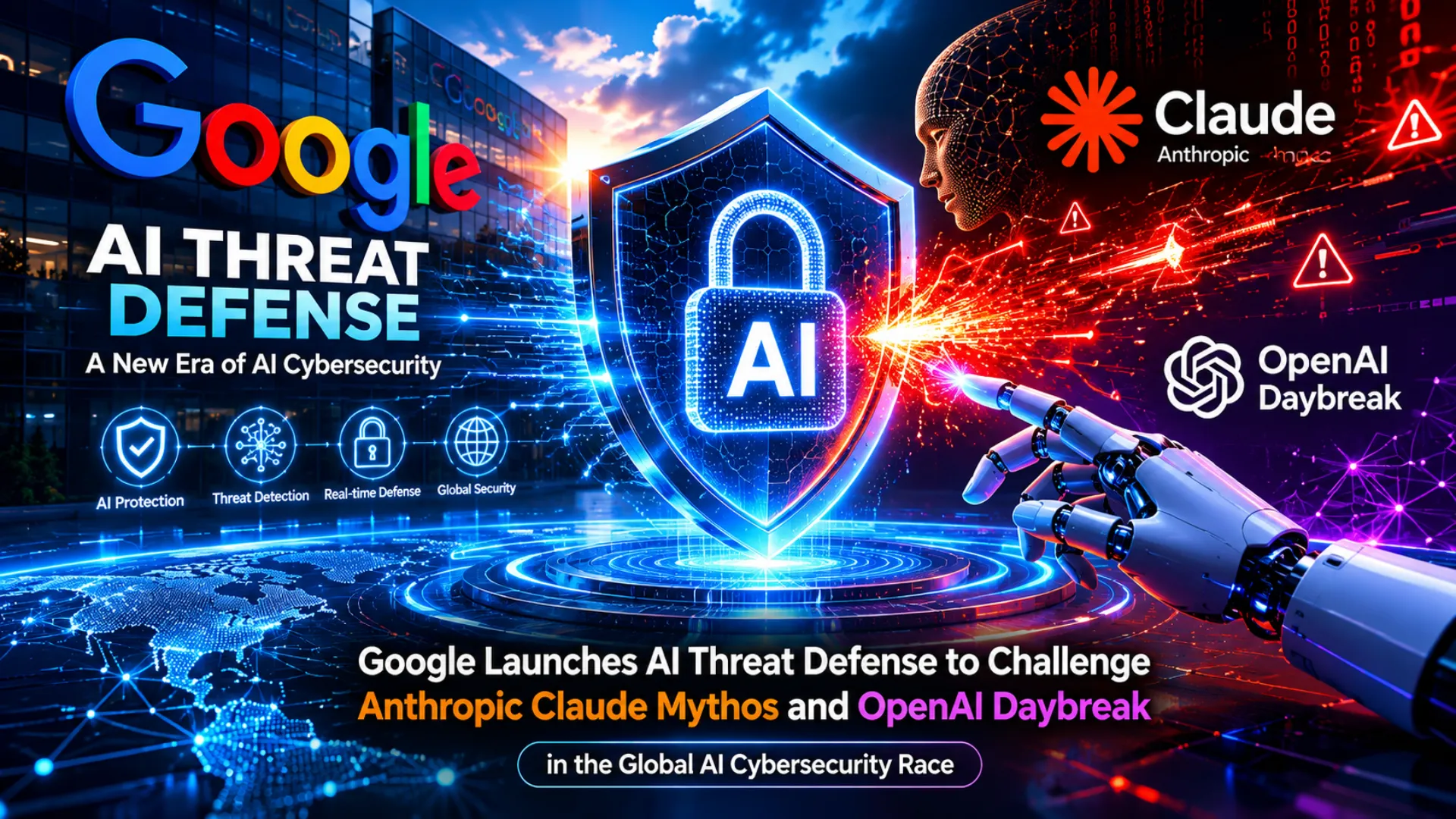
The artificial intelligence arms race in cybersecurity has taken a significant new turn. Google has officially introduced its AI Threat Defense platform, a sophisticated AI powered cybersecurity solution designed specifically to help businesses, developers, and security teams stay ahead of increasingly intelligent digital threats. The announcement comes at a critical moment when the world's most powerful AI systems are being deployed not just to defend software but also to discover and potentially exploit vulnerabilities at a scale never seen before in the history of digital security.
The launch places Google in direct competition with two of the most talked about AI cybersecurity tools of 2026. Anthropic introduced Claude Mythos in April 2026, a model that shocked the industry by reportedly identifying more than 10,000 software bugs within its first month of limited access. OpenAI followed up in May 2026 with the Daybreak platform, built on the foundation of GPT 5.5, positioning itself as a rival to Mythos in large scale vulnerability detection. Now Google has entered the conversation with a fundamentally different philosophy about what AI powered cybersecurity should actually look like in practice.
The Problem That No One Was Solving
While Anthropic and OpenAI built systems capable of scanning millions of lines of code and surfacing vast numbers of vulnerabilities, both companies largely focused on raw model intelligence and scale. The result, according to Google, is a familiar and frustrating problem for security professionals: an overwhelming flood of AI generated alerts with no clear way to determine which ones actually matter.
Google's research and conversations with enterprise clients revealed that cybersecurity teams are drowning in these alerts. When an AI system can identify thousands of potential vulnerabilities overnight, the sheer volume creates a new kind of problem. Security teams end up spending enormous amounts of time triaging alerts that may have no real world impact, while genuinely dangerous, actively exploitable flaws can get lost in the noise. This is the gap that Google says it built AI Threat Defense specifically to close.
The platform does not simply identify vulnerabilities. It goes several steps further by determining whether each flagged issue is actually reachable from the internet, whether it is exposed through live network configurations, and whether a real world attacker could realistically exploit it given the current state of the system. A high severity flaw buried deep in isolated code that has no external exposure is automatically assigned lower priority. This means developers and security teams receive a focused, actionable list rather than an endless queue of theoretical risks.
How Google AI Threat Defense Actually Works
At its core, AI Threat Defense operates as a continuous monitoring system that performs deep scanning across millions of lines of corporate code. The platform uses a tiered model approach to manage both cost and effectiveness. Lighter, more efficient AI models handle broad continuous monitoring across the entire codebase, while Google's frontier Gemini models are brought in for high risk assets and complex exploitability analysis that demands deeper reasoning and more intensive computation.
A key differentiator is the platform's integration with Wiz, the cloud security company that Google acquired in a landmark deal. Through this integration, AI Threat Defense can cross reference code level vulnerabilities against real time cloud and network configurations. This is what allows the system to answer the critical question that other platforms have not addressed: is this vulnerability actually dangerous right now, in this specific environment, under current network conditions? That contextual intelligence is what separates a meaningful alert from noise.
Francis deSouza, Chief Operating Officer of Google Cloud and President of Security Products, described the platform's core value proposition clearly in a published blog post. The platform, he wrote, helps organisations actively predict attack paths, prioritise the most significant threats, and deploy verified fixes faster than adversaries can exploit them. He also drew a pointed contrast with competitors, stating that unlike other model providers that hand security teams a massive unprioritised list of AI generated alerts, Google delivers prioritised fixes to accelerate remediation and secure what he called the Defender's Advantage.
Google Goes Beyond Detection with Autonomous Code Rewriting
Perhaps the most ambitious aspect of Google AI Threat Defense is what happens after a vulnerability is identified and confirmed as a real risk. While OpenAI's Daybreak platform primarily proposes patches for security teams to review and implement manually, Google has taken automation a significant step further.
AI Threat Defense uses autonomous AI agents, operating under human supervision, to actively rewrite legacy and vulnerable code into modern, memory safe programming languages. This addresses one of the most persistent and expensive problems in enterprise software security. Organisations around the world maintain vast codebases written in older languages that are inherently prone to memory related vulnerabilities, including buffer overflows and use after free errors, which are among the most commonly exploited classes of software bugs. Manually rewriting this code is enormously time consuming and expensive. Google is positioning AI agents as the solution to that backlog.
The platform does not stop at rewriting. It also analyses the dependencies of the modified code and automatically generates tests to verify that a fix actually works before it is deployed in a production environment. This end to end approach, from detection to contextual prioritisation to automated remediation and verified testing, represents a meaningfully more complete security workflow than what either Anthropic or OpenAI currently offers.
The Broader Context of AI Cybersecurity in 2026
The emergence of these three competing platforms reflects a deeper shift in how the technology industry, and governments around the world, are beginning to think about AI and software security. Claude Mythos, in particular, has generated significant concern not just among technology companies but also among regulatory bodies and national governments, including in India, where the scale of vulnerability discovery has raised questions about who should have access to such powerful tools and under what conditions.
The concern is legitimate. An AI system capable of discovering tens of thousands of software vulnerabilities in a matter of weeks represents a genuine dual use challenge. In the hands of responsible security researchers and enterprise teams, it can dramatically improve global software quality. In the wrong hands, or with insufficient safeguards, the same capabilities could accelerate the discovery and exploitation of vulnerabilities before patches are developed or deployed.
Google's approach with AI Threat Defense attempts to address part of this concern by focusing the platform's output on exploitability rather than raw vulnerability counts. By ensuring that the most dangerous, actively reachable flaws are surfaced first and resolved fastest, the platform is designed to shrink the window of exposure that attackers depend on.
What This Means for Businesses and Developers
For enterprise security teams, the practical implications of Google AI Threat Defense are significant. Organisations that have struggled to keep pace with the volume of alerts generated by earlier AI security tools now have a credible alternative that promises to work with them rather than against their capacity. The combination of Wiz's cloud intelligence, Gemini's reasoning capabilities, and autonomous remediation agents creates a system that is more aligned with how security teams actually operate under real world constraints.
For developers building on Google Cloud, the integration of continuous code monitoring directly into the development and deployment pipeline means security considerations can be addressed earlier in the software lifecycle, before vulnerabilities reach production environments.
The competition between Google, Anthropic, and OpenAI in this space is ultimately good for the broader ecosystem. Each company is pushing the other to think more carefully not just about what AI can discover, but about what a complete, responsible, and operationally useful AI security product actually looks like. In that race, the real winners are the organisations and individuals whose software becomes safer, faster than ever before.
Frequently Asked Questions
What is Google AI Threat Defense and what does it do?
Google AI Threat Defense is an AI-powered cybersecurity platform that continuously monitors corporate code, prioritizes real and exploitable vulnerabilities, and deploys verified fixes. Unlike traditional tools, it checks whether a flaw is actually reachable from the internet before flagging it as a critical threat.
How is Google AI Threat Defense different from Anthropic Claude Mythos and OpenAI Daybreak?
While Anthropic Claude Mythos and OpenAI Daybreak focus on discovering large volumes of vulnerabilities through raw model intelligence, Google AI Threat Defense focuses on prioritizing only the threats that are realistically exploitable and goes further by autonomously rewriting vulnerable code under human supervision.
What is Anthropic Claude Mythos and why has it raised concerns?
Claude Mythos is a cybersecurity-focused AI model launched by Anthropic in April 2026. It raised global concern, including in India, after reportedly identifying more than 10,000 software bugs within its first month, raising questions about who should have access to such powerful vulnerability-discovery tools.
What is OpenAI Daybreak and how does it work?
OpenAI Daybreak is a cybersecurity platform built on GPT-5.5, introduced in May 2026. It is designed for large-scale code scanning and vulnerability detection, and primarily proposes patches for security teams to review and implement manually.
How does Google AI Threat Defense avoid alert overload for security teams?
The platform integrates with cloud-security provider Wiz to cross-reference discovered vulnerabilities against live network configurations. If a flaw is isolated and unreachable from the internet, the system lowers its priority automatically, ensuring teams focus only on threats that attackers can realistically exploit.
What role does Wiz play in Google AI Threat Defense?
Wiz is a cloud-security platform integrated into Google AI Threat Defense. It allows the system to check whether a discovered code vulnerability is actually exposed through live network configurations, adding critical real-world context to every alert the platform generates.
What AI models does Google use inside the Threat Defense platform?
Google uses a tiered model approach. Lighter, cost-effective AI models handle broad continuous monitoring across the entire codebase, while Google's frontier Gemini models are deployed specifically for high-risk assets and complex exploitability analysis that requires deeper reasoning.
Can Google AI Threat Defense automatically fix vulnerabilities?
Yes. The platform uses autonomous AI agents, operating under human supervision, to actively rewrite legacy and vulnerable code into modern, memory-safe programming languages. It also generates tests to verify that each fix works correctly before it is deployed in a live environment.
Who announced Google AI Threat Defense and what did they say?
Francis deSouza, Chief Operating Officer of Google Cloud and President of Security Products, announced the platform. He stated that it helps organisations predict attack paths, prioritize the most significant threats, and deploy verified fixes faster than adversaries can exploit them.
Why is AI-powered cybersecurity becoming so important in 2026?
AI systems can now discover thousands of software vulnerabilities overnight, creating both defensive opportunities and serious risks. As tools like Claude Mythos and Daybreak grow more powerful, organisations need smarter platforms that not only find flaws but also determine which ones pose a genuine and immediate danger.
What is a memory-safe programming language and why does it matter?
Memory-safe languages are designed to prevent common vulnerability classes like buffer overflows and use-after-free errors, which are among the most frequently exploited software bugs. Google AI Threat Defense can rewrite legacy code into these safer languages, reducing long-term security risk for large enterprises.
Is Google AI Threat Defense suitable for enterprise businesses?
Yes. The platform is designed specifically for enterprise organisations managing large codebases. It continuously scans millions of lines of code, integrates with cloud infrastructure, prioritizes critical threats, and automates code remediation, making it practical for security teams operating under real-world resource constraints.
What is the Defender's Advantage that Google refers to?
The Defender's Advantage is a term used by Google's Francis deSouza to describe the strategic benefit of resolving the most dangerous vulnerabilities before attackers can exploit them. Google AI Threat Defense is built around achieving this advantage through prioritized, verified, and fast remediation.
How does the competition between Google, Anthropic, and OpenAI benefit cybersecurity?
The rivalry is pushing each company to build more complete, responsible, and operationally useful AI security products. The result is a faster pace of innovation in automated threat detection, vulnerability prioritization, and code remediation, which ultimately improves software safety for organisations and users worldwide.
Can Google AI Threat Defense be used by developers building on Google Cloud?
Yes. For developers on Google Cloud, the platform integrates continuous code monitoring directly into the development and deployment pipeline. This allows security issues to be identified and addressed earlier in the software lifecycle, before vulnerabilities ever reach a production environment.
What makes 2026 a significant year for AI and cybersecurity?
In 2026, three major AI companies launched dedicated cybersecurity platforms within weeks of each other. Anthropic released Claude Mythos in April, OpenAI launched Daybreak in May, and Google introduced AI Threat Defense shortly after, marking a turning point where AI moved from supporting security teams to actively leading threat detection and remediation.
Edit Profile
Help improve @KR
Was this page helpful to you?
Contact Khogendra Rupini
Are you looking for an experienced developer to bring your website to life, tackle technical challenges, fix bugs, or enhance functionality? Look no further.
I specialize in building professional, high-performing, and user-friendly websites designed to meet your unique needs. Whether it's creating custom JavaScript components, solving complex JS problems, or designing responsive layouts that look stunning on both small screens and desktops, I can collaborate with you.
Create something exceptional with us. Contact us today
Open for Collaboration
If you're looking to collaborate, I'm available for a variety of professional services, including -
- Website Design & Development
- Advertisement & Promotion Setup
- Hosting Configuration & Deployment
- Front-end & Back-end Code Implementation
- Code Testing & Optimization
- Cybersecurity Solutions & Threat Prevention
- Website Scanning & Malware Removal
- Hacked Website Recovery
- PHP & MySQL Development
- Python Programming
- Web Content Writing
- Protection Against Hacking Attempts