
Cockroach Janta Party Brings Delhi to a Standstill as Thousands March at Jantar Mantar, Demanding Education Minister Dharmendra Pradhan's Immediate Resignation
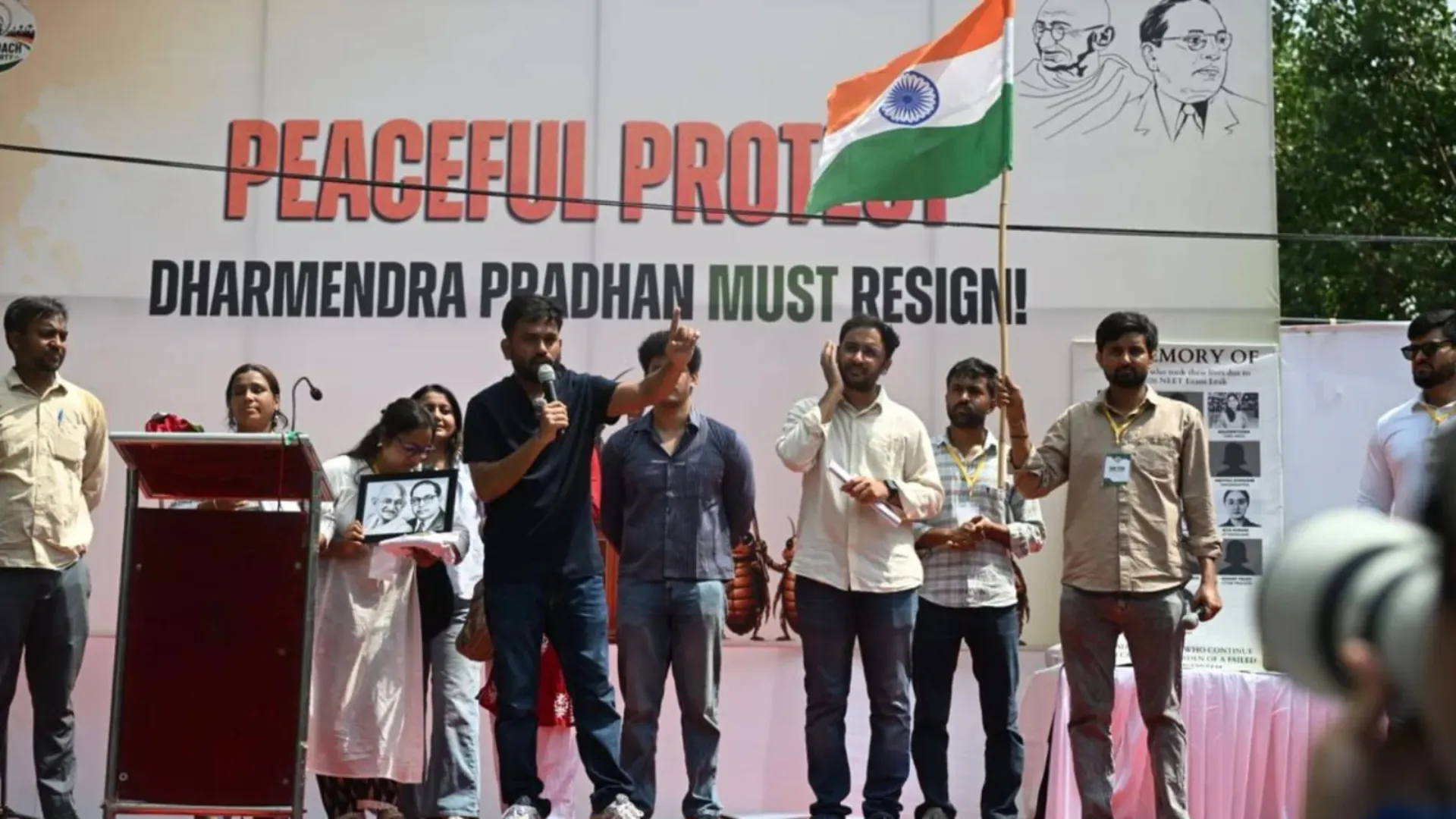
Thousands of protesters descended upon Jantar Mantar in the heart of New Delhi on Saturday, June 20, 2026, as the Cockroach Janta Party staged its second large-scale demonstration in the national capital, turning the iconic protest venue into a sea of anger, satire, and genuine democratic expression. Demonstrators armed with steel plates and spoons banged them rhythmically in the summer heat, shouting "Go Pradhan Go" in repeated chorus, demanding that Union Education Minister Dharmendra Pradhan resign immediately over what they describe as deep-seated examination irregularities within the country's educational system.
The protest, organized by Abhijeet Dipke, the founder of the Cockroach Janta Party, drew participants from across Delhi and several neighboring states, marking a significant escalation in what has emerged as one of the most unexpected and talked-about political phenomena of recent times in India. The gathering attracted widespread public attention not only for its numbers but for the raw, unfiltered energy it brought to one of India's most historically significant protest sites.
A Movement Born From Satire That Became Impossible to Ignore
What began as a joke has transformed into a movement that established political parties are now scrambling to understand and respond to. Abhijeet Dipke, a student of public relations based in the United States, founded the Cockroach Janta Party in an almost entirely satirical spirit, describing his inspiration in terms that borrowed from Kafka's famous literary imagery. Within less than four days of its founding, the party had accumulated more than 1.6 lakh registered members and crossed 2 million followers on Instagram, a pace of growth that stunned political observers and social media analysts alike.
The party's name itself, a deliberate provocation, draws from the idea of representing those who are treated as invisible or disposable in society. It has struck a deep chord particularly among India's Generation Z, a demographic that feels increasingly alienated from traditional political structures while simultaneously being more politically aware and vocal than any generation before it. The CJP has achieved, in a matter of days, what many established political organizations spend years and enormous resources trying to build, and that fact alone has made it impossible to dismiss.
Dipke arrived at Jantar Mantar on Saturday afternoon to a rousing reception from the gathered crowd, who had been waiting in the punishing June heat. His presence energized the demonstration, which had already been building steadily since the early afternoon hours, with protesters arriving in waves from different parts of the city and surrounding regions.
Heavy Security and Surveillance Blanket the Capital
Authorities responded to the protest with an unprecedented level of security deployment across New Delhi. Multiple layers of barricades were installed around Jantar Mantar and the roads adjoining it, with vehicles being inspected at key entry and exit points throughout the city as part of broad preventive measures. Senior Delhi Police officers, including members of the force's senior leadership, were assigned direct field duties to personally oversee crowd management and ensure that law and order was maintained throughout the demonstration.
Reserve police forces were kept on active standby to respond to any untoward development. Officials also confirmed that authorities had granted formal permission for the demonstration to proceed, meaning the protest was entirely lawful in its organization. Closed-circuit television cameras were installed at and around the protest venue to monitor gatherings in real time, while approximately 270 body-worn cameras were distributed among police personnel deployed at the site, ensuring that all proceedings were fully documented and transparent.
The scale of the security apparatus speaks to how seriously the administration has taken this movement, even as it remains, at its surface level, an organization that presents itself through the language of irony and humor. The contrast between the party's satirical name and the government's serious security response has itself become a subject of commentary among political observers.
Sonam Wangchuk Joins the Call for Systemic Educational Reform
The protest drew notable voices beyond its own organizational leadership. Renowned activist and innovator Sonam Wangchuk addressed the assembled crowd, delivering a pointed and emotionally resonant message that cut through the noise and landed squarely on the central issue at stake. Speaking from the heart of one of India's most prominent protest venues, Wangchuk declared that the country's educational system will only change in any meaningful way when elected representatives send their own children to the same schools as everyone else.
His statement was not merely rhetorical. It encapsulated a fundamental grievance that drives the CJP movement, which is the perception that India's policymakers and their families are entirely insulated from the failures and inequalities of the very systems they are responsible for administering. When those in power have no personal stake in whether a public examination is fair or a public school is functional, there is little institutional incentive to fix what is broken. Wangchuk's words crystallized that frustration and were met with sustained applause from the gathered demonstrators.
The Specific Demand: Accountability for Examination Irregularities
At the core of the Cockroach Janta Party's protest is a specific and targeted demand. The protesters are calling for the resignation of Union Education Minister Dharmendra Pradhan, holding him personally accountable for examination irregularities that they argue have damaged the futures of millions of students across the country. Demonstrators also held up posters demanding that the National Testing Agency, known by its acronym NTA, be disbanded entirely.
The NTA has faced sustained scrutiny over how it administers and manages high-stakes national examinations that determine the academic futures of hundreds of thousands of young Indians every year. Questions around allotment errors, irregularities in processes, and a perceived lack of transparency and accountability have fed into a broader narrative of systemic failure within India's centralized educational administration. For young Indians who have spent years preparing for these examinations, the stakes could not be higher, and the sense of betrayal when the system fails them is proportionately intense.
The Broader Political Meaning of a Movement Built on Memes and Outrage
Political analysts and commentators have been watching the CJP phenomenon with a mixture of fascination and genuine uncertainty about what it means for Indian democracy's future. The movement's rapid rise has drawn comparisons to youth-led political mobilizations in Bangladesh and Nepal, where digitally synchronized anger proved capable of unsettling established political arrangements that had seemed immovable.
The CJP has aggregated its following through meme pages, Instagram reels, and semi-ironic political content, growing at speeds that traditional political organizations, with their hierarchies, district committees, and decades-long institutional memory, cannot realistically match or replicate. The fundamental question is whether politics organized primarily through synchronized emotional outrage and digital community can sustain itself beyond the initial moment of intensity.
Critics argue that movements organized around symbolic enemies and collective anger, rather than around detailed policy platforms and long-term political structures, tend to dissipate once the immediate emotional charge fades. Supporters counter that the CJP is doing something different from traditional populism, channeling genuine and legitimate grievance from a generation that has been politically overlooked, and that the satirical framing is a feature rather than a limitation, making the movement more honest about its own provisional and disruptive nature than most political formations care to be.
What is clear is that both the ruling Bharatiya Janata Party and opposition formations are paying close attention. The CJP has become, as analysts have noted, a kind of signal to every political party across the spectrum. The question of what that signal means, and what the correct political response to it is, remains actively contested. Some see the movement as an opportunity for established opposition parties to channel legitimate youth anger into organized political action. Others warn that any attempt by established parties to absorb or co-opt the CJP will destroy the very authenticity that gives it its power.
A Generation Demanding to Be Heard
What Saturday's protest made viscerally clear is that the Cockroach Janta Party, whatever its eventual political trajectory, has tapped into something real and substantial in the Indian public mood. The young men and women who stood in Delhi's summer heat banging plates and chanting slogans are not doing so because they find it amusing. They are doing so because they feel, deeply and genuinely, that the systems governing their futures are broken, that the people responsible for those systems are not being held to account, and that no one in the existing political establishment is listening to them with any real seriousness.
Whether the CJP develops into a durable political platform, serves as a pressure campaign that forces reform without converting into formal electoral politics, or fades as the digital moment that generated it moves on to something else, remains to be seen. What cannot be disputed is that on June 20, 2026, thousands of ordinary Indians stood at Jantar Mantar and made their voices heard in a way that the country's political establishment will not easily be able to forget.
The protest continues. Abhijeet Dipke has confirmed that the campaign demanding Dharmendra Pradhan's resignation will not stop until accountability is delivered.
Frequently Asked Questions
What is the Cockroach Janta Party and who founded it?
The Cockroach Janta Party or CJP was founded by Abhijeet Dipke, a public relations student based in the United States. It began as a satirical political formation but quickly gained massive traction, accumulating over 1.6 lakh members and 2 million Instagram followers in less than four days.
Why is the Cockroach Janta Party protesting at Jantar Mantar?
The CJP is demanding the immediate resignation of Union Education Minister Dharmendra Pradhan over examination irregularities linked to the National Testing Agency. Protesters also want the NTA to be completely disbanded.
What happened at the second CJP protest on June 20 2026?
Thousands of supporters gathered at Jantar Mantar in New Delhi on June 20 2026 for the CJP's second protest. Demonstrators banged steel plates and spoons while chanting Go Pradhan Go, demanding the education minister's resignation under heavy police security.
What did activist Sonam Wangchuk say at the CJP protest?
Sonam Wangchuk addressed the protesters and stated that India's education system will only change when elected representatives send their own children to the same schools as everyone else, highlighting the disconnect between policymakers and public institutions.
How did Delhi Police respond to the Cockroach Janta Party protest?
Delhi Police deployed extensive security measures including multiple barricade layers, vehicle checks, CCTV surveillance, and around 270 body-worn cameras on personnel. Senior officers were assigned field duties and reserve forces were kept on standby throughout the demonstration.
Why are protesters demanding the disbanding of the NTA?
Protesters blame the National Testing Agency for examination irregularities, allotment errors, and a lack of transparency in managing high-stakes national exams that determine the futures of hundreds of thousands of students across India each year.
What makes the Cockroach Janta Party politically significant?
The CJP achieved in days what established parties take years to build in terms of membership and public following. Its rapid rise through social media and Gen Z engagement has drawn comparisons to youth-led movements in Bangladesh and Nepal that successfully challenged entrenched political arrangements.
Is the Cockroach Janta Party protest legally permitted?
Yes. Delhi authorities officially granted permission for the CJP demonstration at Jantar Mantar, making it a fully lawful and authorized public protest.
Edit Profile
Help improve @KR

Was this page helpful to you?
Contact Khogendra Rupini
Are you looking for an experienced developer to bring your website to life, tackle technical challenges, fix bugs, or enhance functionality? Look no further.
I specialize in building professional, high-performing, and user-friendly websites designed to meet your unique needs. Whether it's creating custom JavaScript components, solving complex JS problems, or designing responsive layouts that look stunning on both small screens and desktops, I can collaborate with you.
Create something exceptional with us. Contact us today
Open for Collaboration
If you're looking to collaborate, I'm available for a variety of professional services, including -
- Website Design & Development
- Advertisement & Promotion Setup
- Hosting Configuration & Deployment
- Front-end & Back-end Code Implementation
- Code Testing & Optimization
- Cybersecurity Solutions & Threat Prevention
- Website Scanning & Malware Removal
- Hacked Website Recovery
- PHP & MySQL Development
- Python Programming
- Web Content Writing
- Protection Against Hacking Attempts