
Strait of Hormuz at the Centre of a Deepening Standoff as Iran Warns Ships, Rubio Rallies Gulf Allies and War Clouds Refuse to Clear Over West Asia
As the fragile ceasefire between the United States and Iran enters its most turbulent diplomatic phase, a new flashpoint has emerged at one of the world's most strategically vital chokepoints. The Strait of Hormuz, through which roughly one fifth of the world's oil supply passes every single day, has become the arena of a dangerous confrontation between Tehran's Revolutionary Guards and Washington's top diplomat, with the future of global energy security and a tentative peace deal hanging in the balance.
On Thursday, June 25, Iran's Islamic Revolutionary Guard Corps issued a stark and unambiguous warning to all vessels operating in the Strait of Hormuz, declaring that the only authorised route through the waterway was one designated by the Islamic Republic of Iran. "Any crossing without authorisation is unacceptable and extremely dangerous," the IRGC stated, adding that non-compliant vessels "will be dealt with." The statement sent a visible chill through global shipping markets, where oil prices had already been sliding, with Brent crude falling 1.65 percent to $72.52 per barrel and WTI dropping to $69.32, both hitting their lowest levels since February 27, the eve of the Iran war.
The Iranian warning came in direct response to what the IRGC described as a new route through the Strait announced by "certain authorities" without coordination with Tehran. That route, laid out by Oman alongside the International Maritime Organisation, a United Nations agency overseeing global shipping, hugs the coastlines of the United Arab Emirates and Oman before curving around Oman's Musandam Peninsula. The route was tested on Thursday when a Liberian oil tanker, the Stoic Warrior, successfully navigated the Strait using the new corridor in what observers are calling a direct, if quiet, challenge to Iran's claimed jurisdiction over the passage.
The Stoic Warrior's transit unfolded with global attention. The vessel followed the Omani corridor closely, signalling its intent before departure and completing the journey without incident. Its passage illustrated both the determination of shipping interests to resume normal operations after months of disruption and the unresolved tension over who, if anyone, has the authority to regulate movement through one of international law's most fiercely protected waterways.
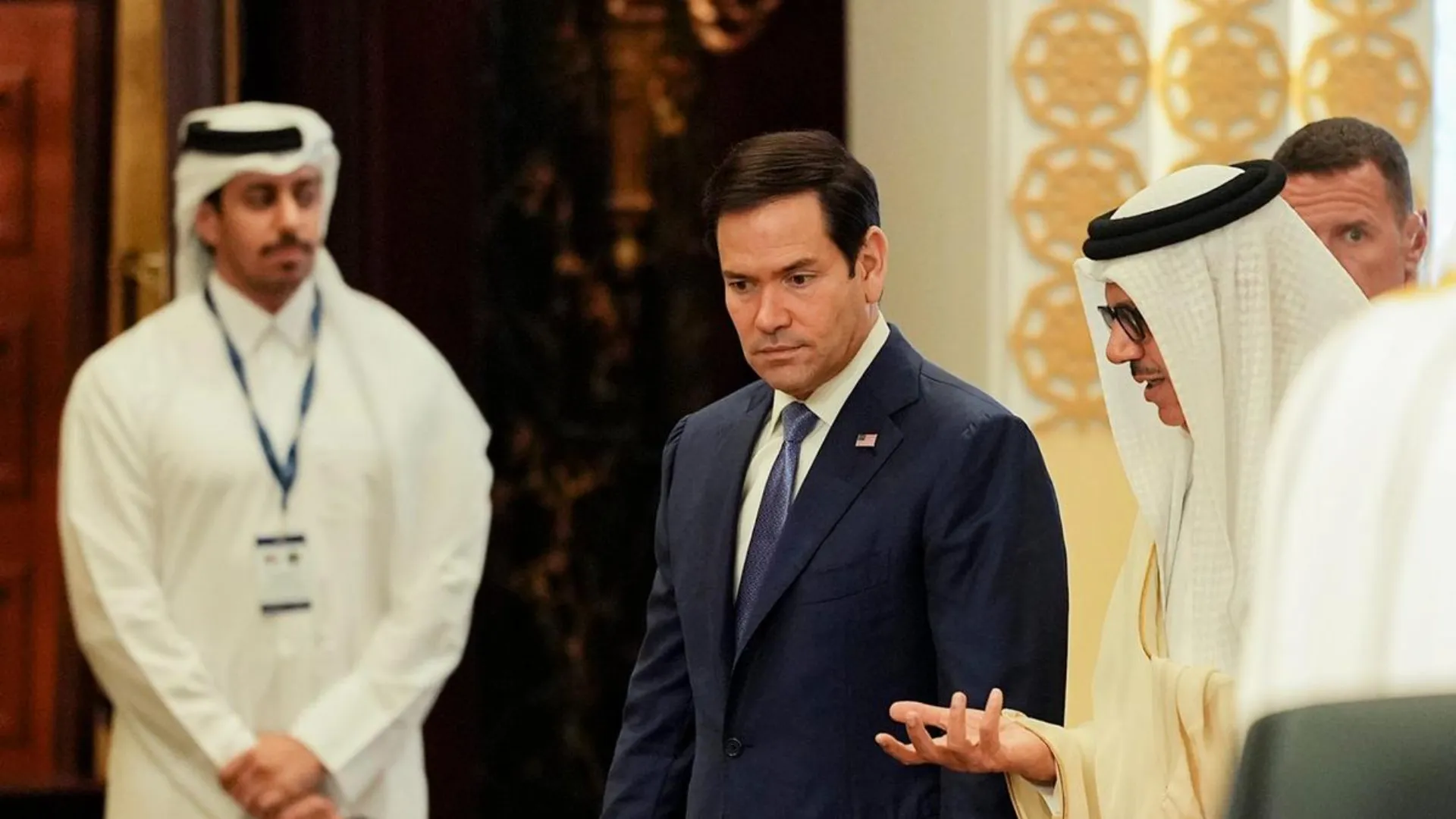
U.S. Secretary of State Marco Rubio, speaking at a Gulf Cooperation Council meeting in the Bahraini capital Manama, where he arrived Wednesday night, addressed the Hormuz standoff with unmistakable urgency. "International waterways do not belong to any nation state," he declared. "This is a foundational principle in the world today, without which the world would be in total chaos." He warned that if the principle of charging fees for passage through an international waterway were accepted, "this will spread throughout the world like a contagion," moving from Hormuz to other vital straits and sea lanes with potentially catastrophic consequences for global trade.
Rubio said there was zero support among Gulf nations for any toll or fee regime on Hormuz, a position echoed by Oman's Foreign Minister Badr Albusaidi, who stated plainly that future arrangements regarding the Strait "do not entail the imposition of any transit fees." Bahrain's Foreign Minister Abdullatif bin Rashid Al Zayani went further, welcoming Oman's maritime corridor as a constructive and practical step toward restoring safe passage for vessels.
Iran, however, has drawn a clear distinction between what it calls maritime service fees and the tolls that Washington and Gulf capitals are objecting to. Tehran has framed its proposed charges as a legitimate recovery of costs associated with maintaining navigational safety, a framing that has found little acceptance among its neighbours or the United States. The semantic battle over the difference between a fee and a toll is not merely technical. It reflects a deeper disagreement over whether Iran has any legitimate authority to regulate or monetise passage through international waters.
While the Hormuz confrontation dominated headlines, the broader geopolitical landscape across West Asia remained deeply unsettled. Secretary Rubio's visit to Bahrain, the final stop on a regional tour that also included Kuwait and the United Arab Emirates, was explicitly designed to shore up Gulf confidence in the interim deal signed last week between Washington and Tehran. That deal ended active hostilities across multiple fronts, including Lebanon, and committed both sides to talks aimed at a permanent settlement. But Gulf Arab nations, many of which were struck by Iranian missiles and drones during the conflict and saw their oil exports effectively blockaded for months, remain deeply sceptical that the agreement adequately protects their interests.
Rubio sought to address those fears directly. "While we want a deal, we don't want a deal at any price," he told Gulf foreign ministers assembled in Manama. "We want to ensure that there is no part of this deal that in any way undermines the security, the stability, or the prosperity of any of our partners in the Gulf region." He reiterated that the United States would remain "completely aligned" with Gulf partners and would consult them on every significant decision taken in negotiations with Iran.
Pakistan, which has played a quiet but meaningful role in facilitating communication between Washington and Tehran, confirmed on Wednesday night that talks aimed at finalising a permanent ceasefire are expected to resume next week, likely on Tuesday. Pakistan's foreign office spokesperson Tahir Andrabi described the current pause as "a temporary gap" rather than a breakdown, saying "parties are on the table" and that the process was moving forward. The confirmation provided some reassurance to markets and governments watching nervously for signs that the ceasefire process might be unravelling.
In Lebanon, however, the picture remained complicated and contradictory. A U.S. State Department official stated publicly that Israel had already taken a concrete step by pulling back from part of its so-called buffer zone in southern Lebanon, describing the move as "a significant demonstration of good faith toward Lebanon's legitimate government." Senior Israeli and Lebanese officials flatly denied this. A senior Israeli defence official said clearly that the military would not be withdrawing from the buffer zone, while a senior Lebanese military official said developments on the ground in recent days "show the opposite of a pullback," noting that Israeli forces had been enforcing the buffer zone against anyone approaching it, including Lebanese Army troops.
The commander of Iran's Revolutionary Guards' Quds Force, Esmaeil Qaani, added a sharper edge to the dispute, warning that Israel must withdraw from Lebanon's entire territory voluntarily or be forced to retreat in defeat. He was speaking after Tehran interpreted the interim deal's commitment to Lebanon's sovereignty and territorial integrity as explicitly requiring Israeli withdrawal from the south of the country, a reading Israel has not accepted.
The violence in Lebanon has not paused during the diplomatic maneuvering. An Israeli drone strike on a vehicle on a road between Zawtar and Mayfadoun in southern Lebanon killed three people on Thursday, according to Lebanon's state run National News Agency, with one additional person wounded. It was the third deadly incident since Tuesday, bringing the death toll from Israeli strikes during the week to seven. These strikes occurred even as Lebanese and Israeli officials held a fifth round of direct negotiations in Washington.
One Israeli soldier was also killed on Thursday during what the Israeli military described as "operational activity" in southern Lebanon, without providing further details. The death underscores the reality that even as diplomats talk, the conflict on the ground has not truly ended.
The domestic political situation in Washington added another layer of turbulence to an already complex week. President Donald Trump's administration formally asked Congress on Wednesday for $87.6 billion in supplemental funding, the vast majority of it tied to the Iran war. The request, which comes on top of roughly $1 trillion appropriated last year and a further $1.5 trillion sought for next year, covers operational costs, the rebuilding of weapons stocks, support for military personnel and readiness, and classified programmes. It includes $21 billion specifically for munitions procurement and industrial base strengthening.
The funding request landed against a charged backdrop. Senate Republicans who had faced a furious face-to-face dressing down from Trump on Tuesday, after a war powers resolution passed the chamber, convened a late-night vote on Wednesday to reject a second similar resolution, this one designed to prevent Trump from continuing military operations against Iran without Congressional authorisation. The reversal was widely read as an attempt to appease a president who had publicly berated his own party's senators for what he described as a dangerous undermining of his wartime authority.
Trump added to the week's unsettled mood when he addressed reporters about the February 28 strike on a girls' school in Minab, in southern Iran, on the first day of the war that killed scores of children. An initial U.S. military investigation reported by Reuters in March found that American forces were likely responsible. The Pentagon has since elevated the inquiry but has not publicly acknowledged those preliminary findings. Asked about the probe, Trump said, "I don't know that they are ever going to solve that problem," a comment that drew sharp criticism from human rights observers and families of victims.
Iran responded to separate remarks by NATO Secretary General Mark Rutte, who confirmed during a Fox News interview that American aircraft had launched from bases in Italy and that Romania had limited commercial air traffic to support tanker operations during the war. Tehran's foreign ministry spokesman Esmaeil Baqaei condemned what he called a "clear and damning admission of NATO's active complicity in an unlawful war of aggression against a sovereign UN Member State," accusing the alliance of violating peremptory norms of international law.
Amid all of this, Shiite Muslims around the world marked Ashoura on Thursday, the holy day commemorating the martyrdom of Imam Hussein at the Battle of Karbala in 680 AD. The observance carried heightened significance this year, coming after months of devastating war in Iran and Lebanon, home to two of the world's largest Shiite populations. The grief of Ashoura and the grief of recent months have, for millions of people, become inseparable.
Analysts watching the trajectory of the U.S.-Iran interim deal have noted that the political figure who may bear the greatest long-term cost of the agreement is Israeli Prime Minister Benjamin Netanyahu. For decades, Netanyahu built his political identity around the claim that he alone could hold Washington and Jerusalem in strategic alignment on the question of Iran, using his relationships with successive American presidents and the Republican Party to ensure that no deal unfavourable to Israel would emerge. The interim accord, reached without Israeli approval and against Netanyahu's sustained objections, has challenged that identity at its foundations, leaving analysts to ask whether the political capital he accumulated over thirty years on the Iran question has now been fundamentally depleted.
The coming days will test whether the fragile architecture of the interim deal can hold under the weight of these overlapping pressures. Iran's stance on Hormuz, the unresolved question of Israeli forces in Lebanon, the political turbulence in Washington, and the deep anxieties of Gulf allies who feel the terms of peace were negotiated without adequate regard for their safety, all represent fault lines that could widen rapidly. The world is watching the Strait of Hormuz not merely as a shipping lane but as a measure of whether the ceasefire represents a genuine turning point or simply a pause before the next eruption.
Frequently Asked Questions
What is the primary concern raised by U.S. Secretary of State Marco Rubio regarding the Strait of Hormuz?
U.S. Secretary of State Marco Rubio warned that Iranian plans to impose maritime tolls or service fees on ships passing through the Strait of Hormuz could spread to other international waterways like a contagion, risking total global chaos.
What warning did Iran's Revolutionary Guards issue concerning the Strait of Hormuz?
Iran's Revolutionary Guards warned that any vessels crossing the Strait of Hormuz without authorization or failing to comply with Iran-designated routes will be dealt with, calling unauthorized transit unacceptable and extremely dangerous.
What demands has Iran made regarding Israeli military presence in Lebanon?
Following a recent U.S.-Iran interim deal, the commander of the Iranian Revolutionary Guards’ Quds Force, Esmaeil Qaani, stated that Israel must withdraw entirely from Lebanon's territory on its own or face forced defeat.
Are Israeli forces currently pulling back from southern Lebanon according to local officials?
No. Despite a U.S. official claiming that Israel pulled back some troops as a good faith gesture, senior Israeli and Lebanese military officials both denied any withdrawal, noting instead that developments on the ground show the opposite.
When are the U.S.-Iran talks expected to resume, and where do they currently stand?
According to Pakistan's foreign office spokesperson, the talks are experiencing a temporary gap rather than a permanent break, and negotiations are expected to resume the following week, likely on Tuesday.
Why is Iraq considering leaving OPEC?
Iraq is suffering a severe financial crisis as a result of the war with Iran. If its oil production quota is not significantly increased by Saudi Arabia and other OPEC allies, the country is prepared to consider all options, including exiting the group.
How did oil prices react to the recent geopolitical updates in the Middle East?
Oil prices extended their decline, hitting their lowest levels since February 27. Brent crude fell to $72.52 a barrel and WTI dropped to $69.32 a barrel due to rising supply expectations in the Middle East.
What domestic political friction did President Trump face regarding the Iran war funding and powers?
President Trump face-to-face harangued Senate Republicans for initially passing a War Powers resolution to block his war in Iran. In response, the senators held a late-night vote to appease him, successfully rejecting the restrictive resolution, while Trump subsequently requested an additional $87.6 billion in war funding.
Edit Profile
Help improve @KR

Was this page helpful to you?
Contact Khogendra Rupini
Are you looking for an experienced developer to bring your website to life, tackle technical challenges, fix bugs, or enhance functionality? Look no further.
I specialize in building professional, high-performing, and user-friendly websites designed to meet your unique needs. Whether it's creating custom JavaScript components, solving complex JS problems, or designing responsive layouts that look stunning on both small screens and desktops, I can collaborate with you.
Create something exceptional with us. Contact us today
Open for Collaboration
If you're looking to collaborate, I'm available for a variety of professional services, including -
- Website Design & Development
- Advertisement & Promotion Setup
- Hosting Configuration & Deployment
- Front-end & Back-end Code Implementation
- Code Testing & Optimization
- Cybersecurity Solutions & Threat Prevention
- Website Scanning & Malware Removal
- Hacked Website Recovery
- PHP & MySQL Development
- Python Programming
- Web Content Writing
- Protection Against Hacking Attempts