Thailand and Cambodia Announce Immediate Ceasefire After Renewed Border Violence
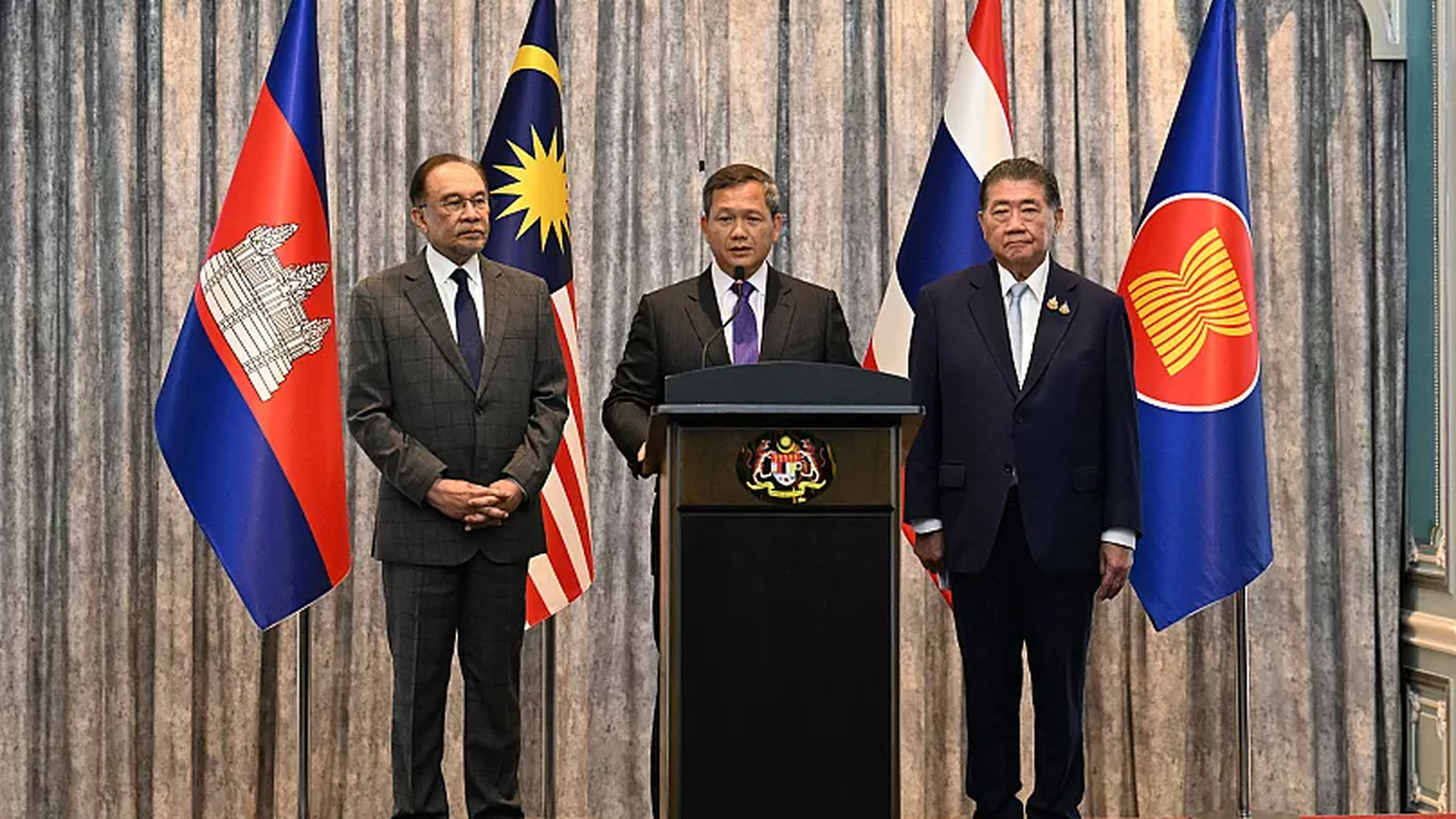
Thailand and Cambodia on Saturday agreed to an immediate ceasefire, bringing a pause to weeks of deadly clashes along their disputed border and marking the second truce attempt between the two neighbors this year.
The agreement comes amid rising regional concern after fighting intensified earlier this month following the collapse of a previous ceasefire reached in July.
In a joint statement issued after talks under the framework of the Special General Border Committee, officials from both sides confirmed that the ceasefire took effect at noon local time on December 27, 2025.
The statement said the truce applies to all areas and covers all forms of hostilities, including the use of heavy weapons and attacks on civilians, civilian infrastructure, and military targets.
The announcement raised cautious hopes for de escalation in a conflict that has once again placed Southeast Asia on edge.
While both governments publicly committed to halting violence, past experience has shown that ceasefire declarations do not always translate immediately into calm on the ground.
A fragile pause after weeks of escalation
The latest fighting erupted after a fragile July ceasefire broke down, with violence intensifying during December 8 and 9.
During this period, Thailand carried out airstrikes and artillery operations, while Cambodia responded with rocket fire.
The exchanges marked one of the most serious escalations in years between the two countries.
Clashes were reported across several contested stretches of the border, particularly around the Dangrek mountain range, a rugged area that runs along northeastern Thailand and northern Cambodia.
The terrain has long complicated border demarcation and enforcement, making it a recurring flashpoint whenever tensions rise.
Military officials on both sides accused each other of provocation during the recent escalation.
Thailand said it was acting to defend its territory and protect civilians, while Cambodia accused Thai forces of crossing disputed lines and using excessive force.
Ceasefire terms and commitments
According to the joint statement released by the Cambodian side, both governments agreed that the ceasefire would be comprehensive in scope.
It explicitly bans the use of all types of weapons and prohibits attacks against civilian populations and infrastructure.
The agreement also applies to all military objectives, regardless of location along the border.
Diplomats familiar with the talks said the language was deliberately broad to prevent loopholes that could allow limited operations to continue under the guise of defensive actions.
The aim, they said, was to create space for renewed dialogue and confidence building measures between the two sides.
However, officials stopped short of detailing enforcement mechanisms or independent monitoring arrangements.
This omission has raised questions about how violations would be verified and addressed if fighting resumes.
Deep historical roots of the dispute
The Thailand Cambodia border dispute dates back more than a century, with its roots in the early 1900s when boundary lines were drawn under French colonial administration in Cambodia.
Thailand has long argued that some of the maps produced during that period inaccurately defined the border and did not follow natural watershed lines referenced in earlier agreements.
These competing interpretations have fueled repeated disputes over territory, particularly around temples and high ground near the border.
While international legal rulings and bilateral agreements have clarified some sections, other areas remain contested.
This has left room for periodic confrontations.
Over the decades, both countries have sought to manage the dispute through joint commissions, military level talks, and diplomatic engagement.
Yet domestic political pressures and nationalist sentiment have often complicated efforts to reach lasting solutions.
United States involvement and diplomatic efforts
During the December escalation, United States President Donald Trump said he had spoken separately with the leaders of Thailand and Cambodia.
He claimed they had agreed in principle to stop the fighting.
He described the discussions as positive and said both governments had pledged to cease all shooting and work toward restoring a peace arrangement similar to previous ceasefires.
Those comments initially raised expectations that Washington might play a mediating role in stabilizing the situation.
However, reports of continued clashes soon emerged.
This highlighted a gap between diplomatic statements and realities on the ground.
Officials in both Bangkok and Phnom Penh later confirmed that outreach from the United States had taken place.
They stressed that conditions for a full ceasefire had not yet been met at the time.
Military commanders, they said, remained concerned about ongoing threats and unresolved tactical issues along the border.
Thailand signals caution despite truce
Even as the ceasefire was announced, Thai leaders emphasized that the situation remains fragile.
Thailand caretaker Prime Minister Anutin Charnvirakul confirmed that he had spoken with President Trump.
He said Thai military operations would continue if threats to Thai territory or civilians persisted.
Anutin accused Cambodian forces of breaching earlier ceasefire commitments.
He warned that Thailand would not hesitate to act in self defense.
His remarks underscored lingering mistrust between the two sides.
They also suggested that the new ceasefire could be tested quickly if incidents occur along the border.
Cambodian officials, for their part, have denied violating previous agreements.
They have urged Thailand to fully respect the terms of the latest truce.
They say Cambodia remains committed to a peaceful resolution and to addressing disputes through dialogue rather than force.
Regional implications and concerns
The renewed violence and the subsequent ceasefire have drawn attention from across Southeast Asia.
Stability along borders is seen as essential for economic growth and regional cooperation.
Neighboring countries have quietly urged restraint.
They are concerned that prolonged fighting could disrupt trade routes and undermine confidence in regional security frameworks.
Analysts say the Thailand Cambodia clashes also highlight the challenges facing conflict management.
This is particularly true in areas where historical grievances intersect with modern military capabilities.
The use of fighter jets, rockets, and artillery marked a significant intensification compared with earlier skirmishes.
This raised the risk of civilian casualties and broader instability.
Humanitarian groups have expressed concern about civilians living near the border.
Many have faced displacement during previous flare ups.
While there have been no comprehensive casualty figures released, officials on both sides have acknowledged deaths and injuries.
The road ahead
Whether the immediate ceasefire will hold remains uncertain.
Past agreements have faltered due to mistrust, miscommunication, and unresolved territorial claims.
Without clear monitoring mechanisms and sustained political engagement, experts warn that even minor incidents could spiral into renewed violence.
Still, the decision by Thailand and Cambodia to formally commit to halting hostilities offers a narrow but important opportunity.
Diplomats say the coming days will be critical.
Military commanders will test restraint.
Political leaders will work to translate words on paper into real calm on the ground.
For now, the ceasefire has paused a dangerous escalation.
It has provided a chance for renewed talks.
Whether it becomes the foundation for lasting peace or merely another brief lull will depend on the willingness of both sides.
As Southeast Asia watches closely, the hope is that this second ceasefire of the year will succeed where earlier efforts failed.
Edit Profile
Help improve @KR

Was this page helpful to you?
Contact Khogendra Rupini
Are you looking for an experienced developer to bring your website to life, tackle technical challenges, fix bugs, or enhance functionality? Look no further.
I specialize in building professional, high-performing, and user-friendly websites designed to meet your unique needs. Whether it’s creating custom JavaScript components, solving complex JS problems, or designing responsive layouts that look stunning on both small screens and desktops, I can collaborate with you.
Create something exceptional with us. Contact us today
Open for Collaboration
If you're looking to collaborate, I’m available for a variety of professional services, including -
- Website Design & Development
- Advertisement & Promotion Setup
- Hosting Configuration & Deployment
- Front-end & Back-end Code Implementation
- Code Testing & Optimization
- Cybersecurity Solutions & Threat Prevention
- Website Scanning & Malware Removal
- Hacked Website Recovery
- PHP & MySQL Development
- Python Programming
- Web Content Writing
- Protection Against Hacking Attempts