OpenAI co founder Greg Brockman faces scrutiny in Elon Musk lawsuit as $30 billion stake and nonprofit shift come under spotlight
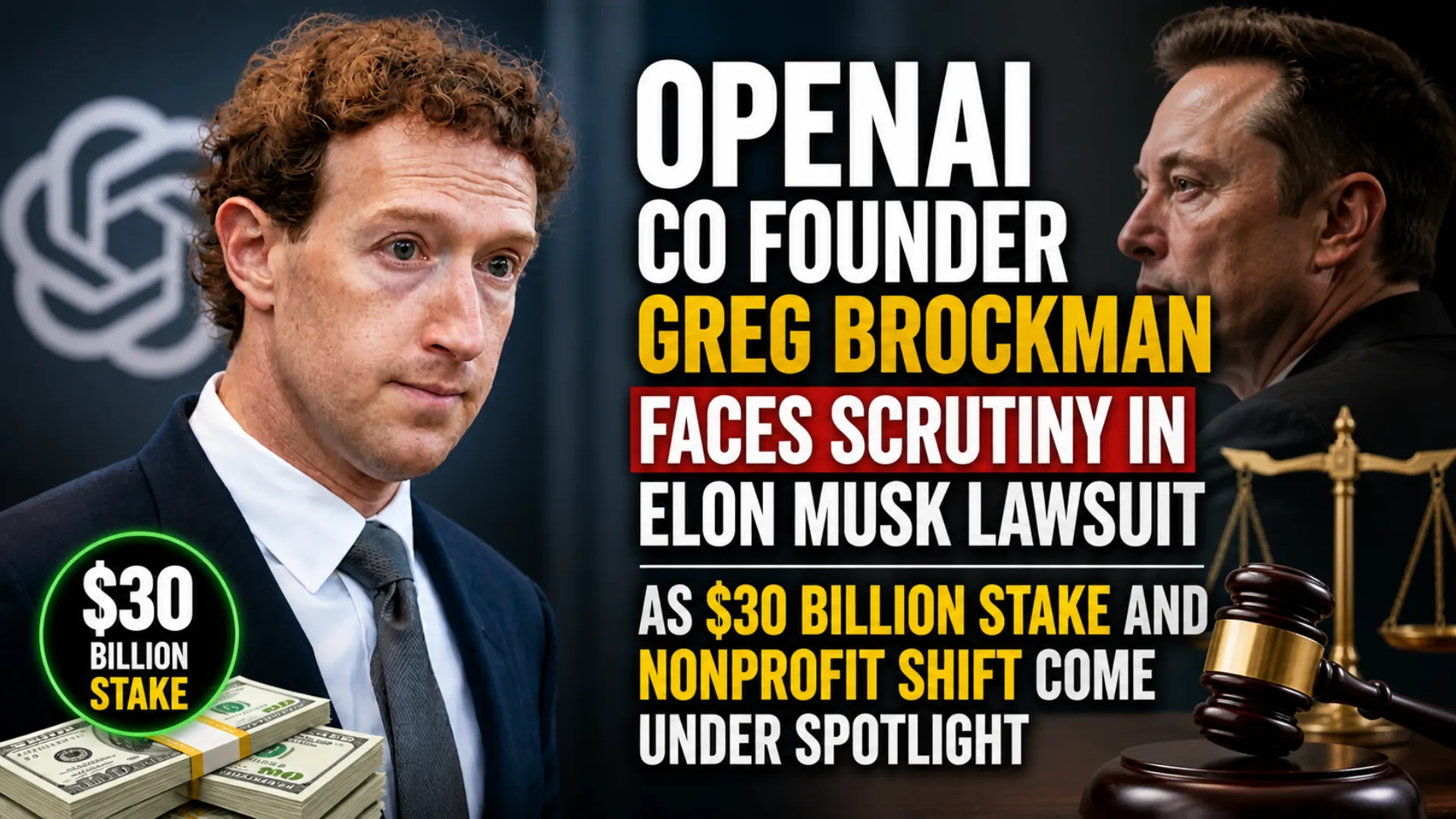
In a closely watched courtroom battle that could reshape the future of artificial intelligence, OpenAI co founder took the witness stand in California as part of a high stakes lawsuit brought by billionaire . The case, unfolding in an Oakland courtroom near San Francisco, has drawn global attention for its implications on the governance, ethics, and commercial trajectory of one of the world’s most influential AI companies.
The testimony comes days after Musk himself addressed the court, framing the dispute as a fundamental clash over OpenAI’s original mission. At the center of the case lies a critical question: whether OpenAI abandoned its founding principles as a nonprofit research entity in favor of building a multi hundred billion dollar commercial enterprise.
Courtroom testimony puts OpenAI’s founding intentions under the microscope
Appearing before the jury, Brockman acknowledged that he currently holds a stake in OpenAI valued at approximately $30 billion, despite not having made a personal financial investment in the company. The disclosure became a focal point of questioning by Musk’s legal team, which is attempting to establish that OpenAI’s leadership benefited financially from a shift away from its original nonprofit structure.
Musk’s attorney, Steven Molo, presented a 2015 email in which Brockman had pledged to donate $100,000 to help attract early funding from Silicon Valley donors. Brockman conceded in court that the donation was never made.
The exchange was part of a broader strategy by Musk’s legal team to argue that OpenAI’s founders, including Brockman and CEO , steered the organization away from its philanthropic roots toward a profit driven model that now dominates the global AI landscape.
Musk seeks return to nonprofit structure as stakes rise for AI industry
Musk, an early supporter of OpenAI, is seeking a court order to force the company to revert to its original nonprofit foundation. He testified last week that he contributed approximately $38 million between 2016 and 2020, positioning himself as a founding benefactor committed to ensuring that advanced AI would serve humanity rather than corporate interests.
During his testimony, Musk argued that his involvement was driven by concerns over the growing dominance of major technology players, particularly , in the AI sector. He maintained that OpenAI was intended to act as a counterbalance to such power, prioritizing safety and openness over profit.
The outcome of the case could significantly impact OpenAI’s future, including its reported plans for an initial public offering. With the company now valued at over $850 billion, any legal ruling that alters its structure could reverberate across the global technology market.
Brockman defends commercial pivot as aligned with original mission
In his testimony, Brockman pushed back against claims that OpenAI had deviated from its founding ideals. He described artificial intelligence as “the most important technological shift in human history” and argued that the organization’s evolution into a commercial entity was necessary to fulfill its broader mission.
According to Brockman, OpenAI’s hybrid structure, which includes both nonprofit and for profit components, has enabled it to build what he described as “the most well resourced nonprofit in history,” with more than $150 billion in equity value tied to its operations.
He emphasized that the organization has not diverted resources away from its nonprofit arm but instead strengthened its ability to pursue long term research and safety initiatives.
Legal tensions intensify as personal and competitive motives emerge
The courtroom drama has also revealed deep personal and professional tensions between Musk and OpenAI’s leadership. Once collaborators, Musk and Altman are now positioned as direct rivals in the rapidly evolving AI race.
OpenAI’s legal team has argued that Musk’s lawsuit is motivated not by principle but by competition. In 2023, Musk launched his own AI venture, , along with its chatbot Grok, positioning himself as a direct challenger to OpenAI’s dominance.
Attorneys for OpenAI have suggested that Musk is using the legal system to slow down a competitor and gain strategic advantage in the AI market. This argument gained further attention after reports that Musk recently integrated xAI into , a company reportedly valued at around $1.25 trillion and also exploring the possibility of a public offering.
Disputed message highlights escalating conflict between key figures
In a dramatic development, OpenAI’s legal team sought to introduce a message allegedly sent by Musk shortly before the trial began. According to court filings, Musk warned that Brockman and Altman would become “the most hated men in America” if the case proceeded.
However, the presiding judge, , denied the request to present the message to the jury, ruling that it should have been introduced earlier during Musk’s testimony.
The decision underscores the tightly controlled nature of the proceedings and the high stakes involved, with both sides carefully managing the narrative presented to the court.
Global AI competition forms backdrop to landmark legal battle
Beyond the personal and financial dimensions of the case, the lawsuit is unfolding against a backdrop of intense global competition in artificial intelligence. OpenAI, widely recognized for developing ChatGPT, faces growing challenges from both established technology giants and emerging players.
Companies such as Google and Chinese tech firms are investing heavily in AI capabilities, while rivals like have introduced competing models such as Claude. These developments are driving rapid innovation but also raising questions about governance, safety, and the concentration of power in the AI sector.
Despite generating tens of billions of dollars in annual revenue, AI companies continue to require massive investments to sustain growth. The costs associated with recruiting top talent, acquiring advanced processors, and building large scale data centers remain significant, reinforcing the importance of capital intensive business models.
Verdict could redefine OpenAI’s future and influence tech industry direction
As the trial progresses, all eyes are on the potential implications of the final ruling. While the jury will provide its opinion, the ultimate decision rests with Judge Gonzalez Rogers. A verdict in favor of Musk could disrupt OpenAI’s plans for an IPO and force a restructuring that alters its competitive position.
Such an outcome would not only impact OpenAI but could also set a precedent for how emerging technologies are governed and financed. It may influence how future AI ventures balance public interest with commercial viability.
Conversely, a ruling in favor of OpenAI would reinforce the legitimacy of hybrid nonprofit and for profit models in the technology sector, potentially encouraging similar structures across the industry.
A defining moment for AI governance and accountability
The Musk versus OpenAI lawsuit represents more than a corporate dispute. It is a defining moment in the evolution of artificial intelligence, raising fundamental questions about accountability, transparency, and the role of profit in shaping technologies that could transform society.
As testimony continues and key figures, including Sam Altman, prepare to take the stand in the coming days, the case is expected to deliver further revelations. For now, Brockman’s testimony has added a new layer of complexity to an already high stakes legal battle, one that could leave a lasting mark on the future of AI.
Frequently Asked Questions
What is the main issue in Elon Musk’s lawsuit against OpenAI?
Elon Musk claims OpenAI abandoned its original nonprofit mission and shifted toward a profit driven model, and he is seeking to force the company to return to a purely nonprofit structure.
Why did Greg Brockman testify in the trial?
Greg Brockman was called by Musk’s legal team to explain OpenAI’s evolution and address claims that its founders benefited financially from the company’s transition to a commercial entity.
What did Greg Brockman reveal about his stake in OpenAI?
Brockman acknowledged that he holds a stake in OpenAI valued at about $30 billion, despite not having personally invested money into the company.
How did Brockman defend OpenAI’s shift to a commercial model?
He argued that the commercial structure supports the company’s mission by enabling large scale investment and resources, calling it necessary for advancing artificial intelligence for humanity.
What role did Elon Musk play in OpenAI’s early development?
Musk was an early supporter who testified that he contributed around $38 million between 2016 and 2020 to help build OpenAI as a nonprofit focused on safe AI development.
What is at stake for OpenAI in this trial?
The outcome could affect OpenAI’s corporate structure and its planned IPO, potentially reshaping its valuation and position in the global AI market.
Why does OpenAI argue that Musk’s lawsuit is motivated by competition?
OpenAI’s legal team claims Musk is acting out of rivalry after launching his own AI company xAI, suggesting the lawsuit aims to slow down a competing organization.
What decision did the judge make regarding Musk’s alleged message?
The judge denied OpenAI’s request to present a message allegedly sent by Musk, ruling that it should have been introduced earlier during his testimony.
How could the trial impact the global AI industry?
A ruling could influence how AI companies balance nonprofit goals with commercial operations, potentially setting a precedent for governance and funding models across the industry.
Who are the key figures expected to testify next?
OpenAI CEO Sam Altman is expected to testify in the following week, which could provide further insights into the company’s strategy and internal decisions.
Edit Profile
Help improve @KR

Was this page helpful to you?
Contact Khogendra Rupini
Are you looking for an experienced developer to bring your website to life, tackle technical challenges, fix bugs, or enhance functionality? Look no further.
I specialize in building professional, high-performing, and user-friendly websites designed to meet your unique needs. Whether it's creating custom JavaScript components, solving complex JS problems, or designing responsive layouts that look stunning on both small screens and desktops, I can collaborate with you.
Create something exceptional with us. Contact us today
Open for Collaboration
If you're looking to collaborate, I'm available for a variety of professional services, including -
- Website Design & Development
- Advertisement & Promotion Setup
- Hosting Configuration & Deployment
- Front-end & Back-end Code Implementation
- Code Testing & Optimization
- Cybersecurity Solutions & Threat Prevention
- Website Scanning & Malware Removal
- Hacked Website Recovery
- PHP & MySQL Development
- Python Programming
- Web Content Writing
- Protection Against Hacking Attempts