
Google and Accel Back Five AI Startups in India, Rejecting Thousands of “Wrapper” Ideas
info Synopsis: Google and Accel have selected five AI startups for their Atoms accelerator in India, rejecting thousands of applications dominated by “AI wrapper” ideas built on existing models. The program will provide funding and cloud credits to startups developing deeper AI innovations across research, enterprise automation, media creation, and industrial manufacturing.
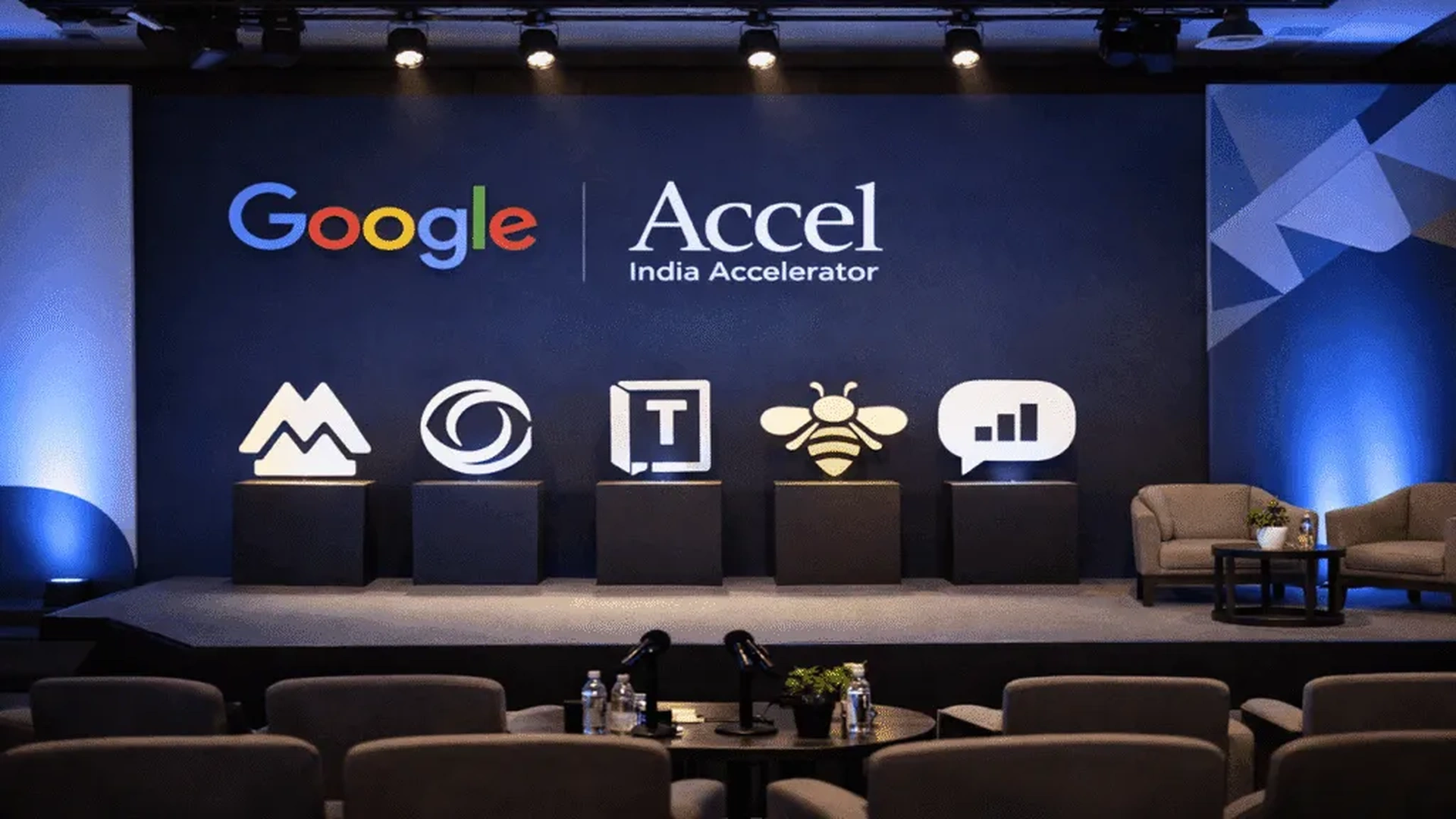
Google and venture capital firm Accel have selected five startups for the latest cohort of their AI-focused accelerator in India, deliberately avoiding companies built as simple “AI wrappers” on top of existing models.
The program, called Atoms, aims to support early-stage startups building artificial intelligence products tied to India’s growing technology ecosystem. The selected companies will receive up to $2 million in funding from Accel and Google’s AI Futures Fund, along with as much as $350,000 in cloud and AI compute credits from Google.
The decision highlights a growing shift among investors who are increasingly wary of startups that rely heavily on existing AI models without introducing fundamentally new products or workflows.
Investors turn away from “AI wrapper” startups
According to Accel partner Prayank Swaroop, the accelerator reviewed more than 4,000 applications, with the majority failing to meet the program’s criteria for meaningful innovation.
Roughly 70% of rejected submissions were categorized as “wrappers” — startups that simply layered AI features, such as chatbots, onto existing software products.
“These companies were not reimagining new workflows using AI,” Swaroop said, explaining why they were filtered out early in the selection process.
The concern reflects a broader trend in the venture capital market. As major AI model developers continue to expand capabilities within their platforms, startups that build thin layers on top of those models risk becoming obsolete if the underlying providers add similar features directly.
Many applicants clustered in crowded enterprise sectors
Beyond the rejected wrapper concepts, many applications were declined because they operated in already saturated categories.
Swaroop said large numbers of startups focused on areas such as marketing automation and AI-driven recruitment tools, sectors where differentiation has become increasingly difficult.
Startups operating in those categories often struggled to demonstrate meaningful technological or market advantages over competitors, he said.
The accelerator program also saw a surge in participation compared with previous years. This year’s cohort received nearly four times as many applications as earlier Atoms programs, with a large share coming from first-time founders.
Enterprise-focused AI dominates India’s startup pipeline
The submissions offered a snapshot of how India’s AI startup ecosystem is currently evolving.
According to the program’s analysis:
62% of applications focused on productivity tools
13% targeted software development and coding
Together, those sectors accounted for roughly three-quarters of all submissions, indicating a strong tilt toward enterprise software rather than consumer products.
Swaroop noted he had hoped to see more innovation in healthcare and education, areas where AI could have significant societal impact but were less represented in the applicant pool.
Google sees startups as a testing ground for real-world AI use
For Google, the accelerator serves a strategic purpose beyond funding early-stage companies.
Jonathan Silber, co-founder and director of Google’s AI Futures Fund, said the program helps the company understand how its AI models perform in practical applications developed by startups.
Participants are not required to use Google’s AI models exclusively. Many companies combine multiple models depending on their workflow requirements.
That flexibility, Silber said, allows Google to gather honest feedback about where its models succeed — and where competitors may currently perform better.
“If a company is using an alternative model, that means Google has work to do to build the best model in the market,” Silber said.
Insights gathered from participating startups can be shared with Google DeepMind teams to improve future AI systems. Silber described the process as creating a “flywheel” between startup experimentation and AI development.
The five startups selected for the 2026 cohort
The latest Atoms cohort reflects areas where Google and Accel believe AI could see deeper real-world adoption.
- K-Dense, which is building an AI “co-scientist” to accelerate research in fields such as life sciences and chemistry;
- Dodge.ai, which develops autonomous agents for enterprise ERP systems;
- Persistence Labs, which focuses on voice AI for call centre operations;
- Zingroll, which is building a platform for AI-generated films and shows;
- Level Plane, which applies AI to industrial automation in automotive and aerospace manufacturing.
A signal of how AI investment priorities are shifting
The selection process reflects a broader shift in how investors are evaluating AI startups in 2026.
Early excitement around generative AI sparked a wave of companies building quick applications on top of large language models. But as the technology matures, investors are increasingly prioritizing startups that build new workflows, infrastructure, or domain-specific capabilities rather than simply adding AI features to existing tools.
The Atoms accelerator’s decision to reject thousands of wrapper-style ideas suggests that venture funding is beginning to favor deeper technological innovation over surface-level AI integration.
For India’s rapidly growing startup ecosystem, that shift may shape how the next generation of founders approaches building AI companies — pushing them to design products that rely not just on AI access, but on original applications that meaningfully transform how industries operate.

Edit Profile
Help improve @KR

Was this page helpful to you?
Contact Khogendra Rupini
Are you looking for an experienced developer to bring your website to life, tackle technical challenges, fix bugs, or enhance functionality? Look no further.
I specialize in building professional, high-performing, and user-friendly websites designed to meet your unique needs. Whether it’s creating custom JavaScript components, solving complex JS problems, or designing responsive layouts that look stunning on both small screens and desktops, I can collaborate with you.
Create something exceptional with us. Contact us today
Open for Collaboration
If you're looking to collaborate, I’m available for a variety of professional services, including -
- Website Design & Development
- Advertisement & Promotion Setup
- Hosting Configuration & Deployment
- Front-end & Back-end Code Implementation
- Code Testing & Optimization
- Cybersecurity Solutions & Threat Prevention
- Website Scanning & Malware Removal
- Hacked Website Recovery
- PHP & MySQL Development
- Python Programming
- Web Content Writing
- Protection Against Hacking Attempts