
NVIDIA Unveils DLSS 5 as Generative AI Enters Gaming Graphics Amid Strong Gamer Backlash
info Synopsis: NVIDIA unveiled DLSS 5 at GTC 2026, introducing generative AI that enhances and alters game visuals in real time. While it promises improved realism, gamers have criticized it as “AI slop,” arguing it changes original art styles. The tech offers developer control but has sparked debate over creativity and authenticity.
NVIDIA Unveils DLSS 5 as Generative AI Enters Gaming Graphics Amid Strong Gamer Backlash
NVIDIA has introduced its latest advancement in real time rendering technology, DLSS 5, during the opening keynote of its GPU Technology Conference 2026. Positioned as a major leap forward, CEO Jensen Huang described the innovation as a defining “GPT moment for graphics,” signaling a shift from traditional rendering methods toward generative AI driven visuals.
The announcement marks a significant evolution in NVIDIA’s Deep Learning Super Sampling lineup, which has historically focused on improving performance and image clarity through AI upscaling. With DLSS 5, the company is moving beyond enhancement into transformation, enabling AI to actively generate and modify visual details within a scene.
Unlike previous versions such as DLSS 4.5, which primarily improved resolution and sharpness, DLSS 5 introduces the ability to reinterpret textures, lighting, and even facial features in real time. This shift reflects a broader industry trend where artificial intelligence is not just assisting creative workflows but directly contributing to final visual outputs.
What DLSS 5 Actually Does Differently
At its core, DLSS 5 leverages a new end to end trained AI model capable of understanding complex scene elements. NVIDIA says the system can analyze a single rendered frame and identify components such as characters, skin textures, fabrics, and environmental lighting conditions.
Using this understanding, the technology generates additional visual information that was not originally present in the game’s rendering pipeline. This includes refined lighting interactions, enhanced material responses, and more detailed facial expressions.
For example, the system can simulate subsurface scattering on skin, improve the way light reflects off hair, and add subtle fabric sheen effects. These changes aim to deliver a more lifelike and cinematic experience without requiring developers to manually create these details.
Importantly, NVIDIA emphasizes that DLSS 5 is designed to preserve the structure and semantics of the original scene. Developers are also given granular control over parameters such as color grading, intensity, and masking to ensure that artistic intent remains intact.
Real Time Performance and Hardware Requirements
NVIDIA claims that DLSS 5 can operate in real time at resolutions up to 4K, making it suitable for modern high performance gaming setups. During its GTC demonstration, the company showcased the technology running on a dual RTX 5090 configuration.
However, NVIDIA clarified that DLSS 5 will also be fully functional on a single RTX 5090 GPU, suggesting that the technology is being optimized for consumer level hardware, at least at the high end.
This performance promise is crucial, as generative AI processes typically require substantial computational resources. Achieving real time output without compromising frame rates will be a key factor in determining the technology’s adoption across the gaming industry.
Game Demonstrations Highlight Visual Changes
To demonstrate DLSS 5 capabilities, NVIDIA presented several high profile game titles including Resident Evil Requiem, Starfield, Hogwarts Legacy, and EA Sports FC.
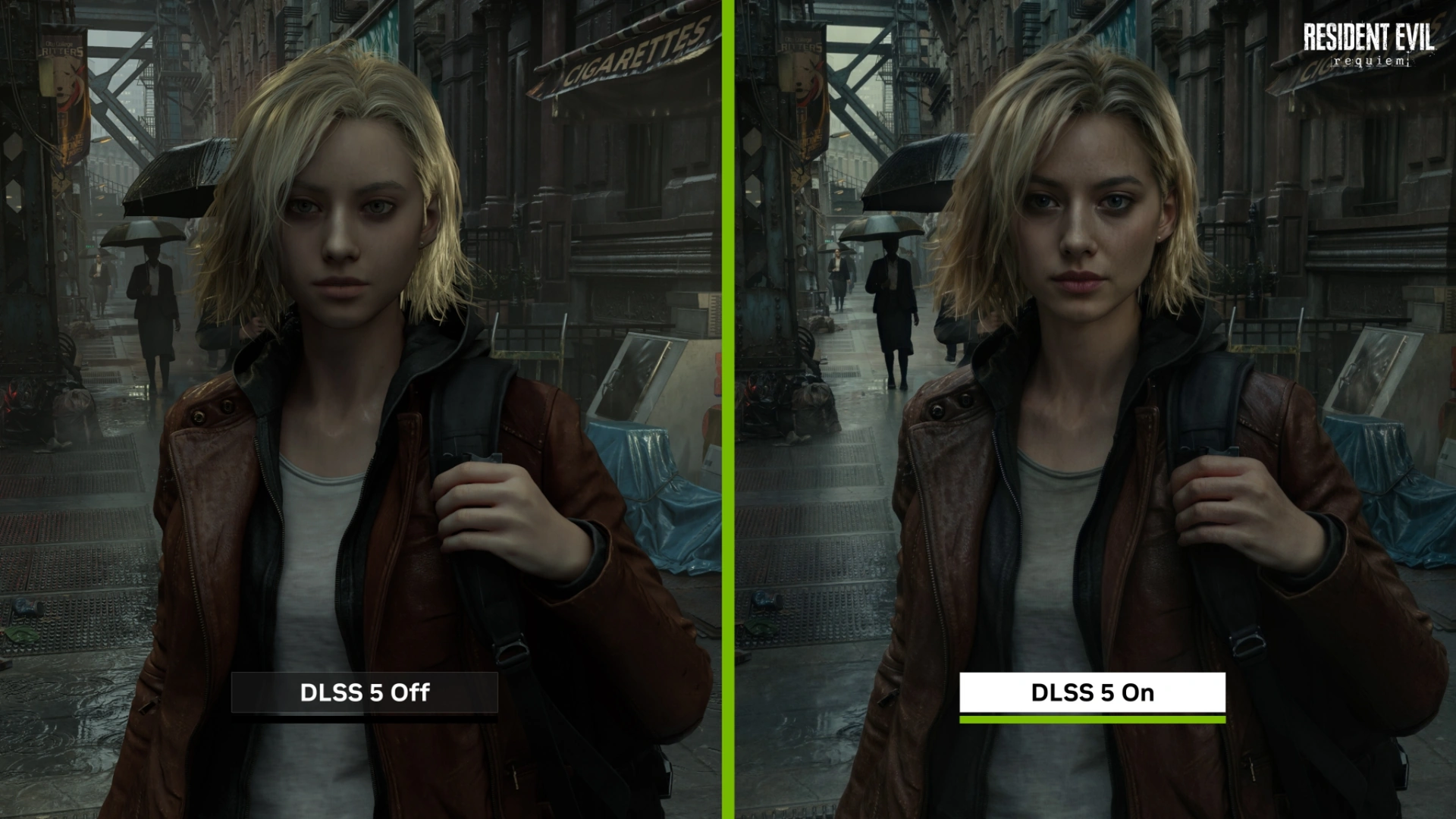
The demos showcased noticeable differences between standard rendering and DLSS 5 enabled visuals. In many cases, textures appeared sharper, lighting more dynamic, and character models more detailed.
However, some of these changes also sparked immediate debate. In Resident Evil Requiem, the protagonist Grace Ashcroft’s appearance was altered in a way that made her facial features look smoother and more stylized. Observers noted that the effect resembled a social media filter rather than a purely technical improvement.
Similarly, in Starfield, DLSS 5 introduced additional facial details and increased sharpness, leading to a noticeably different visual tone compared to the original game design.
Growing Backlash From Gaming Community
Despite NVIDIA’s ambitious vision, DLSS 5 has faced a wave of criticism from segments of the gaming community. Many players have labeled the technology as “AI slop,” a term often used to describe content that appears artificially generated or overly processed.
Critics argue that DLSS 5 goes beyond enhancement and begins to alter the artistic identity of games. By adding details that developers did not originally design, the technology raises concerns about authenticity and creative control.
Some gamers have compared the visual output to Instagram style filters layered over gameplay, suggesting that the results can feel unnatural or inconsistent with the intended art direction.
This reaction highlights a broader tension within the industry as AI becomes more deeply integrated into creative processes. While some see generative AI as a powerful tool for innovation, others worry it may dilute the craftsmanship and intentionality that define high quality game design.
NVIDIA’s Position on Artistic Control
In response to these concerns, NVIDIA has emphasized that DLSS 5 is not meant to override artistic vision but to enhance it. The company states that developers retain full control over how the technology is implemented in their games.
Through adjustable settings, studios can fine tune the extent of AI generated changes, ensuring that the final output aligns with their desired aesthetic. This flexibility is intended to address fears that DLSS 5 could impose a uniform or generic visual style across different titles.
NVIDIA also maintains that its AI models are trained to respect scene semantics, meaning they aim to build upon existing elements rather than replace them entirely.
Industry Implications and Future Outlook
The introduction of DLSS 5 represents a significant turning point for real time graphics. By incorporating generative AI directly into the rendering pipeline, NVIDIA is pushing the boundaries of what is possible in interactive visuals.
If widely adopted, this approach could reduce the workload for developers by automating complex visual enhancements. At the same time, it may redefine the relationship between artists and technology, with AI playing a more active role in shaping final outputs.
However, the backlash surrounding DLSS 5 suggests that acceptance will not be immediate or universal. The success of the technology will likely depend on how well it balances innovation with respect for artistic intent.
Titles Expected to Receive DLSS 5 Support
NVIDIA has confirmed that several upcoming and existing titles are set to receive DLSS 5 integration. These include Resident Evil Requiem, Starfield, Hogwarts Legacy, Assassin’s Creed Shadows, Delta Force, Naraka Bladepoint, The Elder Scrolls IV Oblivion Remastered, Sea of Remnants, Where Winds Meet, Black State, CINDER CITY, NTE Neverness to Everness, and Justice.
The inclusion of such a wide range of games indicates strong initial industry interest, even as public opinion remains divided.
A Defining Moment for AI in Gaming
DLSS 5 may ultimately be remembered as a pivotal moment in the evolution of gaming graphics. By blending traditional rendering techniques with generative AI, NVIDIA is charting a path that could redefine visual realism in games.
Yet, as the early backlash shows, technological progress does not always align with player expectations. The challenge for NVIDIA and the broader industry will be to ensure that innovation enhances the gaming experience without compromising the creative integrity that players value.
As developers begin to experiment with DLSS 5 and gamers experience it firsthand, the conversation around AI in graphics is likely to intensify. Whether it becomes a new standard or a controversial experiment will depend on how effectively it bridges the gap between technical capability and artistic authenticity.

Edit Profile
Help improve @KR

Was this page helpful to you?
Contact Khogendra Rupini
Are you looking for an experienced developer to bring your website to life, tackle technical challenges, fix bugs, or enhance functionality? Look no further.
I specialize in building professional, high-performing, and user-friendly websites designed to meet your unique needs. Whether it’s creating custom JavaScript components, solving complex JS problems, or designing responsive layouts that look stunning on both small screens and desktops, I can collaborate with you.
Create something exceptional with us. Contact us today
Open for Collaboration
If you're looking to collaborate, I’m available for a variety of professional services, including -
- Website Design & Development
- Advertisement & Promotion Setup
- Hosting Configuration & Deployment
- Front-end & Back-end Code Implementation
- Code Testing & Optimization
- Cybersecurity Solutions & Threat Prevention
- Website Scanning & Malware Removal
- Hacked Website Recovery
- PHP & MySQL Development
- Python Programming
- Web Content Writing
- Protection Against Hacking Attempts